The Year in Springfield, 2025…

A city on guard. (WMP&I)
Given a review of recent history in Springfield, 2025 may have expressed the disgruntlement many expected in 2023. However, the reasons may not be particular to the City of Homes. A foul wind from Washington was blowing and perhaps coloring the municipal electorate as much as anything. Courts also played a larger role in the city’s political fortunes than they had in years.
Not unlike the first Trump administration, Springfield has escaped the worst so far. The reckless cuts from DOGE and the more ideological ones reverberated into the city and the region. However, the Commonwealth is well-armed for legal battle—indeed, US District Court in Boston is home to a chunk of the litigation against the feds.
One area where the city was on its own—sorta—was the Environmental and Climate Justice Community Change (ECJCC) Grant. The EPA, with ex-Long Island congressman and now-Trump henchman Lee Zeldin at the wheel—swiped the city’s $20 million award that it had received pursuant to President Joe Biden’s Inflation Reduction Act. The city began to explore legal options.
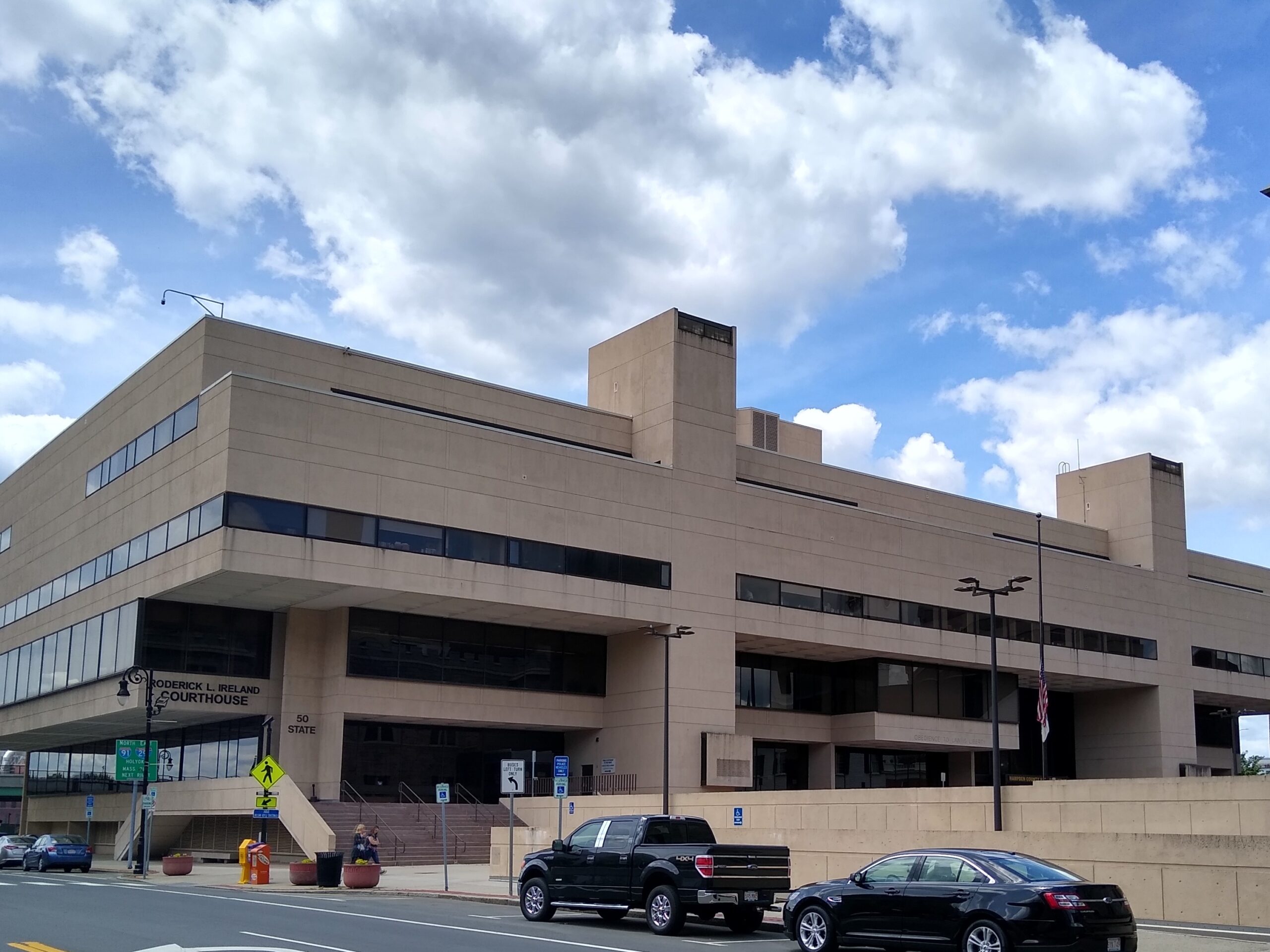
Springfield had its eye on state courts, too, namely those inside the Roderick Ireland Courthouse. The Commonwealth is moving forward with plans to put a long-term lease out to build a new courthouse to replace the long-suffering facility on State Street. The state’s plan, which would see a private developer construct the building and lease it back, had attracted the attention of Massachusetts Inspector General Jeffrey Shapiro. The leaseback plan needed the approval of a panel on which Shapiro sits.
Time for something new. (WMP&I)
The shift from a state-built and owned courthouse to the current plan raised concerns, whether fairly or not, that some kind of fix in for Peter Picknelly’s proposal. The motorcoach mogul had proposed a justice by the river complex—some distance from downtown—and Mayor Domenic Sarno hyped it whenever possible. Although Shapiro voted against the leaseback, the panel imposed measures to assure potential developers they would get a fair shake.
The city election season got an early start when Joesiah Gonzalez, the School Committee member for Wards 1 & 3, said he would challenge Ward 1 Councilor Maria Perez. The race itself would begin one of the wilder episodes in Springfield political history. However, Gonzalez’s bid would also prove to be a harbinger of several challengers to incumbents.
Of course, there was action for the city inside court, too. After years of motions and discovery, Hampden Superior Court James Manitsas turned away Sarno’s last bid to end the lawsuit his former aide, Darryl Moss, had filed. Sarno fired Moss, who is Black, for a social media post. However, the personnel action ballooned into a discrimination suit that put the mayor in the hot seat. A trial was set for October.
A court in Boston also had its say. The biomass plant Palmer Renewable Energy had proposed for Page Boulevard seemingly came back to life after the Appeals Court said its building permit was still valid.
At Council meetings, Ward 2 Councilor Michael Fenton remained president in 2025. The year brought a mix of policy and consternation. Councilors confronted boards and commissions with expired terms and proposed several ordinances. The need for these varied. On the virtuous end was a bill to encourage hiring based on skills and not just credentials. On the ambiguous end was an ordinance establishing minimum apartment sizes.
Guess who’s back? (via Facebook/Springfield Election Commission)
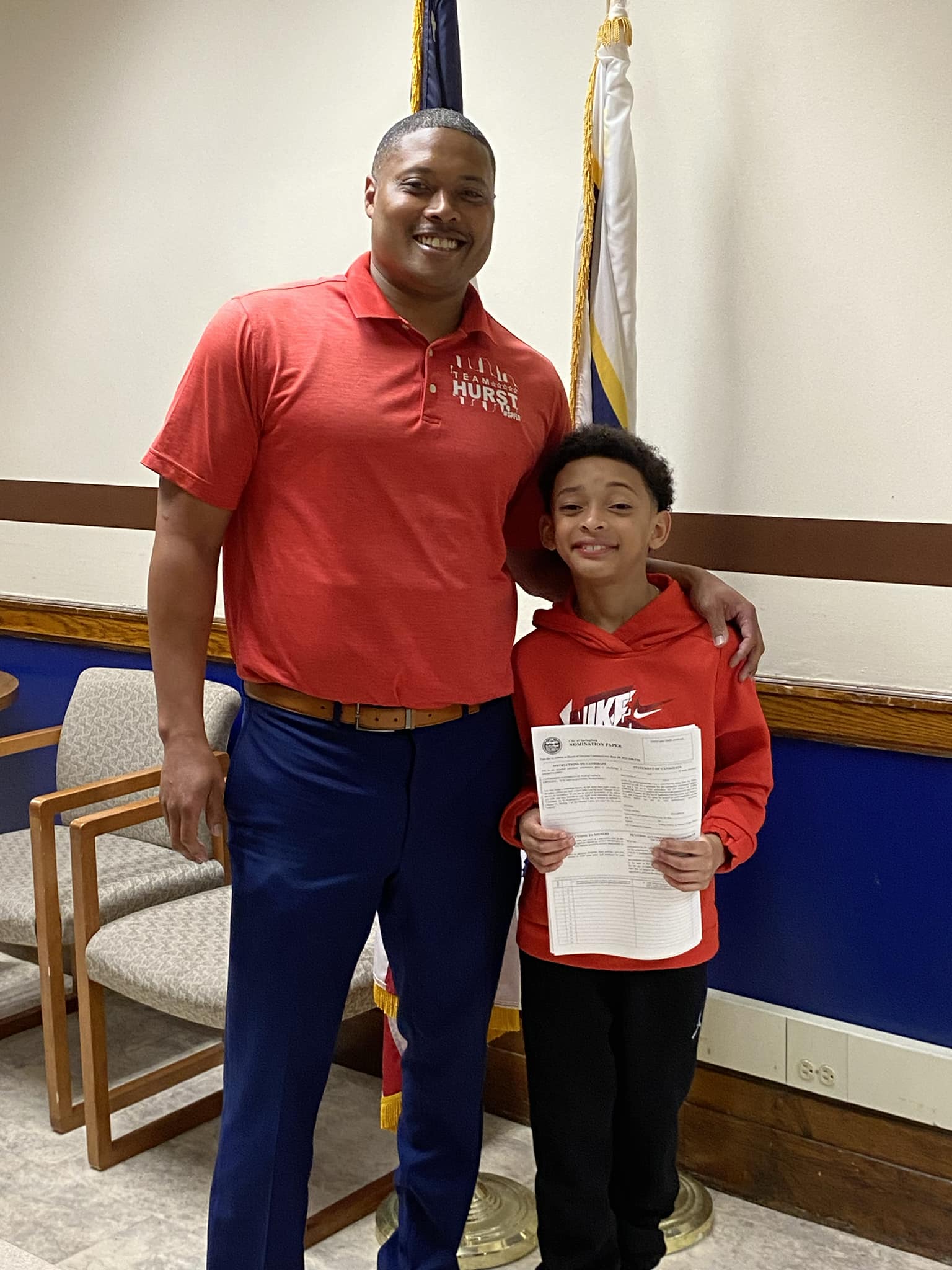
There were no open Council seats in the 2025 election. Nevertheless, five of the eight ward councilors faced challenges, nearly all of which could become serious campaigns. As is usual, the absence of at-large retirements meant that there was a small field of challengers. However, there was one name of note: former Councilor Justin Hurst.
Roughly a year and a half after losing the mayoral race, Hurst was returning to claim an at-large seat. To do so, he would have to push out an incumbent.
When the ballot closed in Springfield, there were challengers lined up in Wards 1, 4, 5, 6 and 7 in the Council and two ward seats on the School Committee. Onetime at-large candidates Willie Naylor, Ed Nunez and Gerry Martin were challenging incumbents Malo Brown (Ward 4), Lavar Click-Bruce (Ward 5) and Timothy Allen (Ward 7) respectively. Mary Johnson, an attorney, and veterans advocate Chuck Whitaker-Battle challenged Ward 6 Councilor Victor Davila. Johnson advanced to the general against Davila.
Among the School Committee district races, Rosa Valentin would face off against incumbent Christopher Collins. Ayanna Crawford again challenged Peter Murphy.
However, the electoral fever was not limited to municipal office. Candidates for office in 2026 began announcing in the summer of 2025. The first was Michael Lachenmeyer, who will challenge Democratic state rep Angelo Puppolo in a primary. Later in the year, Johnnie McKnight, who had run against State Rep Bud Williams in 2024, said he would seek a rematch.
The comparatively young slate of challengers in Springfield’s 2025 election and the 2026 candidates reflect the national trend of generational challenges to incumbents.
Yet the race that started it all was about to get weird. A curious press release came out from the New North Citizens Council (NNCC) announcing that it had fired Councilor Perez. Her day job was with the organization. However, in the days that followed, members of the NNCC alleged that her challenger, Gonzalez, had orchestrated the announcement. The following media attention led Gonzalez to resign from the NNCC board. Perez even filed a defamation suit against him and her former employer.
That might have been the end of Gonzalez’s campaign—but it wasn’t.
Meanwhile, Springfield had gone to court itself—to get its EPA grand back. It joined a coalition of municipalities and nonprofits in a class action lawsuit against Zeldin and his EPA. All plaintiffs lost grant money the Zeldin had snatched. Their suit was filed in Washington and rested on administrative and Constitutional law claims.

A visual recreation of Springfield’s entry into litigation against Trump & Co. (stills via YouTube Marvel)
Unfortunately, ruling from the Supreme Court seemingly gutted hopes of getting the funding back quickly. US District Court Judge Richard Leon dismissed the suit, leaving Springfield and its allies with few options other than appeal.
As the year lurched toward its final months, voters and a Hampden Superior Court jury issued verdicts.
Voters turned out four incumbents and came within only a few votes of cleaning house broadly. Perez hung on as the events of the summer did not flatten Gonzalez. Brown, Click-Bruce and Davila. However, Allen, who had served on the Council since the return of ward representation, was ousted by Martin. School Committee member Collins and Murphy lost their races to Valentin and Crawford respectively.
Hurst was also successful, repeating his original election win twelve years before when he displaced an incumbent at-large councilor. This time, it was Sean Curran who failed to secure another term. Hurst placed second behind Jose Delgado. A freshman councilor, there was a sizable gap between Delgado and the rest of the slate of elected at-large councilors.
The results, both the defeat of incumbents and close calls for others, raises questions about what is on Springfield voters’ minds.
Moss’s prayers for relief…answered? (WMP&I)
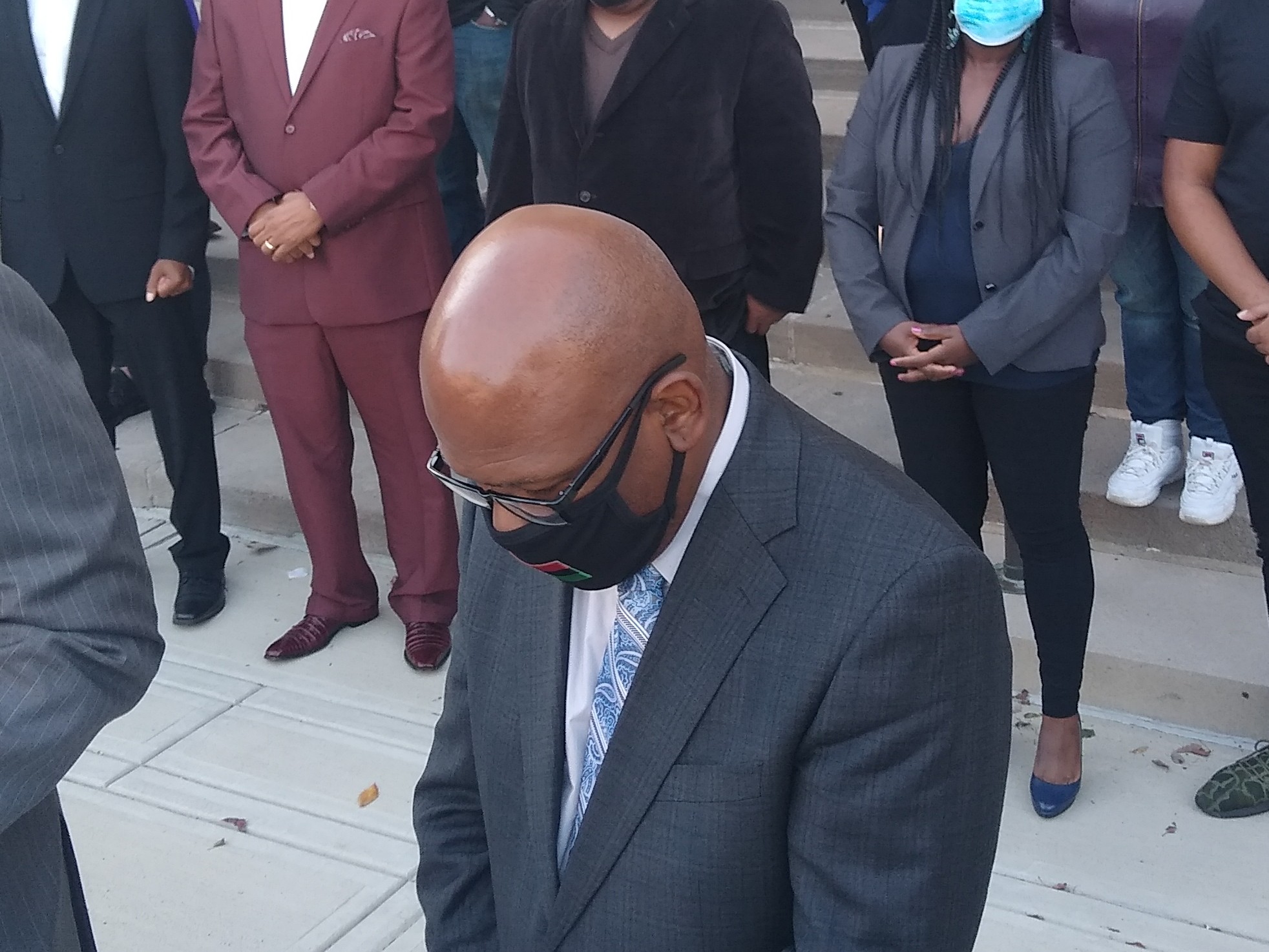
In court, a jury rejected Moss’s claim that his termination was itself a discriminatory act. However, the same jury did find that Sarno had illegally retaliated against Moss for his opposition other discriminatory practices. After post-judgment motion practice, the city faces a nearly $800,000 bill.
The city’s only public higher education institution had been experiencing years of tension between faculty and the administration. However, in December the Springfield Technical Community College faculty union passed a motion of no confidence against both the president—who had faced such motions before—and the Board of Trustees.
The final meeting of the Council in 2025 featured the sudden passage of the minimum square footage bill, an initiative of Curran’s. The legislation had seemed to be on ice after not advancing any further than a preliminary vote. Yet, at the last meeting of the year, it passed.
Another bill of Curran’s was not so lucky. The bill, which would regulate kratom, faced opposition from Health & Human Services Commissioner Helen Caulton-Harris. She said it demanded her department do things it lacked the capacity to do. Curran argued that could be dealt with later. Caulton-Harris prevailed and Curran’s last bill will not pass before he leaves office.
The final Springfield political event of note in 2025 came when a caucus of the Council indicated it would elect at-large Councilor Tracye Whitfield to be its next president. After failing to become president in 2024 and serving as Council Veep in 2025, she defeated Ward 3 Councilor Melvin Edwards in the race to lead the body in 2026. Barring any surprises at the body’s organizational meeting, Whitfield will become the first woman of color to be City Council President.
The city has been bracing for more blowback from the regime in Washington. So far, neither a recession nor massive cuts have hit the city hard yet. However, there are inklings some of the worst may be ahead. The Trump tax cut bill slashed billions from Medicaid, which are essential for the 413’s hospitals. It comes even as there are questions about cuts at Mercy Medical Center. Plus, right-wing activists in the Bay Stat are conspiring to use a ballot question to gut state revenue Springfield relies.
Yet, next year could also see Springfield’s Congressman, Richard Neal, seize the gavel at Ways & Means. A newly re-elected Governor Maura Healey will no doubt have fresh commitments to the region. Whether these could be enough to shield the city from the riptides in the economy and the political sphere remains to be seen.

To be determined. (WMP&I)