Making Springfield History, the Spotlight Turns to Council President Whitfield…

On this dais in 2026… (WMP&I)
SPRINGFIELD—Tracye Whitfield started her fifth term as an at-large City Council by taking a second office: City Council President. In doing so Monday, she became the first woman of color to lead the municipal legislature here. Although historic, a fact that inarguably filled the city’s biennial inaugural exercises, it was hardly the only takeaway Whitfield intended people to have.
Whitfield becomes council president at a fraught national moment and amid looming challenges for Springfield. She is not discounting the barrier she has broken, but she said her emphasis as president will be on the city’s problems. Before a packed Council chamber, she expressed gratitude for her colleagues and promised hers would be a forward-looking presidency.
“Thank you for believing in me and trusting me to serve as your council president. This responsibility humbles me and I accept it with seriousness and gratitude,” she said.
Since the City Council became unicameral in 1962, council presidents have overwhelmingly been white men. Only four women and four men of color have led the body. At-large Councilor Kateri Walsh, herself one of those four women, nominated Whitfield from the floor.
Whitfield and at-large Councilor Jose Delgado, whom Walsh nominated for vice president, won their respective offices unanimously. The votes came after a caucus last month at which vice president was not contested, but president was.

POTSCC and VPOTSCC. (WMP&I)
The President of the Springfield City Council is not all-powerful. As presiding officer, presidents manage meetings, explain rules and set the tone if not the agenda of meetings. Aside from filling in during mayoral vacancies, its most notable power is appointing committees.
In her speech, Whitfield announced plans for four special committees with a focus on tax bills, economic development, alternative revenue and transparency in city contracting. Councilors Zaida Govan, Delgado, Victor Davila and Malo Brown would lead them. She later indicated the leadership of standing committees would be similar.
Whitfield had a winding path to council president. A onetime Finance Department employee, she sought an at-large Council seat unsuccessfully in 2017. Whitfield ascended into a seat anyway when Thomas Ashe resigned to become Mayor Domenic Sarno’s chief of staff. She became only the third woman of the color—at the time—to serve on the body.
She had challenged Ward 2 Councilor Michael Fenton ahead of his return to the post in 2024. That bid fell flat, though she became vice president the following year. Whitfield mustered the votes for council president for 2026, defeating Ward 3 Councilor Melvin Edwards.
Speaking to WMP&I by phone Monday evening, Whitfield suggested the history she had made was not her principal focus. She said she had never seen a political career for herself and rather than view the milestone as something for one identity or another, it could be a model for anyone.
“I feel that no matter the race, color, creed, religious preference. sexual preference, you can just do what you put your mind to,” Whitfield said.

Figures like school superintendent scan be political, but Dinnall noted the unusualness of her speaking and why it felt important to do so. (via Springfield Public Schools)
Still, the ceremony itself did little to hide the history happening.
Among the speakers Whitfield invited were the city’s first African-American leader of the Police Department, Lawrence Akers, and the first Black woman to serve as Superintendent of Schools, Sonia Dinnall. Councilor Walsh, also the chair of the Springfield Women’s Commission, noted the fact itself.
Yet, Whitfield’s moment comes as the United States is in a time when the federal government is trying to suppress any recognition of such milestones.
“That’s noise to me,” Whitfield said. She urged people to celebrate what they wanted.
The challenges the city faces are steep enough. Aside from the Captain Planet villains in the Environmental Protection Agency swiping $20 million for Springfield, the feds have not targeted Springfield in particular.
However, the city faces considerable challenges of its own.
“I just want people to understand that we have our own individual gifts that we give to each other,” she said. “Hopefully we used those differences and gifts and come together and grow Springfield.”
This goal is a challenge for any pol in Springfield, a city whose placid public life belies tempestuous politics. For Whitfield, that also means overcoming doubts some have. Her blunt style can be brutally effective, such as with the mayor, but it draws hairy eyeballs, too.
Even Akers, while speaking during the ceremony, said as much. Though, he also indicated that such conclusions were misguided or incomplete.
“When I first began hearing your name and your word as a new city councilor, I heard many things, some suggesting that you were strongly critical of the police department, even unfairly,” the Police Superintendent said. It created a narrative, he explained.
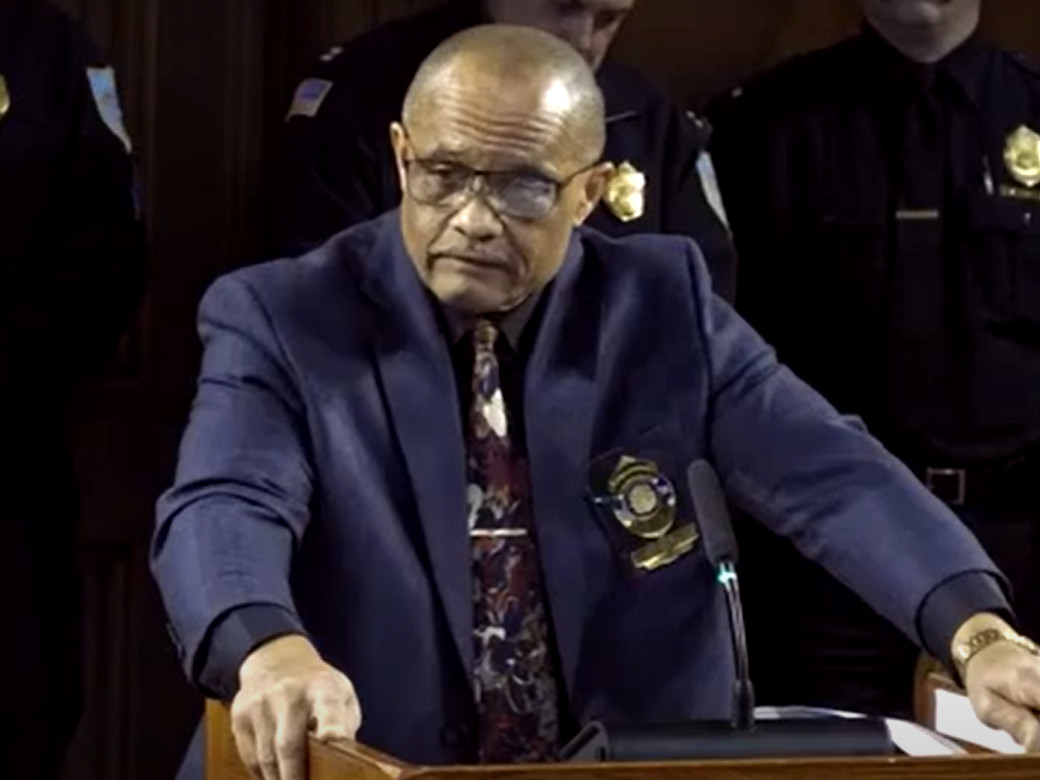
Akers in 2025; today a Whitfield fan. (still via YouTube/Focus Springfield)
“But then I met you. I spoke with you. I listened to you and I learned that many of those characterizations were not totally true,” Akers continued. Whitfield was critical, he admitted, but also led and sought accountability and fairness.
In her speech, Whitfield made a point to say she did not want to settle scores and praised three of the council presidents she served under. They were Fenton, returning at-large Councilor Justin Hurst and former at-large Councilor Jesse Lederman. (Lederman had a brief cameo in the hearing, holding the box from which councilors would draw their seat assignments.)
She told WMP&I that what stood out about their tenures was their willingness to stop and explain rules and procedures during debates. Whitfield explained that there was some orientation for councilors, but getting the information at a meeting when an issue arises has value, too.
“They give you a little bit of information to read, but I’m a hands-on learner anyway,” she said.
Whitfield hopes to continue herself and she said she was working with Focus Springfield, the city’s public access network, to get such text and explanations on screen when possible.
As for agenda, the new council president told WMP&I she hoped to have committee assignments out soon. Other than indicating the chairs of standing committees would mirror those she had named for the special committees, Whitfield said the special committees would include people from outside City Hall. As the case when previous presidents set up such panels, there will be a call for applicants.
She also indicated she would propose changes to the rules of the City Council, pending legal review. As per usual, the Rules are on the agenda of the Council’s first full meeting.

Bureaucratic renovations ahead? (WMP&I)
As for the goals of her special committees, Whitfield did not rule out legislation. However, she is looking at recommendations that city departments could implement. Some things like improving notice and transparency for city contracting, which Whitfield discussed in her speech, may be more a question of how than what.
A couple of the committees, namely those on budgeting and development, may dovetail with one another. Whitfield has been among the louder voices calling for property tax relief. She pointed to the hefty “padding” or free cash—unspent funds from a previous fiscal year—some department budgets have. Some wiggle room is reasonable, but not the amounts the city often has.
“We shouldn’t have $18 million in free cash year over year,” Whitfield said.
If the city budgets less, it needs of its potential property tax levy. However, to give relief to taxpayers, councilors would need to shrink by tens of millions of dollars. Alternatively, the city could find new revenue outside property taxes, something Councilor Davila’s panel is looking at.
Beyond economizing, another pathway is increasing the levy through new growth. Whitfield’s economic development panel will look at how to make building in the city easier, too.
“When we have more new growth, more of that goes toward the property tax growth” instead of existing homeowners, she said.
Council presidencies seldom attract a judgment of history as mayoral administrations do. If the office did not matter, there would never be those secret scrambles for votes. Who holds the office is more than a figurehead, but still just one of 13. That Whitfield became the first woman of color to be council president does not change this context.
However, there is work to do. While Springfield has clawed its way out of the abyss over two decades, it has not reached the peak of its potential either. Closing her speech on Monday, Whitfield appeared to acknowledge her tenure as council president could matter in pushing the city up that cliff.
“Finally, Springfield, I stand before you grounded, grateful, and ready,” Whitfield said. “I do not take this responsibility lightly. I feel it in my spirit, in my body, and in my calling. Together, we will build a government that is accessible, transparent, and rooted in community. Together, we will move Springfield forward, not with noise, but with purpose, not with division, but with collaboration, and not with fear, but with faith.”