With Transition Near, Simmering STCC Faculty Again Call out Cook, but Flame Trustees, Too…

Speak softly and carry a big STCC? (via mass.gov)
It was the week after Thanksgiving, but the Faculty Union at Springfield Technical Community College was still cooking. On December 5, members issued their latest vote of no confidence in STCC president John Cook. At first glance, it looked like leftovers. It was the third such a vote against him. Yet, it was not the same recipe. This time they moved to find no confidence in STCC’s cabinet and the entire STCC Board of Trustees, too.
The reasons for including a broader range are manifold. One big factor is Cook’s announcement he will leave next year. The antipathy unionized staff and faculty have for him runs deep after nearly 10 years. Some of the factors in the new no confidence motion are present at the state’s other community colleges. Still, STCC faculty indicate these just cap long-simmering tensions and unresolved issues.
“When leadership consistently fails to provide clear communication, dismisses campus concerns, centralizes decision-making without appropriate consultation, or presents a misleading narrative to external stakeholders, the institution’s functioning and mission are compromised,” the union writes in its motion’s preamble.
The situation has led to loss of trust in all leadership and “a campus environment increasingly defined by fear, opacity, and disengagement.“
STCC-MCCC Vote of No Confidence (1) by wmasspi
On October 1, Cook said he would depart next summer. That launched a search process, but faculty doubt it will include broad campus input.
The union has passed motions of no confidence twice before. Faculty and other staff at STCC lament these did not shift the narrative much.
“The early votes, we really felt we had a chance to save a lot of stuff from going wrong,” said one faculty member, who requested anonymity out of fear of reprisal.
In response to a request for comment from Cook, his cabinet and/or the Board, a STCC spokesperson provided a statement from Cook. It focused on the positive without directly engaging with the union’s criticisms.

The union thinks there are still too many Cooks in STCC’s kitchen. (via stcc.edu)
“As I shared two months ago with all college stakeholders: I am struck by the remarkable changes across higher education during my tenure, and how STCC continues to be a special institution,” Cook said. “This is not to say there have not been disagreements during my tenure, and I readily acknowledge that message today from some of our employees. Yet STCC, with a vital mission, has also responded and adapted during very complicated times, and there is so much we have accomplished together.”
In a statement, Noe Ortega, Commissioner of Higher Education told WMP&I his agency was reviewing the motion.
“The Department of Higher Education (DHE) is aware of the concerns expressed by the Springfield Technical Community College (STCC) faculty union through its December 5 Vote of No Confidence,” he said. “We’re reviewing the faculty union’s statements and appreciate its engagement.
Ortega urged the Board of Trustees to do no less.
Governor Maura Healey appoints community colleges’ boards of trustees. Her office referred questions to DHE. Since becoming governor, Healey has named three trustees. Others are serving terms that began before she took office.
The chair of STCC’s Board of Trustees is Michael Knapik, a vice-president for government and community relations at Baystate Health and a former state senator. He did not respond to emails requesting comment. The full Board has not met since mid-November and is not scheduled to reconvene until January 26.
The latest motion comes as the state’s community colleges face a surge of enrollments. Last year, Massachusetts began offering free classes at its two-year colleges. At STCC, it has compounded the long-running grievances that have festered among staff for years now.
“I would also say we have tried all other avenues and exhausted all other avenues,” Aisling Buckley, an academic advisor said of resorting to a new motion of no confidence.
The seven-page no confidence document lays out familiar complaints about Cook. The breakdown of shared governance—which the American Association of University Professors defines as “the joint responsibility of faculty, administrations, and governing boards to govern colleges and universities,”—is a theme of past no confidence motions.
The earliest no confidence vote, in 2017, prompted state leaders to urge patience. Cook only took office the year before. Changes to educational programming contributed to the 2020 vote. STCC did walk back the academic reconfigurations. The threat of their return remained, though, prompting uncertainty among faculty, students and the latter’s potential employers.

Faculty at STCC have been stewing over Cook for years. (via wikipedia)
Jennifer DeForge, a full-time faculty member within the Architecture and Building Technology (ABT) program who also teaches classes on Civil Engineering Technology (CET), said the failure to include faculty in decisions to merge academic programs could undermine STCC’s offerings.
In an email, DeForge explained that these two programs within which she teaches have “natural points of intersection.” Yet, “the depth and intent of each program are fundamentally different and serve distinct industries.”
“Despite this, there have been ongoing discussions—against the recommendations of faculty from multiple disciplines—about merging these two programs in a way that would effectively eliminate the Civil Engineering associate degree,” she emailed.
In 2021, the Massachusetts Community College Council (MCCC), the statewide faculty union, challenged the reorganizations in Suffolk Superior Court. Its suit named Cook, STCC and the Board of Higher Education (BHE), which coordinates policies for state colleges. The union also challenged faculty dismissals at the Division of Labor Relations (DLR). The parties made a deal on the DLR matter. A judge dismissed the lawsuit.
“We’re not saying the president doesn’t have a right to change thing, but we should still have the opportunity to talk about it and provide feedback,” Renae Gorman, a physical therapy professor and president STCC’s faculty union, said before the new vote of no confidence.
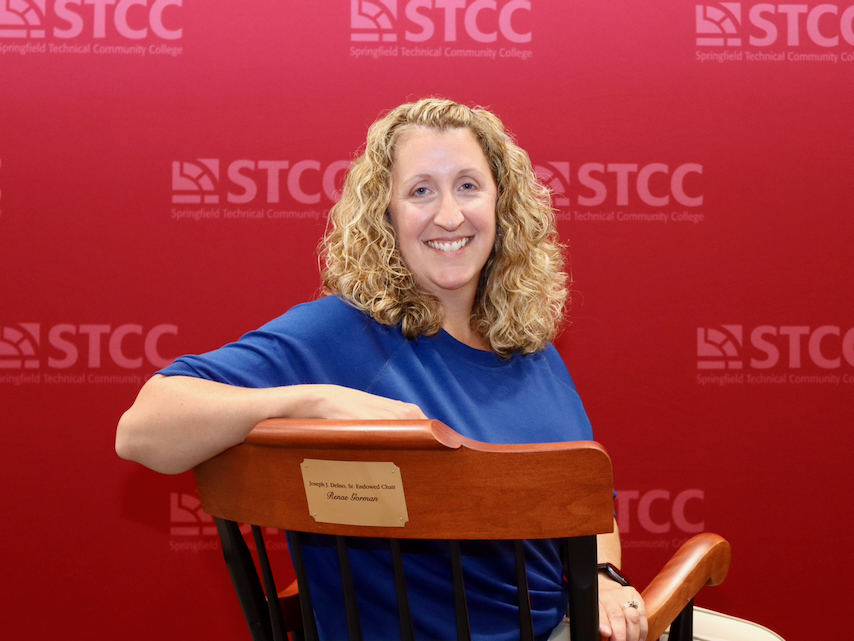
STCC faculty union head Renae Gorman and her members have wanted better communication with STCC leadership. (via stcc.edu)
The new motion also blasts Cook’s handling of communication with various stakeholders. It pans the use of Q&A only for town halls. This appears as an example of disengaged leadership and insufficiently transparency on finances, initiatives, challenges, and successes.
“If you’re in these types of leadership positions, they should be able to lead and they’re not leading in a way that’s constructive,” Gorman said.
The bill of particulars goes on to allege Cook tightly controls—and even distorts—information fed to the trustees. He also allegedly limits who can address them directly. The most alarming of these claims is that the president “sanitizes” the Board’s minutes.
The union notes he claims to be avoiding creating a transcript. However, “doing so often misattributes or omits the correct sentiments” of “the individuals who expressed them, resulting in minutes that do not accurately capture the true nature of discussions.
As for the cabinet, the motion takes aim at the Chief Academic Officer, the Chief Financial Officer, and the Vice President of Student Support Services. Some of these grievances pertain to the things the union condemns Cook for. However, it levies no fewer than three charges against the student affairs veep. Among these is behavior that is “authoritarian, dismissive, and rooted in fear rather than support.”
Among these claims is a failure to address overworked academic advisors. Staff experience “deepened burnout, reduced morale, and eroded trust in the VP’s ability to lead a student-serving division.”
“No one wanted to do that,” Buckley, the advisor, said of the motion of no confidence. “But what other options are there when you’re not heard time and time and time again?”
Buckley said that the flood of students compounded the problems that STCC faculty and staff had been having. By her reckoning, enrollment nearly doubled since the free community college program began and later expanded.
Claudine Barnes, the president of the MCCC, confirmed this is a problem across the Commonwealth.
“The reality is that now that student have this opportunity, they are coming back years after going to school,” she said. “They need more support services.”
Given what STCC faculty have experienced, Barnes said the MCCC fully backed the chapter’s no confidence motion.

Is the True North for votes of no confidence at North Shore Community College? (via masscc.org)
Though rare, other community colleges have seen no confidence motions. At North Shore Community College, Barnes said, a no confidence vote led the president there shift gears. Such votes at other colleges led to presidents’ ousters. STCC’s Board of Trustees is just “blindly” following administration, she observed.
“That’s what sets STCC apart and that’s why we now have significant concerns about the trustees as fiduciaries for the institution,” Barnes said. “They should be worried about the things being brought to them.”
The bill of particulars alleges the Board has not evaluated the effectiveness of STCC’s governance since accreditation.
The motion condemns the Board for allowing Cook to control its meetings. It says he dictates relationships between the Board and stakeholders like the All Unit Congress (AUC), an umbrella group for STCC employees. The union calls out trustees for limiting the campus community’s participation, complicity in the misuse of personnel privacy rules to conceal info and failing to respond to communications.
DeForge, the ABT and CET professor, also said reorganizing academic programs like hers had long-term consequences. The long-term health of STCC should be a focus of the trustees.
“From my perspective, it was important for the Board of Trustees to be included because programmatic decisions with long-term consequences—such as the potential closure of the [CET] program or restructuring of the ABT curriculum—require oversight beyond the administration alone,” DeForge emailed.
“Decisions that could dismantle or fundamentally alter long-standing, workforce-critical programs should involve transparent discussion, data-driven evaluation, and broad stakeholder engagement,” she continued.
The union has sought help from state officials, but letters to various electeds often yield no response. DHE has organized meetings and opened a complaint portal. (A spokesperson said DHE had not received a complaint about STCC leadership since 2024.) Still, the faculty union remains frustrated.
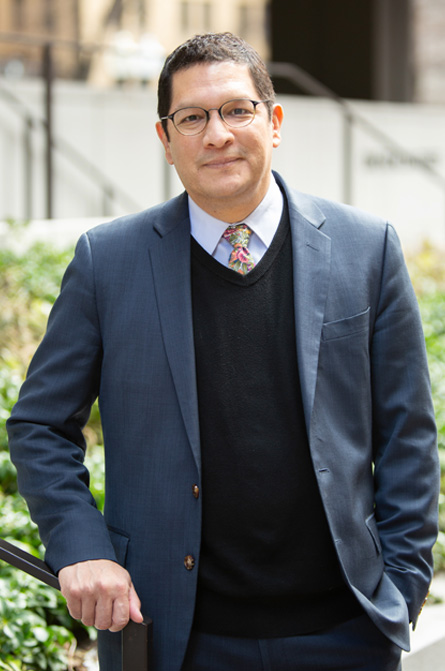
Yes or Noe? Ortega suggests the Board has work to do. (via mass.gov)
The no confidence vote against the trustees—again, direct appointees of the governor—has seemingly gotten some attention. Ortega, the Higher Ed Commissioner, addressed the Board directly in his statement.
“I trust that STCC’s Board Chair and Trustees will closely review the concerns expressed within the context of their ongoing work and will engage in effective dialogue with the faculty and work to rebuild trust,” he said. “STCC is a crucial part of Massachusetts’ public higher education system, providing opportunity and workforce development in Springfield and surrounding areas.”
The decision to include the trustees in the no confidence vote also connects to the search for Cook’s successor.
An email on the search committee selection process, which WMP&I obtained, states the executive committee of the Board of Trustees would draw from several campus constituencies. However, the exact number and the criteria they will use seems vague. The motion of no confidence accuses the Board of adopting the most restrictive interpretation of BHE guidelines for searches.
“The concerns that exist stem from many years of not having a shared governance system that effectively incorporates the voice of the campus into decision making,” Christina Atwater, a business administration professor who co-chairs the AUC, said in an email.
In his statement, Ortega noted that consistent with BHE guidelines, a DHE staffer “is serving on STCC’s presidential search committee to ensure its process for identifying the best candidate to lead STCC into the future is carried out consistent with the BHE’s expectations.”
Whether that will allay faculty and staff’s concerns is unclear. Exhaustion is typical among critics of Cook, both those still on campus and those who have left. Those who recall his predecessors do not recall feeling this way, but his impending exit has not brought relief.
According to Gorman, the STCC faculty president, said things has gotten worse. The union has long complained about Cook’s “mansplaining” and “stonewalling” at faculty town halls. Since his exit announcement, Cook has begun to check out even skipping some union-management meetings for the first time.
“He didn’t communicate that to the union he decided not to attend,” Gorman said, recalling a recent meeting.