Take My Council, Please: Hungry, Hungry HIPAAs…
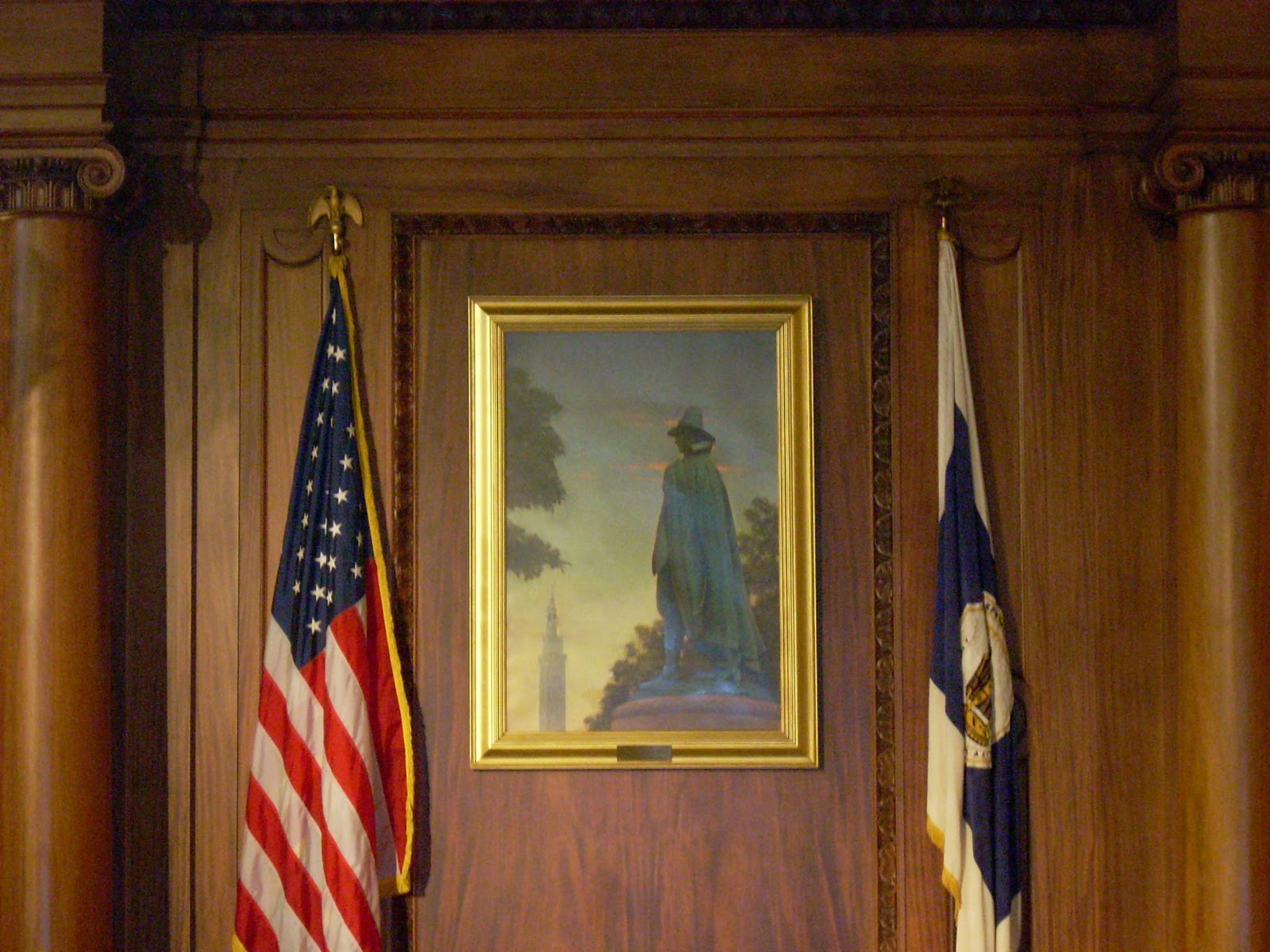
Dusting this original off for a fully in-person Council (WMP&I)
The Springfield City Council had a debate May 18 that no one could miss. It was the first time since the shroud of the coronavirus fell upon the city that all 13 serving councilors had assembled in person for a regular meeting. Full in-person attendance had its advantages, including procedural efficiencies the Council had gone without for six years.
What may have brought the full house was a resolution encouraging in-person attendance—but not all councilors were on board. Looming in the background was the Council’s continued reliance on the state’s lingering pandemic-era open meeting rules. Councilors traded arguments which ran from passionate to…unusual. Indeed, the Health Insurance Portability and Accountability Act of 1996 (HIPAA) had a cameo.
The debate on the resolution, which Ward 7 Councilor Gerry Martin introduced, became heated. There was a stark divide on the Council, although it did not follow any obvious ideological, demographic or geographic lines.
As agendas go, the one last Monday was relatively short and straightforward. Old business including the modifications to the rules for public speak-out and the community impact resolution on the future new courthouse did not receive votes.
The Council received reports from the Finance and Public Safety committees. It approved Eversource’s request for access to Cherokee Drive, Oak Hollow Road and Orlando Street.
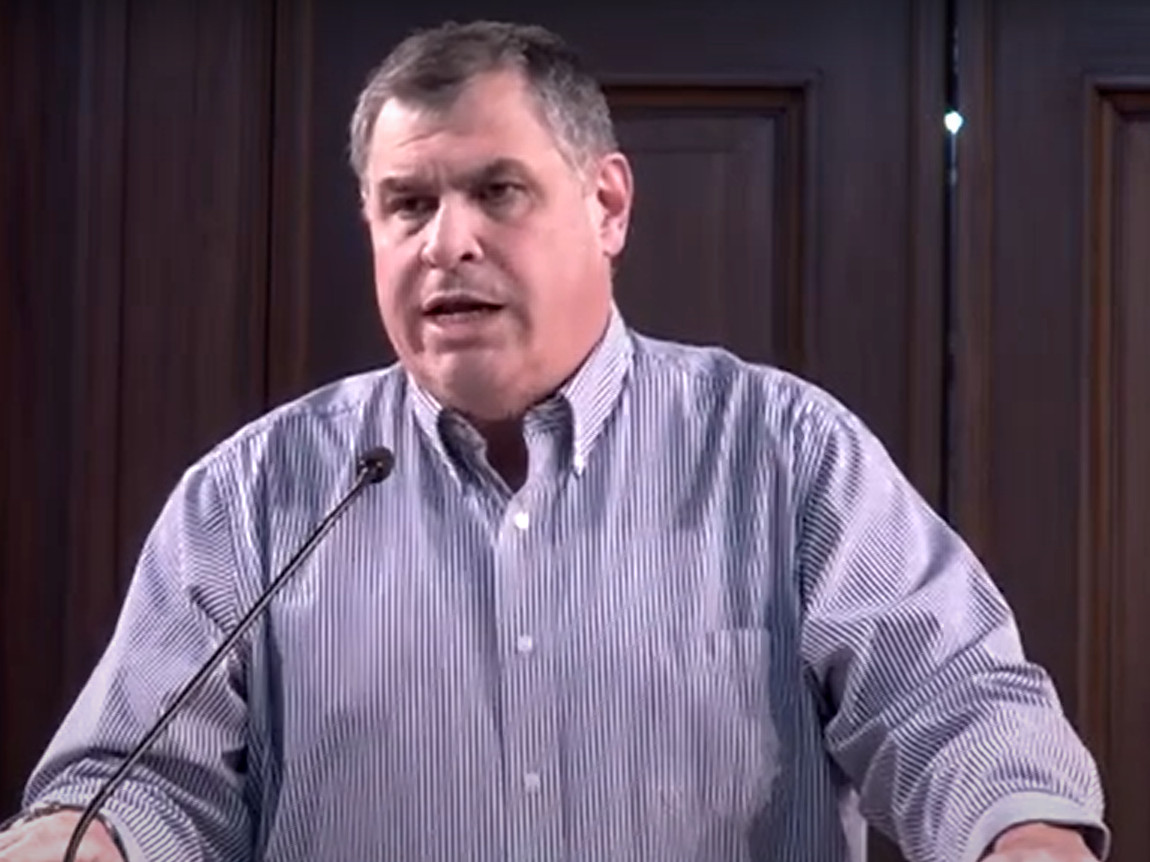
Cignoli presented most of the items unrelated to councilors’ attendance. (still via YouTube/Focus Springfield)
Public works chief Chris Cignoli presented the Eversource requests. The Cherokee Drive request is for a pole to provide more service to Frank Freedman Elementary School. Eversource’s work on Oak Hollow will serve a pump station in adjacent East Longmeadow. Finally, the Orlando Street work will allow service to go over the street as opposed to through backyards as it currently does.
The Council approved loading zones on Stockbridge Street as the owner of adjacent buildings undertakes work for renovations. The zones will also assist in the construction of the new parking garage at Cross and Willow streets.
The Council was able to take some of these votes, and the approval of small grants for the Library Department, by voice vote because all members were present in the chamber. As the Springfield City Council and other state panels went virtual in March 2020, state open meeting laws were revised to accommodate the sudden change. Among the guidance that came out in that period was a requirement that items that normally only require a voice vote would require a recorded vote.
When the Council returned in a hybrid setting in the summer of 2022, this guidance was still in force. Although virtually every City Council meeting since has had an in-person cohort at least a few councilors have been remote, barring voice votes—until last Monday.
The Council also approved a bill from a prior year for the Police Department on a voice vote.
Some items still required a roll call vote. Councilors unanimously approved a transfer of $1.8 million from free cash to retire the snow and ice removal deficit for this year. Cignoli told councilors that the three major drivers of the deficit were employee overtime, plowing contractors and salt.
The Council also approved easements for Eversource at two schools and revision to the eminent domain order for the X reconstruction project in the Forest Park neighborhood. The change was technical, as one property had changed hands and Council had to update the owner’s name.
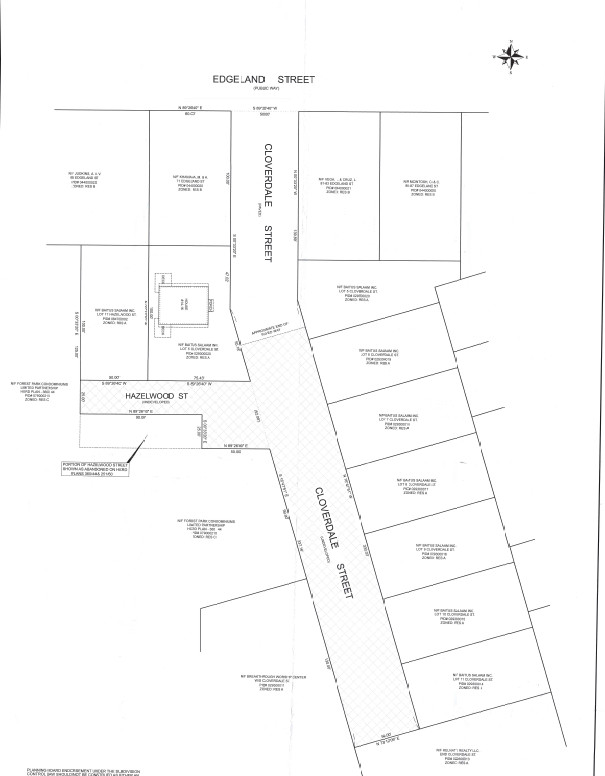
Plucking Cloverdale just below its turn southeast. (via Springfield City Hall)
Ward 6 Councilor Victor Davila called the discontinuance of Cloverdale Street out of order. The discontinuance only affects part of the street that exists solely on paper. The part with homes on it will remain. The Baitus Salaam mosque on Longhill Street purchased much of the property along the theoretical part of Cloverdale as part of plans for a larger facility. Parcels the mosque will not own abut belong owners who also own parcels with access to another public way.
The item had been sent to committee earlier this year. Since then, Davila, who represents the area, said he and other councilors had reviewed the site. He believed it was ready to move forward.
Before a final vote, at-large councilor Justin Hurst questioned whether any of the petitioners or corporators of the mosque had been involved in any evictions. While Hurst assured he supported the project, he said someone had alleged one of the mosque’s advocates had purchased a home and tried to evict its occupants. The corporators from the mosque were confused. They said the land purchased was vacant lots and the mosque owns no residential property. Hurst dropped the matter then.
The discontinuance passed without dissent.
The in-person resolution Councilor Martin introduced was, by its nature, nonbinding. Still, it called for councilors to attend all meetings except for circumstances involving family or health emergencies (including serious illness) or another “extraordinary hardship, as determined by the Council President.”
The item drew cosponsors including at-large Councilor Jose Delgado, Ward 3 Councilor Melvin Edwards and Ward 8 Councilor Zaida Govan. By contrast, Council President Tracye Whitfield announced her opposition to the measure ahead of the meeting.
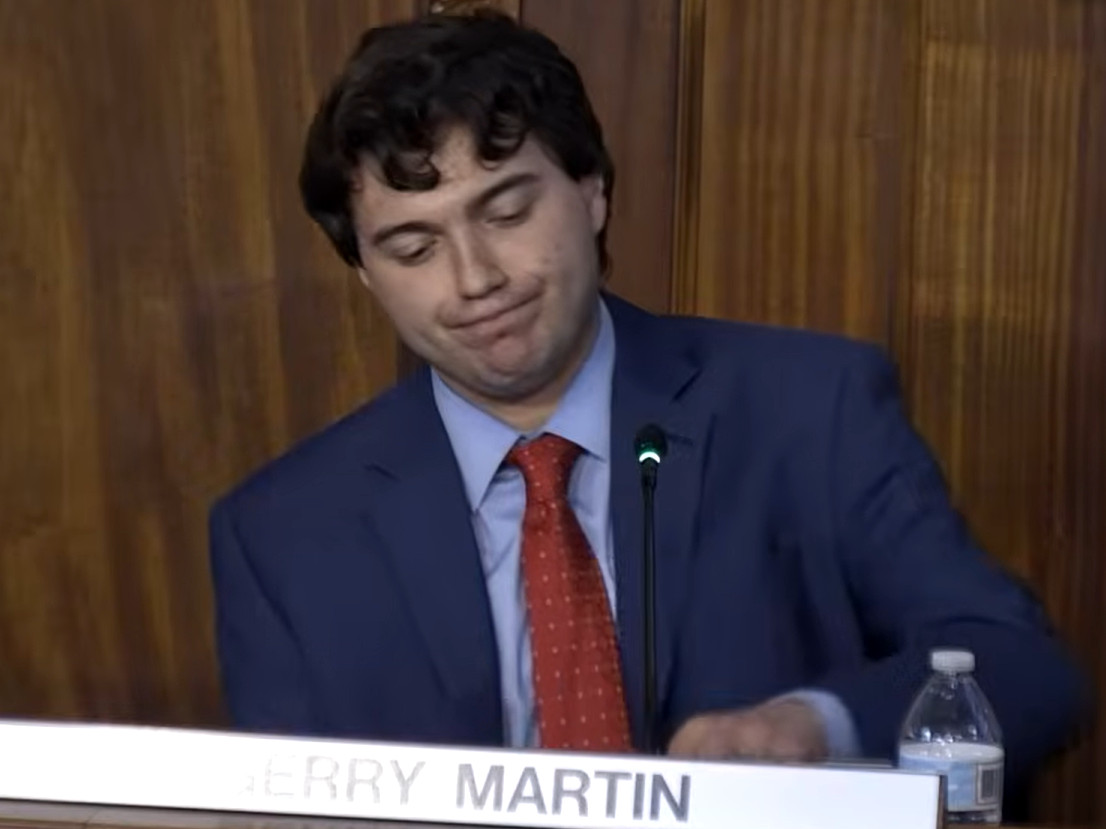
Governing Mondays, amirite? (still via YouTube/Focus Springfield)
Addressing his resolution, Martin noted it was the first time all councilors had been present for a meeting outside of inaugural exercises. He said the public wanted members physically present and observed that City Hall employees had returned to the office full time some time ago.
“But there’s a double standard for politicians. We get to use Zoom whenever we like,” he said. “That’s a double standard and I reject it entirely.”
Govan said that while Zoom attendance is convenient, constituents had told her the body should meet in person whenever possible. Drawing on her background as a social worker, the Ward 8 councilors added that body language is easier to interpret in-person and facilitates communication. Govan also alluded to the benefits.
“It was wonderful to do a voice vote,” she said.
There was vehement dissent, too. Ward 4 Councilor Malo Brown registered his opposition in a fusillade of criticism that accused Martin of grandstanding, insisted he responds to constituents and questioned whether Health & Human Services Commission Helen Caulton-Harris was consulted—ostensibly an allusion to her role leading the city’s response to the pandemic.
Ward 1 Councilor Maria Perez was equally hostile to the resolution, but offered more coherent concerns. She suggested the measure only created a “platform for division.” Yet, the thrust of her objection lay in the suggestion that Zooming into a meeting indicated less than diligent service.
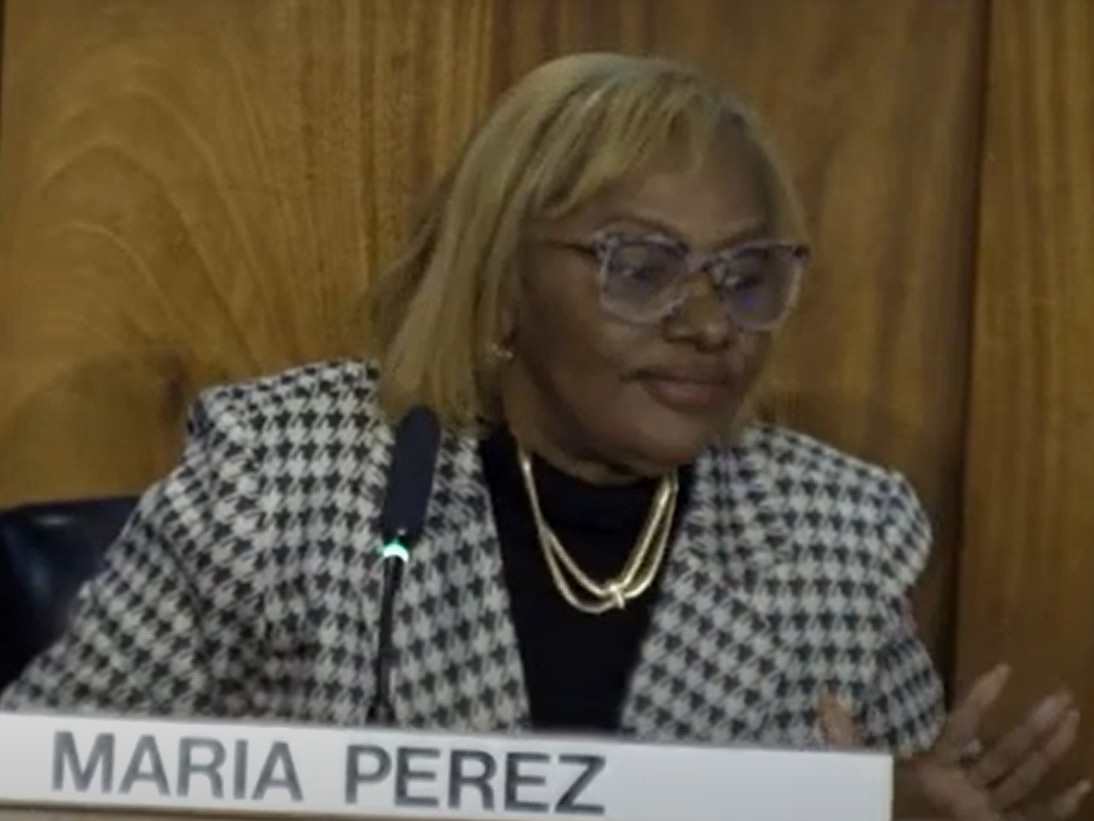
Perez in 2024 in person. (still via YouTube/Focus Springfield)
“There have been many occasion where in-person attendance is not feasible. Like a day like today, I’m risking as an asthmatic,” she said. (Air quality was poor that day according to the Massachusetts Department of Environmental Protection.)
At-large Councilor Brian Santaniello, speaking in opposition, said he saw several flaws.
“One of them is we have to get permission from the council president if there’s an illness or somebody’s sick in the family,” he said. “That is a violation of the HIPPA law.”
It is not. HIPAA generally does not apply to employers and generally only applies to the disclosing of information by somebody other than a patient. Just as an employer requiring a doctor’s note is not a HIPAA violation—as the patient is the one disclosing it—conveying information to the Council President would not be a HIPAA violation.
Councilor Edwards, speaking in support, recalled his longstanding in-person attendance when the Council had in-person operations, save when he blew out both knees in 2012.
“I understand how people are passionate about this issue. To me, this is not grandstanding,” Edwards said. “This is in response to our constituents who are tired of seeing a blank screen with just our name on it.”
Edwards reiterated that councilors not feeling well would not be barred from remote participation. While he dismissed the HIPAA invocation, he added that councilors who are unwell would only have to tell the Council President to have it recorded in the minutes. No doctor’s note or medical information would be necessary.
The debate continued in that fashion. At-large Councilor Kateri Walsh defended the status quo, calling remote participation a tool. She also moved to send the item to committee. Councilor Davila was supportive, but wanted some tweaks in committee. Councilor Hurst said he did some math and found attendance to be around 88%, and therefore though the measure was unnecessary. He added that it paled in comparison to other matters like the attack on voting rights.
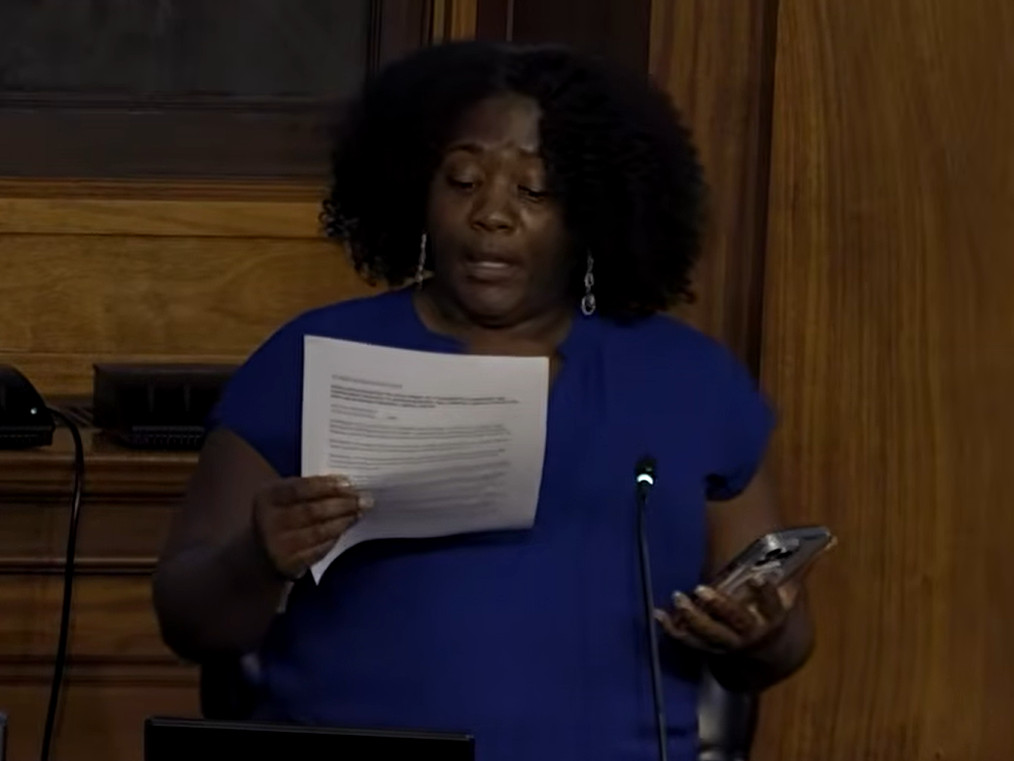
Whitfield stepped down to voice her opposition, after steering the body through an at-times rowdy debate. (still via YouTube/Focus Springfield)
Martin rose to respond to some objections. Although there was a pending motion to committee, Whitfield was open to letting him speak generally. However, after he cheekily observed it was good to see Brown in person, the Ward 4 councilor leapt to make a point of order against debating beyond the motion. Whitfield eventually conceded the point.
“It’s not about division. It’s about respect for our constituents,” Martin said, arguing against a committee referral. “I disagree with the state guidelines. I disagree with the governor. We should be here. Springfield has the opportunity to lead on this issue and to be a leader and to be here for the people.”
Whitfield ceded the dais to Council Vice President Delgado to add her words of opposition. She emphasized that the vicissitudes of life were such that the virtual option should remain as is. In contrast to other opponents, she credited Martin’s claim that constituents want them back in person. However, she countered that she had not heard it much herself.
“I think that we can have healthy discussions around these things,” she said.
Debate concluded when Ward 5 Councilor Lavar Click-Bruce called the question. The final vote to committee was 9-4. Councilors Edwards, Michael Fenton, Govan and Martin dissented.
To some, the question of virtual versus in-person attendance can seem, well, remote from councilors.
(WMP&I)
The situation exists in part because the legislature keeps extending exceptions to the open meeting law rather than establishing uniform policy and long-term digital accessibility for the public. Municipalities do not need to heed the extension, but Beacon Hill need not avoid a permanent policy indefinitely.
There may be benefits for the Council, though. These include procedural perks like voice votes as well as Councilor Govan’s point about improved communication. Perhaps better communication might yield other dividends for the Council itself and, indeed, Springfield overall.