SCOTUS Ruling Sends Ripple through Fight for Springfield’s Climate Grant…

Could Barrett’s split concurrence chomp Springfield’s grant? (created with images via Reuters/WSJ & City of Spfld)
The United States Supreme Court dealt a potential blow to efforts to recover grants that Donald Trump’s administration had swiped from Springfield and other municipalities. In a fractured ruling, five of the nine Supremes stayed an order that had required the National Institutes of Health to restore grant funding. The ruling, in effect, said recovery of the funds did not belong in US District Court.
The NIH case involved a wholesale recission of grants funding “DEI” research. In June, a judge in Boston ruled that violated the Administrative Procedure Act (APA) and told the feds to keep paying the grants while the case was litigated. The August 21 SCOTUS ruling turned on Justice Amy Coney Barrett’s concurrence. She let the lower court block the anti-DEI policy, but she suggested recovery of actual money can only come from a claim in the Court of Federal Claims (CFC).
If that ultimately applies to Springfield, the city would need to do the same to get back the $20 million grant it received from the Environmental Protection Administration. Upon taking office, Trump and his EPA administrator Lee Zeldin turned the agency’s name on its head. Among its anti-environmental actions have been wholesale voiding of money to reverse climate change.
The agency illegally rescinded Springfield’s grant earlier this year. In June, the city joined several municipalities and nonprofits in a class action lawsuit to revive the funding. Until the Supreme Court’s action, the most immediate question before Judge Richard Leon of the District of Columbia was whether the grant had advanced to a point that Congress could not have rescinded it.
During a brief attack of humanity, SCOTUS had stopped Trump’s attempt to keep filling Salvadoran prisons with migrants. Since then however, the conservatives on the Court, who outnumber the liberals 2 to 1, have used the so-called shadow docket to undo numerous injunctions lower courts have issued to halt the administration’s illegalities.
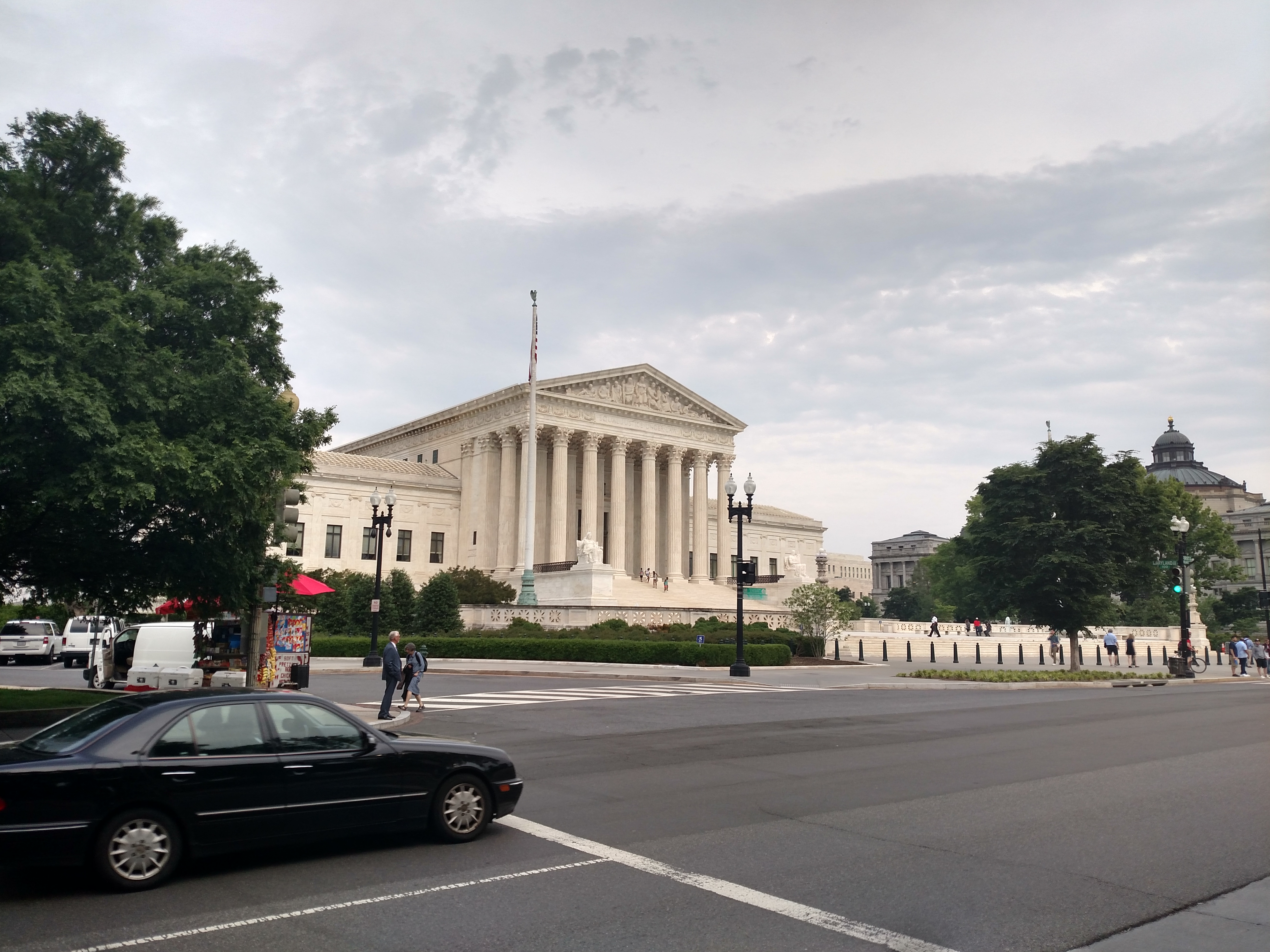
SCOTUS emitted some jurisprudential pollution last week that may affect Springfield. (WMP&I)
Before the High Court had been a request for a stay. Boston federal Judge William Young issued the original injunction. The Court of the Appeals for the 1st Circuit refused to stay it. SCOTUS did not issue a final ruling. However, its actions on the shadow docket signal the intentions of the majority.
Unlike many of the shadow docket cases, the prevailing justices actually put something to paper. Well, sorta.
Four conservative justices wanted to vacate Judge Young’s ruling blocking the anti-DEI policy. Barrett would not do that. She did agree that the administration could cut off the funding pending a final resolution. However, she strongly hinted that efforts to recover lost grant money would require filing in the CFC. That might only be possible after a final ruling on the anti-DEI policy. In other words, the two issues were separate claims for separate forums.
“The claims are legally distinct,” Barrett wrote, if quite unconvincingly. “And if the CFC has exclusive jurisdiction over the grant terminations…the plaintiffs cannot end-run that limit simply by packaging them with a challenge to agency guidance.”
The liberal justices and otherwise conservative Chief Justice John Roberts would have let the funding continue during litigation. In an opinion Roberts penned, they agreed on blocking the anti-DEI policy. As for the funding, he said allowing the money to flow only made sense. Justice Ketanji Brown Jackson, as has (justifiably) become her wont, blasted the majority and specifically accused her colleagues of “Calvinball jurisprudence with a twist.”
Public Rights Projects is representing the municipal plaintiffs, including Springfield in the suit. Jonathan Miller, the group’s chief programs officers, said last week’s ruling was part of a disconcerting trend. He said SCOTUS making it harder for individuals, localities and institutions to secure their legal rights.
“If local governments are limited in how they can challenge illegal federal actions, there are fewer checks and balances on the administration’s power — leaving communities without real paths to justice,” Miller said in a statement to WMP&I. “Rules without remedies undermine the rule of law itself.”
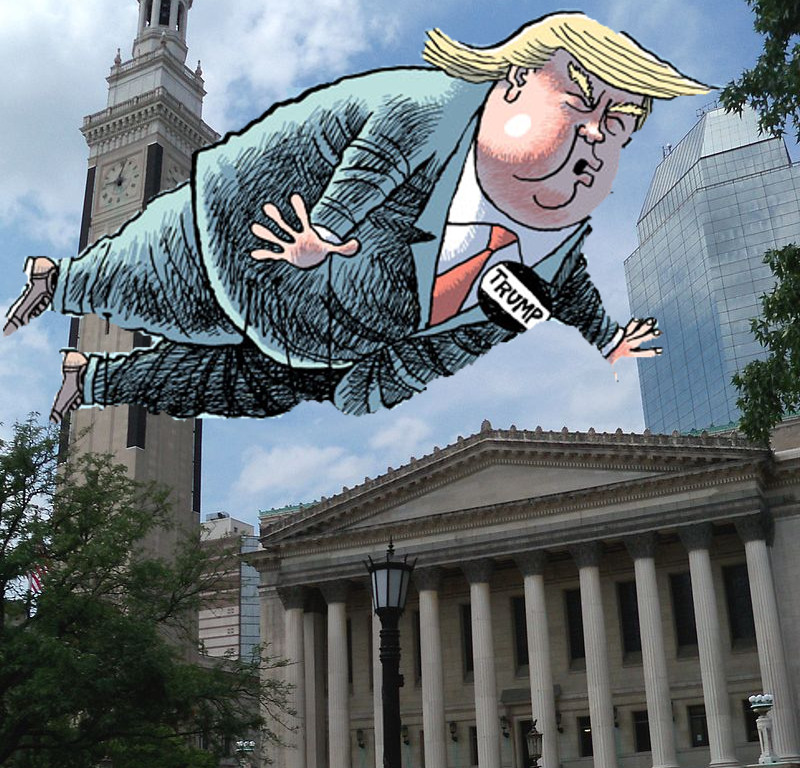
Trump’s DOJ is already raining on the Springfield’s legal parade. (created via wikipedia images and Pittsburgh Post-Gazette cartoon).
Trump’s Department of Justice has already begun to mist litigation against it over funding with a golden shower of supplemental filings. One hit Springfield’s case on August 22. What it means for Springfield’s case is uncertain, but the ruling seems like less than great news.
The cases do share some similarities, namely their reliance on the APA. However, the NIH case, whose plaintiffs include the Commonwealth of Massachusetts, leans more heavily on APA claims. That case focused on the administration’s decision to essentially declare all funding involving DEI to be contrary to federal policy.
DEI, which stands for diversity equity and inclusion, is a boogeyman for Trump and his supporters. Generally speaking, they have invoked opposition to “DEI,” however nebulous, to block things pertaining to race, gender and sexuality. In the NIH case, that became a policy that served as cover for plainly bigoted recissions of any research that focus on groups like African-Americans or LGBTQ people.
The class action lawsuit Springfield joined includes several constitutional claims. These might let it evade the SCOTUS cons’ insistence that financial relief is only available in the CFC. Because the administration rescinded an entire program Congress created, it is possible that a court could still order dispersal of the funds, including Springfield’s grant.
How that would happen is not clear, though. The Supreme Court has only directly addressed APA claims. Yet, it has strongly suggested that recovering grant money is like enforcing contracts. It is not a direct appropriation that, arguably, a district court could order the administration to pay.
For example, the administration has tried to justify defunding Radio Free Europe/Radio Liberty (RFEFL) on the same theory Barrett posed today. However, Congress explicitly appropriated funding for RFEFL. RFERL won an injunction and got its funding. Similarly, the Government Accountability Office found that Trump’s attempt to shutdown the Institute of Museum and Library Sciences via impoundment—withholding of funds—was illegal.
In a supplemental filing, the plaintiffs in Springfield’s suit noted that their constitutional claims form an independent basis for the suit to proceed. The NIH case, they argue, does not change that.
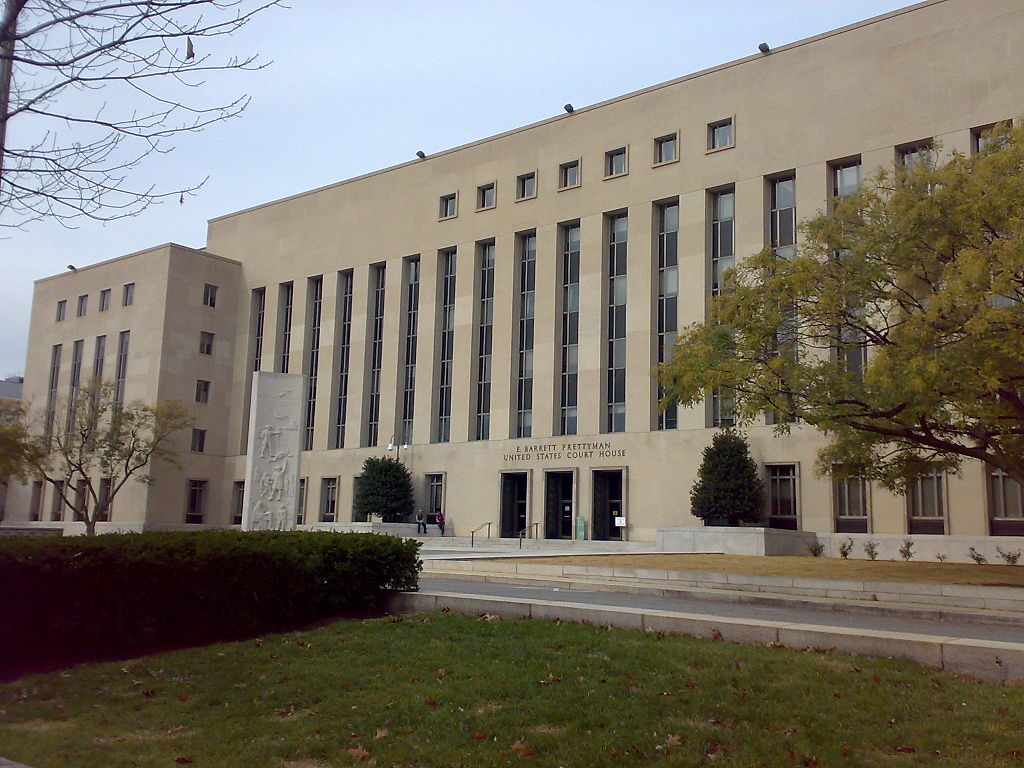
The E., um, *Barrett* Prettyman courthouse where Springfield and its co-plaintiffs argued its case to Judge Leon this month. (via wikipedia)
“The executive branch’s decision to both terminate the entirety of the congressionally mandated Environment and Climate Justice Block Grant program, and to terminate the hundreds of grants here for ‘policy reasons,’ violated the Constitution and can and should be enjoined,” the plaintiffs write in reply to the feds’ notice of the SCOTUS decision.
They add that the NIH opinion did not terminate the APA claims and recovery of funds was still possible.
Yet, Springfield won a competitive grant from the EPA. No congressional appropriation names Springfield directly. Nor is its EPA grant like so-called entitlement grants it receives like the Community Development Block Grant. The city receives the amount it does because it meets criteria set out in statute.
That does not mean Springfield will never see it money. Rather, it may either take time. Alternatively, its lawyers will need to convince the courts—including, perhaps some SCOTUS cons—the EPA grants are different. It is possible the grant’s tight timelines could factor into that.
Massachusetts Attorney General Andrea Campbell, whose office has helped Springfield during this episode, condemned the Supreme Court’s NIH ruling. However, in a statement last week, she added the fight was not over.
“The Supreme Court’s decision is wrong and deeply disappointing. Even though the Court did not dispute that the Trump Administration’s decision to cut critical medical and public health research is illegal, they ordered the recipients of that funding – hospitals, researchers, and the state – to jump through more hoops to get it back,” said Campbell said in a statement after the ruling.
“Even if accountability is delayed, we won’t stop fighting to protect this funding, our residents, and our rule of law,” she added.