Analysis: Class Dismissed at Hampshire Should Be a Warning Bell for the 413…
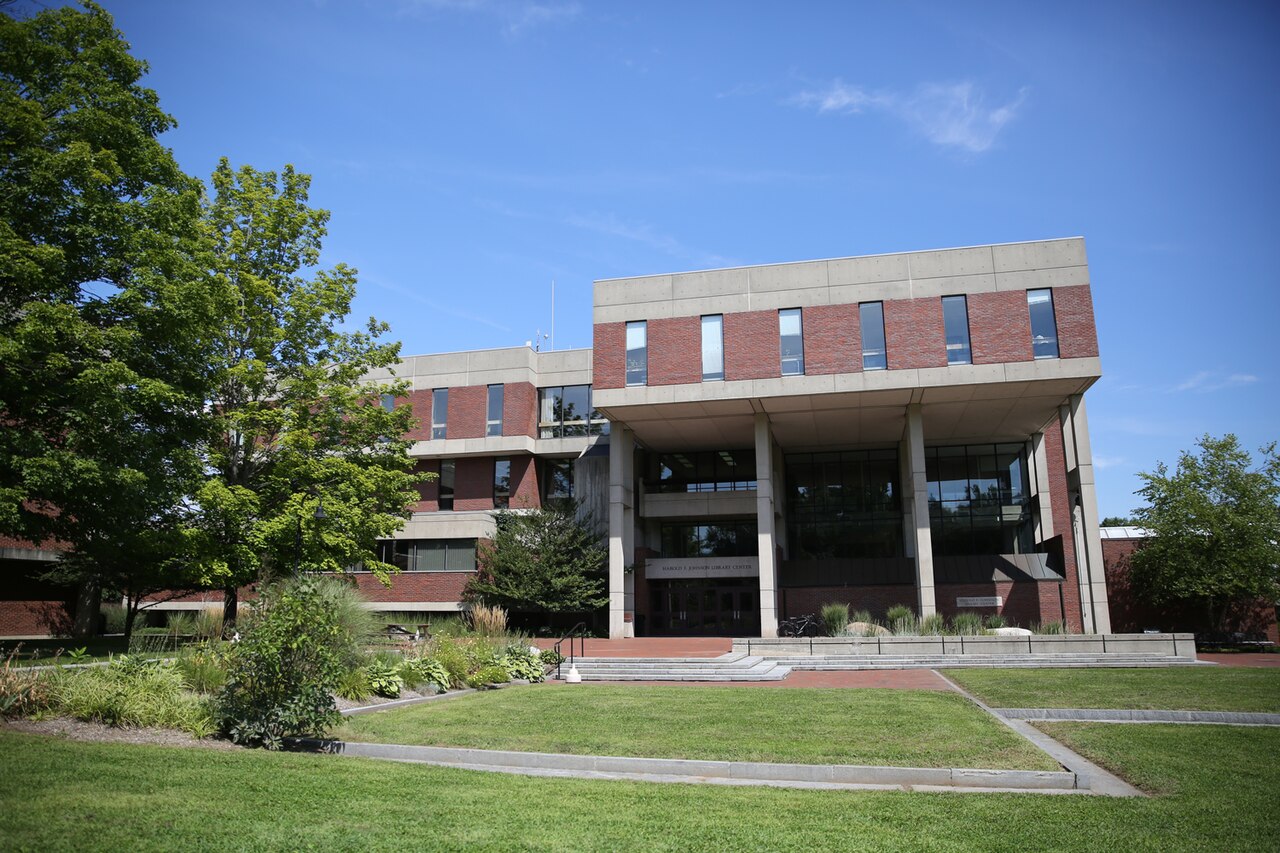
The Hampshire College library will fall silent at year’s end. It could echo into the region’s economy. (via Wikipedia)
The closure of Hampshire College in Amherst was probably not a shock to those who knew of its troubles. In 2019, the institution communicated difficulties that prompted it to contemplate dramatic measures just to survive. It set forth a recovery plan, but its accreditation was precarious. Apparently, Hampshire’s efforts failed, as on April 14 the Board of Trustees voted to shut the college down.
Hampshire College, which ran a non-traditional baccalaureate program for undergraduates, is not representative of the 413’s higher education institutions. Yet, college closures do happen. Hundreds of layoffs will follow Hampshire’s demise, likely hitting Hampshire County hardest. Just as important, the episode underscores the stakes for the wider Western Mass region.
Like the rest of Massachusetts, health and education are major parts of the 413’s economy. Those sectors face tremendous risks as Donald Trump and his regime make spurious and paranoid attacks on higher education while gutting health care funding.
This danger is acute in Western Mass because the region has leaned toward these sectors but it still has fewer and smaller colleges than Greater Boston has. The 200 plus jobs Hampshire College sheds will hit harder here than it might in Boston and comes amid several local mass layoffs. Mount Ida’s closure in 2018, while not without its impacts, was barely a blip on Newton or Greater Boston’s economies.

Onetime industrial/commercial buildings like 235 Chestnut were among several downtown Springfield parcels zoned to allow more uses last month. (via Springfield City Hall)
While manufacturing remains an important employer in Western Mass, leaders in the region have begun to accept what statewide economic policymakers had long ago. Heavy industry and other sectors that blossomed in the early 20th century are not returning. Springfield recently rezoned several industrial parcels in Springfield, an admission that those buildings will not return to their old uses.
Hampshire’s closure will be orderly. Not every college shutown is. The state Department of Higher Education (DHE) provides a consumer protection function for private ones. While it cannot stop or order a college’s closure, the agency has been working with Hampshire’s administration to ensure the school has contingency planning.
DHE Commissioner Noe Ortega noted the impact the closure would have on the whole community.
“The Department of Higher Education has been in close contact with President [Jennifer] Chrisler and her leadership team, and we share a commitment to supporting the best interests of students, faculty and staff,” Ortega said.
Many students at Hampshire will likely transfer to nearby colleges and some of those schools may even have reason to absorb some of Hampshire’s faculty and staff. Yet, this hits like a factory closing could. Some estimates suggest as many as 500 jobs could disappear. The college’s formal notification to the state, however, puts the figure around 200 to 250 by year’s end.
In a joint statement, State Senator Jo Comerford and State Rep Mindy Domb, who represent Amherst in their respective chambers, called the closure “devastating” for everyone connected to the school.
“In partnership with the Governor’s Western Massachusetts office, we will help to ensure employees have access to state support and students have every chance to finish their college education. Beyond student transfers, we will work with state and local leaders to support the wider community and navigate the challenges in the weeks and months ahead,” Comerford and Domb said.

CRRC’s idling of railcar plat workers was briefly one of region’s biggest loss of jobs this fiscal year. (via Wikipedia)
Hampshire’s job losses pile onto other large losses. Under the Worker Adjustment and Retraining Notification (WARN) Act, employers must give the state notice when 100 or more full-time employees lose their jobs. The state’s companion law sets the threshold at 50 jobs. According to state data, only three mass layoffs in the Western region since summer 2021 saw more jobs losses than what Hampshire’s closure will bring.
For comparison, when Smithfield Meats announced the closure of its Springfield meatpacking facility on Carando Drive, the company told state officials 190 jobs would go away. Goulet Trucking in South Deerfield noticed 144 job losses just this month. The other big layoff was at railcar manufacturer CRRC. The company furloughed employees while shells for subway cars for Boston were held up at customs. The company rescinded the furlough when the feds let the cars go.
There are always ebbs and flows in employment. Higher education and health care are no different. In December 2024, Springfield Anesthesia Services shut down, idling nearly 100 employees. Baystate Health ended up hiring much of the laid-off staff.
However, larger blows like Hampshire’s shuttering are not always easily replaced. Even some smaller shifts can have huge consequences. Holyoke Medical Center and Mercy Medical Center’s pullbacks on maternity care in 2020 and 2025 respectively may not trigger a WARN notice, but it leaves gaps in the economy. (Mercy has faced—and denied—accusations that it intentionally let its maternity staff headcount fall.)
Hospitals are huge employment centers, but they are not immune to downsizing or closure. The debacle with Steward Health Care led to the outright closures of hospitals. Western Mass is no stranger to this. North Adams Regional Hospital closed in 2014. Berkshire Medical Center bought its assets and opened a new hospital on the same site 10 years later. In Springfield, many wonder about Mercy’s longtime future. (UPDATE: On April 27, Baystate Health announced it would buy Mercy Hospital.)
On the one hand, the region’s economy will likely continue to mirror New England’s overall. Health and education and the sectors that support them will remain critical. On the other hand, what Western Mass has built up is not enough and it could easily decline. As the broader regional economy is anemic, health and education rely on transfers from Boston and Washington. Both sectors are vulnerable to the feds’ spasms of austerity.
There is only one actor that can impose a course correction for the 413: the Commonwealth. There is no magic incantation and there are many regional economic mouths to feed even in this tiny state.
Some partial solutions are also statewide solutions. Ongoing efforts to knock down the barriers to housing can encourage jobs in construction. This softens housing costs, freeing up money for things other than keeping a roof over their heads. Plus, it may provide homes for workers in Greater Boston, Connecticut or New York.

Lots of rail work ahead. (via Google Maps)
Investments in transportation will be necessary to carry both workers and visitors. The glacial pace of East-West rail—now part of Compass Rail—has huge economic consequences. Just starting the Inland Route—Boston to New Haven via Springfield—will have taken seven years counting from receipt of a federal grant to startup service in 2030. (It goes back to 2014 if one counts from when former State Senator Eric Lesser first turned east-west rail into a political shibboleth.)
Beyond start-up service, the timelines are even longer. Palmer residents are understandably perturbed that their city may not see a rail station until 2033. The indeterminate schedule for further work in Pittsfield is irking officials out there, too. In short, the Commonwealth needs to find not only more money but also the will to change the lumbering pace of essential work that can and will connect the region.
Beyond infrastructure, state officials need to build up relationships between employers statewide and all regions (not just Western Mass). There may be some back-office functions Harvard, Raytheon or State Street Bank—to name a few—could put in Greenfield or Pittsfield rather than Texas or abroad.
State officials could also use their clout to encourage or even force localities to abandon political barriers and local pieties that complicate investments. This is not necessarily about a community opposing any one project like a data center. Rather, it would require the state to clean up gross and self-serving local “processes” that favors incumbents and insiders.
At the same time, state should show more care when attracting new business from the borderlands of neighboring states. Attracting Lego to Boston from Enfield was a blow to Western Mass.
It may be that Hampshire College’s end was just a freak occurrence, unique to its problems. Perhaps the health care industry in Western Mass will weather the impending federal cuts.
State officials will say they are doing what they can. No doubt that is true—to a point. Again, it is clear this is not enough. Whatever the political cost of pushing harder, the fact is the Commonwealth will pay sooner or later if it cannot further realign the economy and limit regional disparities.