Moss Triumphant As Jury Finds Sarno Violated His Ex-Mayoral Aide’s Rights…
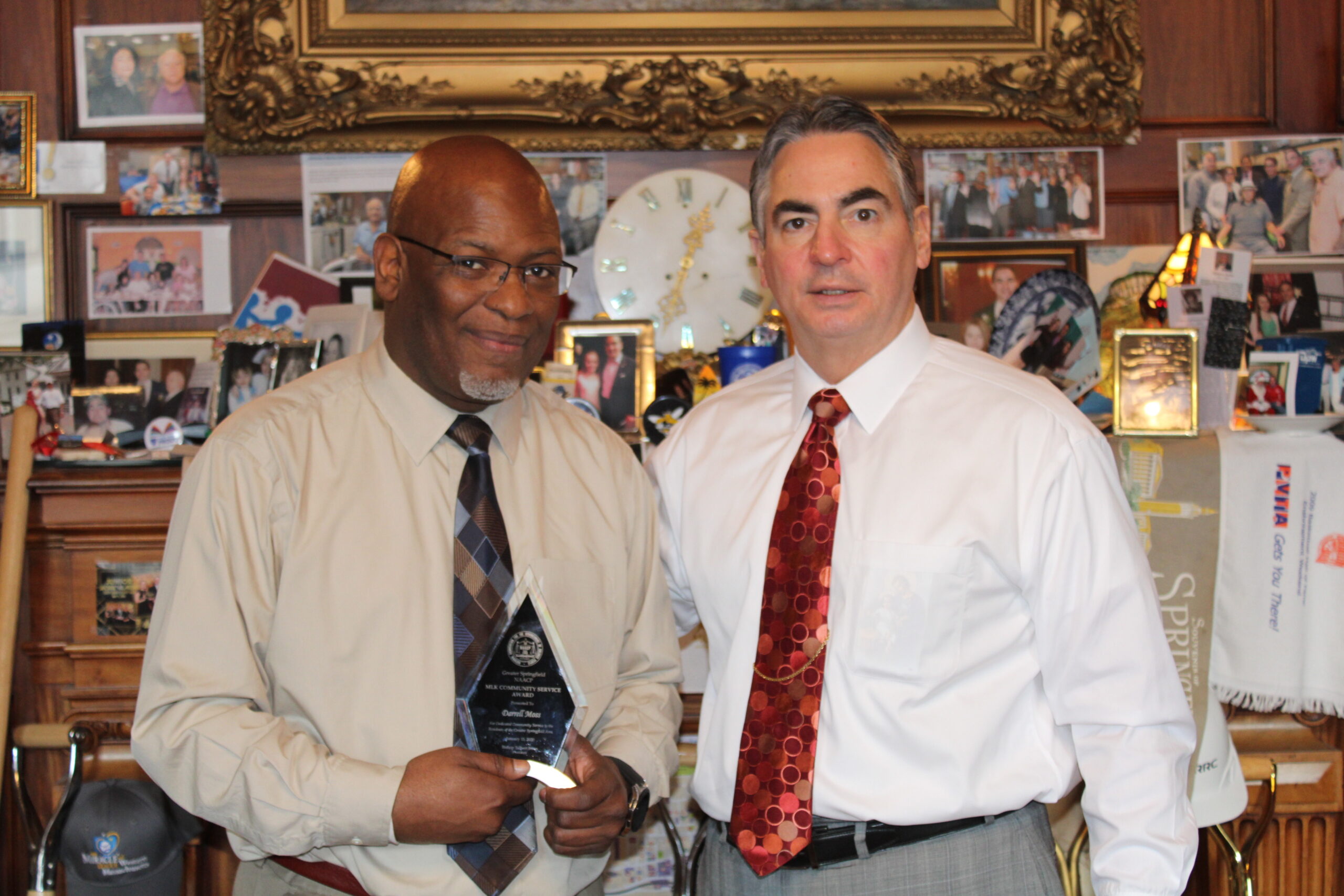
A file photo, obviously, of Moss and Sarno. (via Springfield City Hall)
On Wednesday, a Hampden County jury delivered a significant victory to Darryl Moss, a former aide to Springfield Mayor Domenic Sarno, that simultaneously rebuked his former boss. After a weeklong trial, the jury agreed that by firing Moss, Sarno, and by extension the city, had illegally retaliated against him for speaking out about discrimination in 2020.
In the wake of George Floyd’s murder that year and the events that followed, Moss posted a reference to the show Lovecraft Country on Facebook. The post’s invocation of “rifles” prompted an investigation into where Moss violated the city’s social media policy. Sarno claimed the result was the basis for turfing Moss. Moss sued two years later. Jurors sided with Moss and awarded him $750,000 in damages.
“With prayers and positive energy, we’ve weathered the storm,” Moss said on Facebook Wednesday. “Today, we stand poised to hear the verdict and move forward into the next chapter; grounded in faith, gratitude, and resolve.”
While he may have meant it more generally, Moss added that the fight was not over.
The Republican reported earlier on Wednesday that Moss prevailed feson a theory of retaliation, not his direct claims of discrimination.
Moss’s suit against Sarno and the city took on added significance because of the context of his termination. Amid high COVID, a racial reckoning and what would become the final months of Donald Trump’s first term, the termination struck a particular chord in Springfield.
Yet, as both a legal and political matter, the case also penetrated Sarno’s inner sanctum in a way few suits can or do. While the city is no stranger to employer discrimination claims, both meritorious and meritless, it is quite rare for the mayor to be directly implicated. Though he leads the city, the chief executive has relatively few direct reports, save department heads and his immediate staff.
As a named party, the lawsuit subjected Sarno to depositions and other discovery. Generally, most lawsuits would not get that close to his office, let alone directly inside it. Other suits involving the mayor, such as the push to enforce the Police Commission ordinance, would not have included discovery requests served on his mayorness.
Buoniconti, essentially: It ain’t over ’til it’s over.
Moss’s attorneys did not respond to requests for comment. Springfield hired an outside attorney, Patricia Rapinchuk, who served as co-counsel with the city’s deputy city solicitor. Rapinchuk referred questions to the Law Department. In a statement released to the media, City Solicitor Stephen Buoniconti indicated the case was not over.
“The City of Springfield’s Law Department will be filing a motion for a new trial in the next 10 days based on the irregularities of the testimony heard by the jury,” he said. “Multiple motions for a mistrial were argued to the Court and will be readdressed on appeal.”
In the runup to the trial, the city had successfully challenged several of Moss’s original claims. Others, however, endured and could be the basis for appeals. Buoniconti also appeared to allude to some testimony from witnesses during the trial that may have been inflammatory.
The full breadth of those motions will arrive in the coming days and weeks. However, it won’t change the fact that Moss’s central claims succeeded in a complex area of law. Although the mayor escaped a verdict that directly found he had discriminated against Moss, the finding may have still stung.
Despite plans for the city to fight on, Sarno issued an almost chastened statement after the verdict that otherwise made no reference to the jury’s decision.
“As I have stated on many occasions during my 18 years as mayor, one of our greatest strengths is the diversity of our city,” he said in a release, while touting his relationships across Springfield’s communities. “I will continue to make my decisions based on what is in the best interests of the citizens of Springfield. I am honored to serve as your Mayor.”
Moss’s attorneys amassed pages of discovery and hours of deposition testimony to make their case. It is—or at least it was—relatively rare for discrimination claims to arise from cartoonishly overt racism. Therefore, few discrimination suits are slam dunks. That Moss only prevailed on retaliation, a claim that trips up many defendants, underscores this.
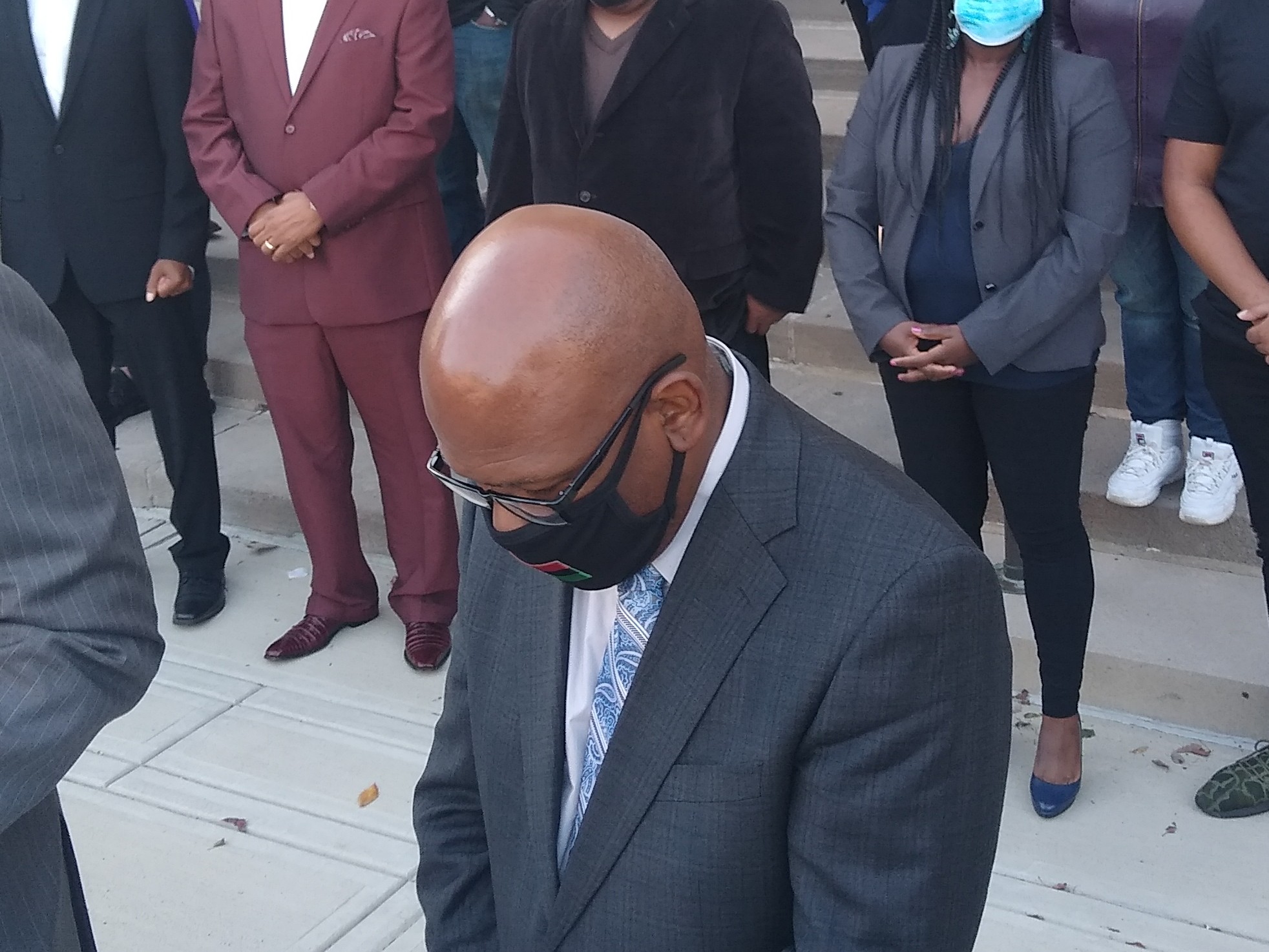
Moss at the rally before his termination. (WMP&I)
The evidence had begun to surface in motions both sides had filed in recent months. These records suggested that retaliation would be Sarno and the city’s Achilles’ heel. They showed how the sequence of events leading up to Moss’s firing, including a rally on his behalf the day before, seemingly left the city exposed.
The case also noted friction between Moss and the mayor, to say nothing of Pearl Street, after the brawl between Black patrons and off-duty cops broke out near Nathan Bill’s Bar & Restaurant.
The city’s social media policy is onerous and unforgiving. Yet, if the city could prove it was applying those rules equitably, Moss’s case could have failed. Lawyers for the city and Sarno could not convince a judge to dismiss the case on that theory, though.
The former aide’s post came about after Trump defended Kyle Rittenhouse, the armed Wisconsin teenager who killed two people during George Floyd protests. Moss called Trump’s backing of Rittenhouse a “declaration of war,” tagged a friend and said “grab the rifles.” The phrase is a reference to scenes in Lovecraft Country, which reflects on racial tension itself. Episodes of the show became exhibits in the case.
The post made its way to the police department and eventually its then-Commissioner, Cheryl Clapprood. It ultimately landed in the lap of HR/Personnel Director William Mahoney, who conducted the personnel investigation. The probe received press attention, culminating in the rally Moss supporters held.
With his job in the balance, Moss said little at that event other than implying he would run for office. (By the time of his deposition in this case, he was living in Atlanta.) This timeline and other evidence likely underpinned the verdict.
There was one other moment during trial that ostensibly pertains to the claims Moss lost. However, it did help the city either. Moss’s attorney asked Sarno if other employees social media were investigated in this heated moment in America.
“No,” Sarno replied, according to The Republican.