Analysis: Four Springfield Incumbents Lost Reelection; What Are City Voters Saying…?

Who is still standing after Springfield’s election and why did so many fall? (WMP&I)
Running citywide in Springfield, as Gerry Martin did two years ago, is a mammoth undertaking. Reaching the 21,000 or so voters who show in a mayoral year, spread across 33 square miles, is exhausting and time consuming. Running for City Council in a single ward this year let him canvass the same homes and sit down in the same living rooms two or three times.
“These people are really starting to know me and I’m really starting to know them,” Martin told WMP&I before the election.
It paid off. Martin is now Councilor-elect for Ward 7. He upended Timothy Allen, who has held the seat since ward representation returned in 2010. Martin’s tenacity may explain the lopsidedness of his victory. Yet, something bigger seems to be afoot in Springfield.
Two School Committee members lost their seats and an incumbent at-large Councilor was squeezed out. A few more incumbent councilors almost lost. Something seems to be gnawing at the municipal electorate and perhaps it will eat into the results in the next mayoral race.
This year’s election in Springfield was only for City Council and School Committee. Mayor Domenic Sarno’s term runs through 2027. In raw vote totals, more people voted in 2025 than in previous midterms. The turnout rate this year was slightly lower than in 2013. However, Springfield had 23,000 more registered voters in 2025 compared to 2013.
Several things weighed down the defeated, explaining the results to a point. For example, Allen faced an energetic candidate and was himself unprepared for Martin’s strength on the campaign trail. Once former at-large Councilor Justin Hurst entered the race, city politicos knew there was a chance he could leap into the top five and push out either Sean Curran or Brian Santaniello. The former drew the short straw
Chris Collins and Peter Murphy, the defeated School Committee incumbents, may have faced backlash over last year’s superintendent search. Rosa Valentin will replace Collins in the Committee seat for Wards 6 and 7. Ayanna Crawford, who had challenged Murphy before, found success this year. She will represent Ward 2 and 8 on the Committee next year.

“Something festers in the heart of middle Springfield.” Is it housing prices? (still via New Line Cinema)
However, the near-losses among incumbents show how the political shudder went deeper.
Ward 1 Councilor Maria Perez had to beat back challenger Joesiah Gonzalez, whom many observers left for politically dead after a scandal over the summer. Ward 6 Councilor Victor Davila barely hung on, resisting a challenge from Mary Johnson by only 18 votes.
Councilor Malo Brown and Lavar Click-Bruce, who represent Wards 4 and 5 respectively, faced serious challengers in Willie Naylor and Ed Nunez. Neither were thought to be in any danger. Thirty votes separated Brown and Naylor. Nunez held Click-Bruce to a 49-vote margin according to unofficial results. Both races were within less than three points.
What sent this shockwave through the electorate? It may be the national backlash against incumbents, which could have influenced nonpartisan municipal races in Massachusetts as much as it carried Democrats to stomping victories coast to coast. Is that all, though?
Springfield is in an unusual place after years of municipal challenges—relative stability.
There is the very real hell the feds threaten to rain down on communities like Springfield, but the city is in a better place than it has been in decades. It weathered the pandemic about as well as it could, not only financially but also socially. Even the post-COVID crime surge is ebbing. Problems remain in schools due to learning loss, but that is not unique to Springfield.
The question of costs comes up a lot these days. Residential tax bills have grown as home values rise and commercial values plummet or, at best, remain level. It has become a regular exercise in Springfield to pull change out of the municipal couch to reduce the tax levy and thus, hopefully, lower tax bills. However, the savings could barely fill a roll of quarters.
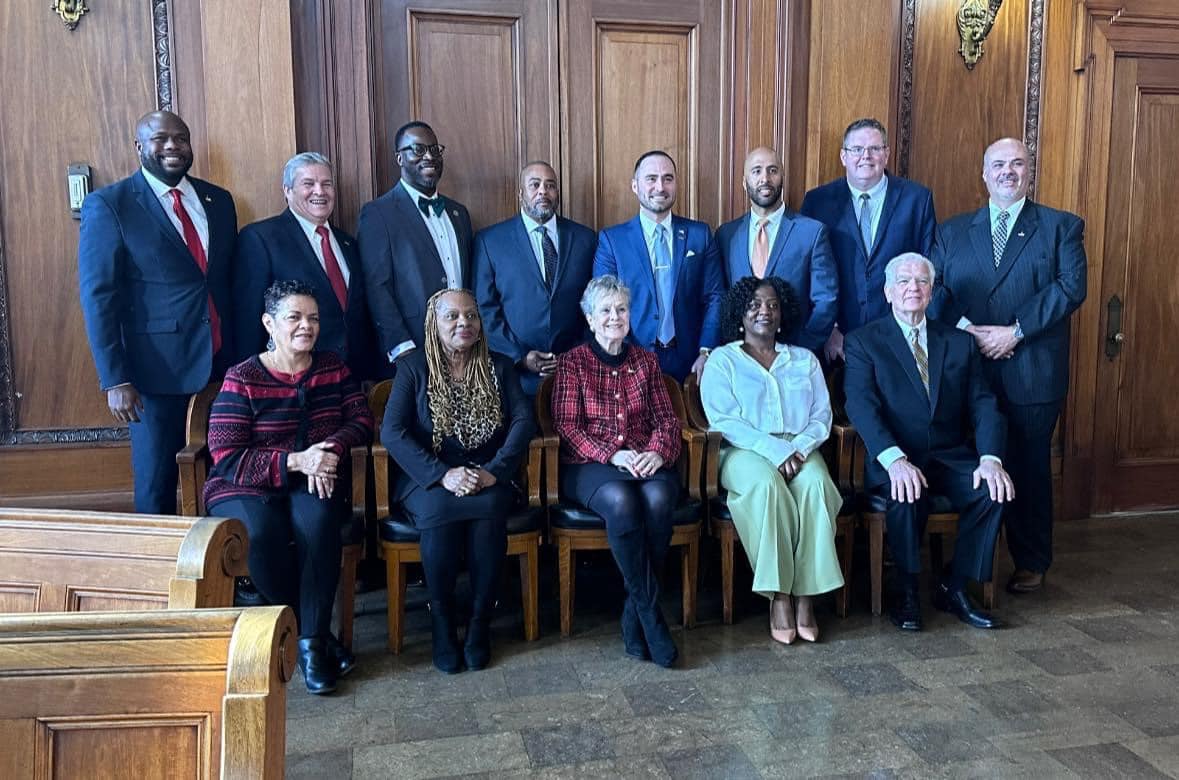
Have councilors done enough? Maybe not if two lost and four more barely scraped by. (via Facebook/Springfield City Council)
The city’s pols and bean counters alike know voters would recoil if that pittance on tax bills led to less police or fewer library hours. After the Control Board, the Great Recession and the tight labor market after COVID-19, city services have improved. The last thing residents will want to hear is Springfield must do more with less.
That does not mean costs are not a culprit, though.
Despite a depressed economy relative to the commonwealth, Springfield housing prices have risen. Both rents and home prices have become a burden across tax brackets in the city. Increasingly, the cost of housing is exceeding what city residents’ wages can sustain. Springfield has authorized some tax breaks and altered the zoning ordinance to conform with state mandates, but not much else.
It is not clear that either City Hall or Tapley Street, where the city Planning & Economic Development Department resides, is thinking ahead enough on housing. The piecemeal approach, especially downtown, is not going to be enough as rail service from Springfield expands in all directions.
Even with vile air blowing in from Washington, many residents feel the city should have turned a corner by now. Famine and pestilence have ridden past the city. Surely, a civic resurrection is in order. The problem is that since debates about COVID funding have died down, 36 Court Street often seems adrift. A lot is still happening, but does it stir residents’ hearts and, more importantly, put money in their pockets?
The new courthouse aside—which is no more an economic development plan than any government building is—there are no megaprojects on the horizon. (That’s fine, because most just add to Springfield’s menagerie of white elephants.)
The flip side of rising costs is raising wages and broadening the jobs base. One big project cannot do this. Eventually, without broader and bigger change, the color drains out of ribbon-cuttings, leaving them as no more than a ceremonial shovel or photo buried in the mayor’s office.
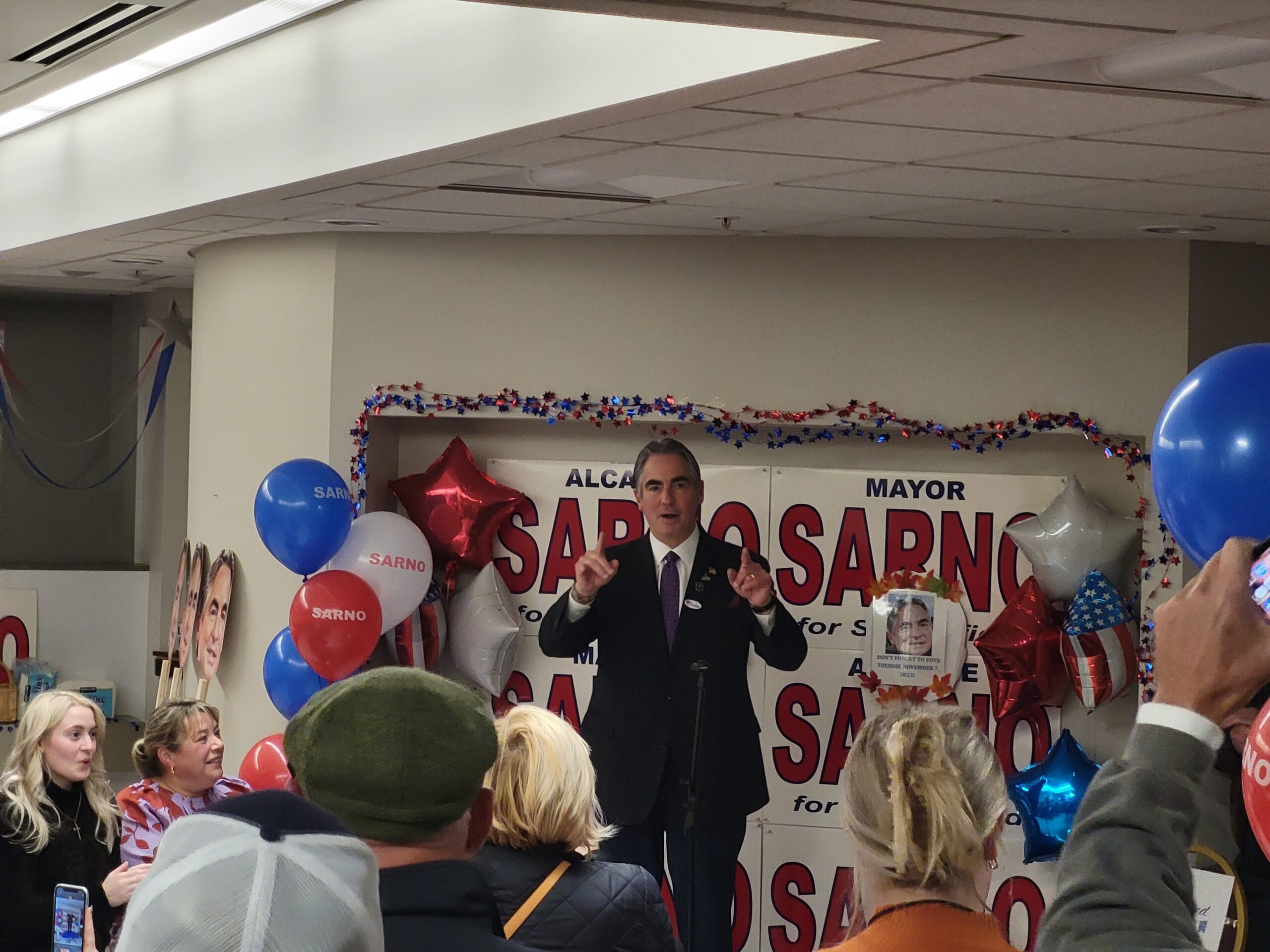
Could city politics point somewhere else next time Sarno is up? (WMP&I)
Could such inchoate forces have contributed to this year’s election results? Something was driving voters to vote and to vote out incumbents last week. It could have implications for 2027.
Once and soon-again Councilor Hurst is widely tipped to run for mayor again that year. He probably did not need to return to the Council to mount another bid, but the position can help as he hunts for the votes he needs to get a majority against Sarno.
However, his is not the only name in the mix. Rumors abound about a former mayor moving back to the city and making a run.
Or maybe city voters will be looking for a break from the past entirely. Youthful exuberance was only part of the tale in 2025. Being somebody other than the incumbent alone will likely not be the whole story of 2027. Maybe the narrative may turn on who correctly divines the signal in this year’s noise and promises Springfield something different, tangible and, above all, plausible.