Take My Council, Please: Press Any Key to Discontinue…
Not starring Bill Murray (WMP&I and Google images)
Within hours of its end, the modest agenda for the February 2 Springfield City Council meeting ballooned into a larger controversy. To rectify, it may require rescinding and/or reconsidering one action in Groundhog Day-esque fashion.
The trouble erupted after City Council Tracye President Whitfield failed to immediately recuse herself from consideration of a street discontinuance. She co-owns the entity that owns a property that would grow once the city discontinues the street. Plus, her son was presenting the item. While she did not vote on the item, her time briefly presiding during consideration means the Council must purge its vote to terminate the street.
Councilor Malo Brown participated in the meeting virtually.
The discontinuance at issue was one of two on the agenda. The other, for part of Wilbraham Avenue, came at the request of Springfield College. That request went to committee.
The other, for a stretch of Wallace Street that only exists on paper, did pass. This discontinuance would return the land where a street would go to the adjoining property owners. One of them is JETS Property Development, LLC, in which Whitfield has an interest. State records had listed her as its resident agent until February 7, when she resigned.
After the meeting, a flurry of correspondence bounced between councilors and the Law Department. To Whitfield’s credit, she sought review of the situation Monday evening. Emails she released publicly confirm she informed City Solicitor Stephen Buoniconti and updated her colleagues promptly. His report came back on Thursday.

Break on through to the other preside. (still via YouTube/Focus Springfield)
“I want to take full responsibility and publicly acknowledge my mistake in not recusing myself immediately from the discussion related to the discontinuance of a city street,” Whitfield said in a statement on Friday. “Public service is a privilege, and I take seriously the responsibility that comes with serving as a public official. I misunderstood the conflict-of-interest rules as they relate to participation in discussion.”
Whitfield went on to say she misunderstood when, while presiding over the meeting, she should have recused herself. She also addressed JETS’s purchase of property at an auction. She added that she would seek additional ethics training and speak with the Council’s attorney before meetings.
“I am embarrassed by this mistake and I offer my sincere apology. Transparency and honesty are core values that guide my life and my leadership,” she said.
During the meeting and in subsequent public comments, Whitfield ascribed her error to her newness as Council President. When zoning changes for the same property came before the Council in 2024, she did recuse herself. Video from that meeting shows her in the chamber as she announced and then-Council President Michael Fenton restated her recusal. Later wide shots of the chamber show she had left before or during the debate.
Buoniconti’s memo said Whitfield’s participation in the debate violated state ethics law “in multiple ways.” He urged the Council to remove the taint by rescinding its vote to discontinue the relevant stretch of Wallace Street.
Whitfield indicated in the hours after Monday’s meeting that she would also inform the state Ethics Commission. Buoniconti’s memo also said it would be forwarded to the Commission. Citing a legal mandate for confidentiality, a spokesperson for the Commission declined to comment. However, he did indicate that, as a general matter, the Commission reviews all reports of violations of state ethics law.
“The Commission’s Legal Division may provide public employees with conflict-of-interest-law advice pertaining to future conduct, but may not provide advice regarding past conduct,” spokesperson Gerry Tuoti said in an email. “Anyone who believes the conflict of interest law has been violated may report an alleged violation to the Commission’s Enforcement Division.”
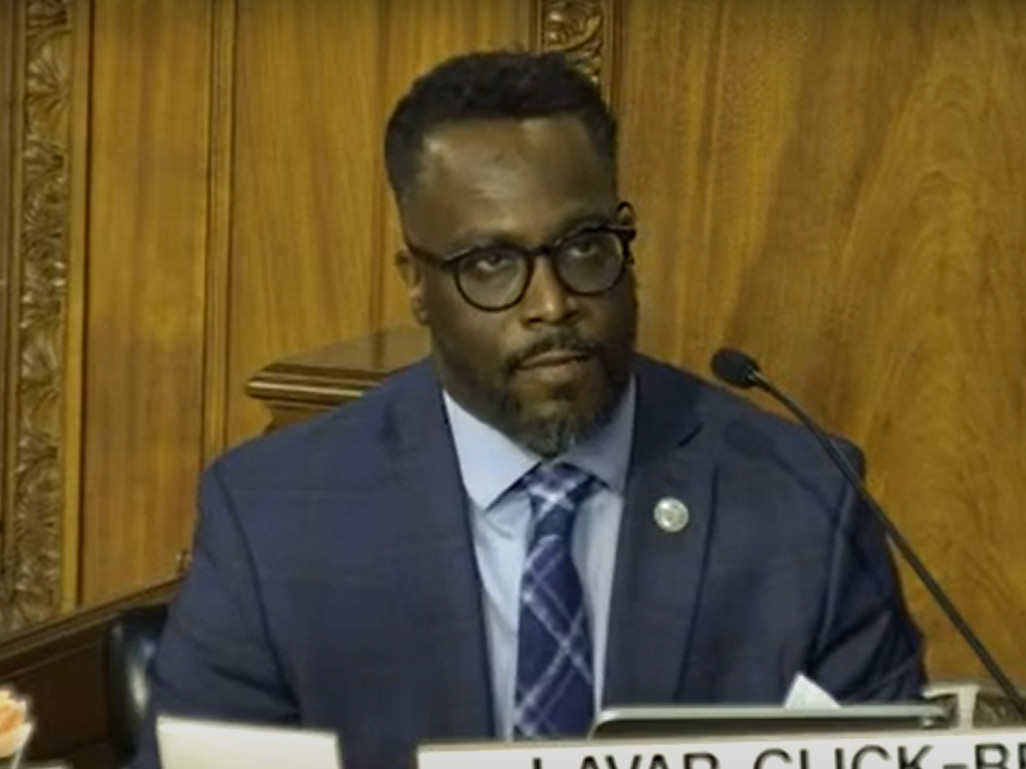
Click-Bruce said the Food truck ordinance is still cooking. (still via YouTube/Focus Springfield
The meeting had started normally enough. The Council heard committee reports. Maintenance & Development chair Lavar Click-Bruce announced that the new food truck ordinance still needed work. The Council later voted to return the bill to committee.
The Council received notice of a zone change for Beth El Synagogue’s property on Dickinson Street. It received an unremarkable December revenue and expenditure report from Comptroller Patrick Burns.
President Whitfield announced that an item on the rules for 2026, including an earlier start time for meetings, did not need a vote. The Council tabled it instead. A separate proposal to move public speak out’s start time went to committee.
After some debate, councilors voted to allow electrical pole work on Parker Street. They also later approved gas line upgrades for Belle and Normandy streets, Denwall Drive and Allen Park Road.
Springfield College’s request to discontinue Wilbraham Avenue runs from King to Hickory streets. Kevin Roy, representing the college, said it related to safety concerns.
At-large Councilor Justin Hurst moved to send the item to committee citing community concerns that arose from a prior discontinuance, possibly for another part of Wilbraham Avenue in the college’s footprint.
Councilors also questioned the impact on utilities, which have their own rights under the discontinued street. Roy also stated that the college had met with stakeholders.

Springfield College’s Cooper and staff asked for more of Wilbraham Avenue to be discontinued, but the request is now to be continued. (via Springfield College)
Springfield College President Mary-Beth Cooper was on hand and suggested that the neighborhood would not like the plan any more in three weeks than it does now. She styled the issue as a matter of safety, as well.
Nevertheless, councilors decided to send the discontinuance to committee unanimously. Whitfield told Cooper to submit the materials she had, including any video, to Council staff to circulate them to councilors.
In response to questions from councilors, the representative from the Department of Public Works, Hector Velez, clarified that the discontinuance would, in effect, return the land to abutting property owners. In this case, that would be Springfield College.
Streets are not really property the city owns. Rather, they function as easements to abutting properties in perpetuity—or until the city discontinues the street. There are various legal complexities but discontinuing a street does have the effect of increasing the size of abutting parcels of land.
When the Council moved to the Wallace Street discontinuance, Jelani Bland, an officer of JETS Property Development—and Whitfield son—presented it. He described the property JETS owns, which is itself on Wisteria Street, as a wooded area that often experiences illegal dumping. The plan, Bland said, would be to build two buildings on the property. When Ward 2 Councilor Fenton later asked if the plot was big enough, Bland said the plan would be to buy an adjacent property owner’s share of the discontinued Wallace Street. If the full width of the street were added to JETS’s property, there would be space for two structures.

The red highlight is JETS Property Development’s lot in Wisteria Street. Wallace Street, as labeled, continues past Wisteria into the white space. But the white section is “unimproved” and only really exists on paper. (via Springfield Assessor/GIS)
Before Fenton asked this question, though, he queried Whitfield about recusal.
“I hate to ask, but I’m just uncomfortable, so I feel like I have to ask if you intend to recuse at all from any part of this discussion,” Fenton said.
“Absolutely,” Whitfield responded, though she suggested she was not sure when to do so. Fenton indicated she should do so now. Whitfield called up Council Vice President Jose Delgado to take over the debate.
During the rest of Fenton’s questioning, he asked whether Bland or his co-investors had been in touch with the adjacent property owner. Bland said there had been contact, but the owner was not a resident and could not sign the discontinuance.
Fenton did not oppose discontinuing a “paper street.” However, he also said there were other issues to flesh out before final approval. Fenton moved to send the discontinuance to committee.
Other councilors focused on the need for housing in the city. At-large Councilor Kateri Walsh noted that this process would not happen quickly anyway. The motion to committee failed 2-10, with only Fenton and Ward 3 Councilor Melvin Edwards in support.
After the move to committee failed, Fenton aired concerns about the economic impact. His main concern, however, was the absence of support from abutters in the record.
The discontinuance passed 10-2 with Edwards and Fenton in dissent.
The meeting continued with acceptance of small grants and donations and the body’s approval of a $2.5 million bond for design work on a new school. This facility would replace White and Kensington schools. Director of Capital Asset Construction Peter Garvey said this was for preliminary work as part of an application to the Massachusetts School Building Authority. There is no site yet, but Garvey said the combined DeBerry-Homer Street school was a model.
The Council’s final action on February 2 was moving the food truck ordinance to committee.

City Solicitor pondered a lot in his otherwise brief memo. (via Springfield City Hall)
However, it would not be the last word on last Monday’s meeting. In his memo, Solicitor Buoniconti indicated that Whitfield’s failure to recuse immediately was a major problem. He identified four potential violations on Whitfield’s part.
The first was her participation in any part of the debate. The other three pertained to a failure to disclose. Buoniconti indicated that she had a responsibility to disclose her interest in JETS and her relationship with Bland as her business partner. He also said Whitfield had an obligation to file disclosures with the City Clerk, which had no such disclosures on file.
Buoniconti’s memo indicated that Whitfield had also engaged with the Planning Board when it considered the zone change. The Republican also reported engagement with the Board of Public Works. The spare minutes from the Planning Board’s review of requests for JETS’s property on Wisteria Street do not mention Whitfield. Neither panel’s meetings appear on Focus Springfield’s YouTube page. WMP&I could not confirm Whitfield’s participation as alleged as of posting time.
The memo also claimed some councilors were unaware of Whitfield’s relationship to JETS and Bland.
The Council moved on Friday to hold a special meeting on February 13 to rescind approval of the Wallace Street discontinuance. Before Whitfield’s press conference, several councilors gathered at City Hall to announce the special meeting.
“We must ensure public trust and the process is open, fair and free of undue influence,” Ward 6 Councilor Victor Davila said, according to WAMC audio of that press conference. “I am very concerned with this situation, out of an abundance of caution and to ensure the public trust.”
Joining Davila were Delgado, Edwards, Fenton, Walsh, Ward 7 Councilor Gerry Martin and a-large Councilor Brian Santaniello. Fenton and Walsh spoke in favor the special meeting and recission. Santaniello also backed rescission but acknowledged Whitfield’s desire for a solution.

Whitfield at her swearing in as president last month. While accepting responsibility, she attributed her error to being new to the presidency. She has said she would looking at additional ethics training for councilors. (WMP&I)
“Council President Whitfield, in my opinion, did the right thing by going to the Law Department,” he said. “She did ask how this thing could be resolved, and the city solicitor came up with a resolution, and the resolution is to rescind the vote. That’s exactly what the council is going to do.”
Whitfield read her statement on Friday. Per WAMC Northeastern Public Radio’s audio of the event, she also said she supported her colleagues’ actions to correct the situation.
“Yes, I endorse it absolutely. When there’s something done wrong it needs to be corrected, and I have no problem with whatever corrective action city council takes,” she said.
Further consequences will be for the state Ethics Commission to determine. The Commission can issue fines of up to $10,000. However, the Commission has looked upon self-reporting favorably. It could even spare Whitfield a formal adjudicatory proceeding and yield only a letter.
There may be political fallout from this episode. The next election is too far away to assume it will reverberate that far. Rather, the impact may manifest in the quieter exhaustion and replenishment of political capital within the walls of 36 Court Street and across the city’s nodes of power.

(WMP&I)
Still, the prompt action of Whitfield, her colleagues and the Law Department has likely contained the damage in a more practical sense. Buoniconti’s letter makes no direct reference to his authority to issue such opinions under the city’s Ethics Ordinance or the state law it mirrors. However, this situation should spotlight the city’s own oft-forgotten conflict of interest law.
Perhaps if that ordinance and the city Ethics Commission it creates functioned, it would alleviate situations like this one.