Take My Council, Please: Early to Bed, Early to Rise, Early to Adjourn…
UPDATED 1/18/26 11:53AM: To reflect a correction to properly portray proposed changes to public speak out.
Lighting a fire under itself. (WMP&I and Google images)
The first regular Springfield City Council meeting of 2026 after last week’s inauguration largely featured consensus. The highlight of the evening was a new contract with the firefighters. There were also new economic development grants and a conspicuous cut to a grant the Police Department has received for years.
The meeting also featured the once-annual adoption of the rules of the City Council. Newly installed Council President Tracye Whitfield told her colleagues that she had few changes. One was still in the works, but the other was ready to vote on. She proposed—and the Council concurred—to begin meetings at 6:30PM instead of 7PM.
Ward 4 Councilor Malo Brown was absent from the meeting. Ward 1 Councilor Maria Perez attended virtually.
The meeting began with reports from the newly reorganized committees. Finance Committee Chair Zaida Govan announced that all the financial items on the agenda were good to go. Maintenance & Development Chair Lavar Click-Bruce said his panel recommended the food truck ordinance updates remain in committee.
In addition to the time change, Whitfield previewed a change to public speak out. However, she said she wanted to pilot it first.

The president proposes earlier beginnings… (WMP&I)
The time change would have meetings start half an hour sooner. Public speak-out, which usually begins 30 minutes before meetings, will not be pushed back. Rather, it would be added to the meeting under the proposed pilot. Whitfield and other councilors indicated the earlier start time would make meetings more accessible.
The proposed change passed unanimously. Some councilors noted that it would require committee meetings held on Mondays to begin earlier, possibly during working hours. Govan, who represents Ward 8, also suggested moving the Council’s hard stop time to 9:30PM from 10PM. There was some interest in retaining the 10PM stop time, but the new stop time passed without dissent.
The Council also approved a new pact with city’s firefighters. The agreement with the International Association of Fire Fighters, Local 648 is technically two contracts. One runs from July 1, 2024 to June 30, 2025. The second runs from July 1, 2025 to June 30, 2028. Firefighters will receive 3% salary increases each year of the agreement.
The city also agreed to switch scheduling to 24-hour blocks. Labor Relations/HR Director William Mahoney explained that currently the Fire Department operates on a four on/four off schedule. Over the four on days, firefighters alternate between day and night shifts. Going forward, they will work 24 hours—technically one 10-hour shift and one 14-hour shift consecutively—followed by 48 hours off, another 24-hour two-shift block and then 96 hours off. Mahoney said this would not change the number of hours or pay.
There were schedule changes for others IAFF members who work 9 to 5. Firefighters can also man road construction sites and members of the maintenance division with commercial driver’s licenses will get an annual 1% lump sum. The city also can utilize assessment centers instead of the Civil Service exam.
At-large Councilor Kateri Walsh asked for input from firefighters. Although city employee unions can advocate for Council approval of contracts, it would be legally dicey for them to discuss the contract at a meeting too much. Under state law, the city’s bargaining agent is the mayor or his designee. Fire Commissioner B.J. Calvi, who is not covered by a union contract, stood to speak. He said the union ratified the agreement with about 75 precent support.
Councilor accepted an unremarkable November revenue and expenditure report from Comptroller Pat Burns. They allowed Eversource to open up Grover Street to upgrade a gas main. Small grants for Elder Affairs and Health & Human Services also received approval.
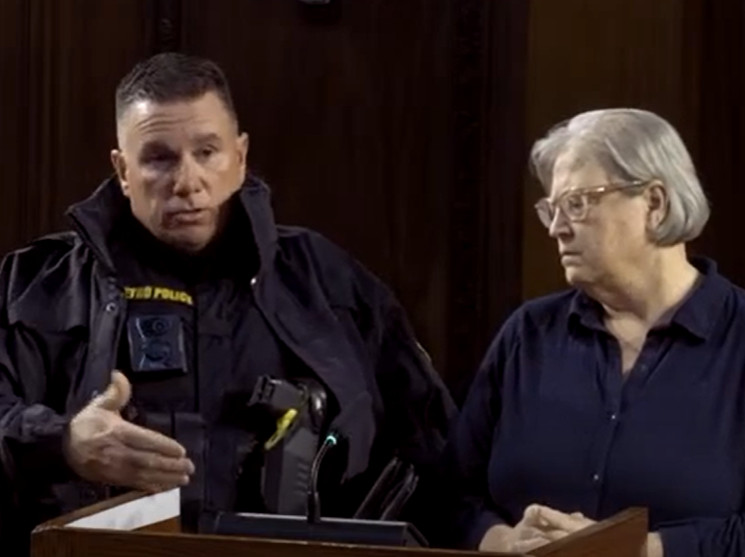
Lt. Elliott, left, in 2024. (still via YouTube/Focus Springfield)
Police Lieutenant Brian Elliot presented the annual Shannon Grant. He noted that this year’s $860,689 funding was a 31% reduction from the previous year. At-large Councilor Justin Hurst inquired into whether this was unique to Springfield, but Elliot indicated it affected all eligible municipalities. At-large Councilor Brian Santaniello asked whether this was related to federal cuts, but the lieutenant said this was a state grant. Councilors accepted the funds without dissent.
Deputy Economic Development Director Brian Connors presented a trio of grants. Two, a $100,000 brownfields grant and a $300,000 site readiness grant, are for the site of the former Massachusetts Career Development Institute. The city is preparing to redevelop the parcel on Wilbraham Avenue where the former educational facility had once stood.
Connors also presented a $3 million MassWorks grant for improvements downtown bounded by Main, State, Union and Willow streets. Work will include tree-planting and sidewalks as the city looks ahead to building a new parking garage to service the area.
All three grants received approval without dissent.
Councilors approved money for the Library and Public Works departments. One was a $269,750 grant for sidewalk installation along Roosevelt Avenue between Alden Street and Wilbraham Road. The other, for $618,298, is the city’s annual state aid from the Massachusetts Board of Library Commissioners.
Both grants passed unanimously.
The final item that received final approval was authorization to pay a $1,495 bill from 2024.
Public work czar Chris Cignoli said the funds would pay Sodexo for food the city provided workers during snow removal duty. He said he had checked with the company about old bills and Sodexo told him there were none. Nevertheless, the bill came. Councilors greenlit payment.
For the benefit of the Council’s newer members, Cignoli again laid out the food truck ordinance revisions. In short, they would apply many regulations for food trucks parked on public property to those operating on private property.
Amid some back and forth with councilors, Cignoli said that he was working with the city’s HHS department to identify the trucks his department does not already regulate. The health department already inspects those trucks and should have contact information he can use to inform them about upcoming changes, should the Council approve the revisions.
For now, the Council accepted the Maintenance & Development Committee’s recommendation and kept the item in committee.

(WMP&I)
The first committee meeting of the new Council had no items controversial enough for any fissures to open up among members. The barest whisps of maneuvering ahead of the 2027 mayoral election may have been there, but it is too early for these to be anything more than distraction.
The main takeaway for now is the Council is back for 2026—but it will be going to bed earlier from now on.