Appeal Is Just One Stop on the Long Path to Saving Springfield’s Climate Grant…

An AC/DC strategy? Alternative court in the District of Columbia for the Plaintiffs? (WMP&I)
WASHINGTON—Fifteen months after Springfield formally accepted its Environmental and Climate Justice Community Change (ECJCC) grant, it and several cities and environmental groups were fighting to keep the program alive. Far from 36 Court Street, in a wood-paneled courtroom between the Capitol and the White House, a motley crew of grantees urged a federal appeals court to reverse a lower court’s dismissal that had doomed an effort to revive the ECJCC program.
It may be a tough sell.
Under the glare of 28 portraits of past judges of the Appeals Court for the District of Columbia Circuit, the lawyer for the grantees argued that the administration had not fully voided the ECJCC grants. Thus, the rescission of the funds written into Donald Trump’s tax bill did not apply. Yet, these other legal fights over the administration’s refusal to spend money Congress appropriated could seal the fate of Springfield’s grant and others’.
“We recognize that the outcome of this case may, to some extent, be guided by this Court’s forthcoming en banc decisions in Climate United and NTEU,” said Benjamin Grillot, the attorney advocating for the environmental groups and municipalities.
The two cases that could shape Springfield’s are reviews of decisions on a green bank—also created by former President Joe Biden’s climate bill—and the Trump administration’s attempt shut down of the Consumer Financial Protection Bureau. These two differ greatly from the ECJCC case. Yet, they both touch on the broader—and rampant—problem of this executive not following the law.
Those cases could just as easily not matter. To pay for Trump’s tax cut, formally the One Big Beautiful Bill Act (no, really), Republicans cut food stamps, slashed Medicaid and swept funds from programs like ECJCC that the EPA had not “obligated.”
“I think we explained very clearly why the funds were not de obligated when H.R. 1 passed, and they’re still available,” Grillot told WMP&I after the arguments on March 16, referring to Trump’s tax cut by its bill number.
When Springfield and its co-plaintiffs filed their class action last year against the EPA and Lee Zeldin, the Captain Planet eco-villain henchman who runs the agency, the case was relatively straightforward. The pullback of funds violated both the law and the Constitution. The EPA did not follow the proper process to rip away the funding. Its refusal to spend money as Congress had directed was unconstitutional.
It’s not even Dr. Blight or Lutin Plunder in charge at the EPA these days. (WMP&I)
The Trump administration illegally cut programs with abandon last year. Consequently, the suit over the ECJCC funding was only one of many filed across the country. Others had varying degrees of success. However, last summer saw two intervening events changed the legal postures of Springfield’s case.
In August, the Supreme Court controversially put its foot down. It insisted that using the Administrative Procedure Act (APA) to stop the cancellation of grants was generally not appropriate. This is largely what lead District Court Judge Richard Leon to dismiss the suit initially.
Leon declined to probe whether another factor had doomed the ECJCC suit. Trump’s tax cut passed in July between the filing of the suit and Leon’s ruling. The district court judge noted but did not engage with the question of whether the funds still existed or not.
By the time the question came before Judges Sri Srinavasan, Neomi Rao and Justin Walker—the first an appointee of Barack Obama, the latter two Trump appointees—the case had become somewhat removed from Springfield. Back in 2024 , the city was celebrating the $20 million grant to expand tree cover, remove hazardous materials and more. Now, the plaintiffs were just trying to resuscitate the ECJCC program.

Judges Srinivasan, Rao & Walker heard the appeal. (created via law.com, Wikipedia & Google images)
It was a dreary day in DC when the case came before the three DC Circuit judges. Washington offices citywide were closing early due to a tornado watch, a meteorological coincidence for an observer from Western Massachusetts. Indeed, the ECJCC funds would have financed the restoration of tree cover lost to the cyclone that ripped through Springfield in 2011.
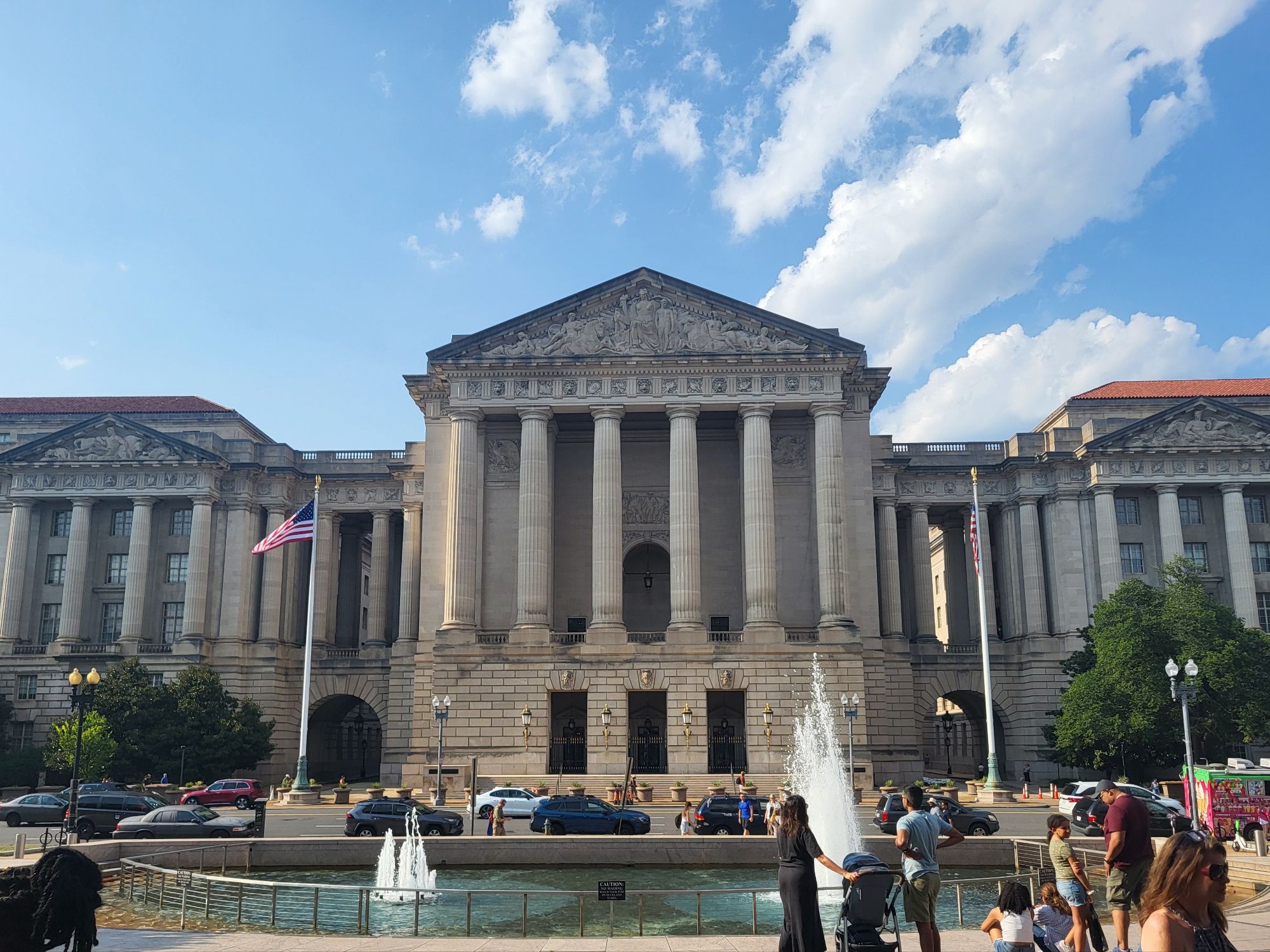
The DC Circuit sits in the E. Barrett Prettyman Courthouse. Judge Leon’s court sits there, too. Harry Truman laid the building cornerstone. While quiet on March 16, it is a familiar place for those litigating against—and on behalf of—Trump’s government.
Much of Grillot’s argument centered on the status of the ECJCC’s funds. Judge Srinivasan did ask about the underlying question that Leon ruled on. Judge Rao asked about the plaintiffs choice to litigate under one section of the APA over another. However, the money was front and center.
Grillot emphasized that EPA had not functionally de-obligated the funds because the grantees had appeal rights and because they skipped several steps. Among those was identifying closeout costs that the EPA said the grantees could recover. Without doing so, the funds did not become de-obligated. Therefore, they were not swept up to pay for the tax bill. Indeed, the closeout amount remains unknown.
The administration’s lawyer, John Bailey, insisted that the cancellation letter was enough. By sending it, the EPA had freed up the funds such that Congress could put them toward the tax cut.
“What is your support for that?” asked Rao, who usually rules in Trump’s favor. “We’re not budget law experts, and there’s very limited briefing that the government has offered to support this position.”
Bailey pointed to federal budget documents that the establishment of agreements locks up the funds.
“We think of these agreements, those are the binding obligations that give rise to the obligation in the first instance, and so upon termination, when that legally binding agreement is no longer operative, at that point, the funds become unobligated within the meaning of” the tax bill.
Rao also asked about the closeout costs. Could they remain obligated even if nobody knew what they were yet? Bailey said yes. She seemed unsatisfied if not unpersuaded.
Grillot returned to this during his rebuttal, noting that Congress cannot rescind an unknown amount of money. The Plaintiffs had noted in their briefs that prior to passing the tax cut, Congress received an estimate for unobligated ECJCC funds that did not include funds Springfield and others had received.
To repeal the way the government was arguing, Grillot said, Congress cannot be vague or cute about it.
“If it wanted to have a future effect, then it could have written something like that, but it didn’t,” plaintiffs’ counsel said. “This is a situation in which it is a snapshot in time of July 2025.” Only unobligated funding at that moment—and the EPA failed to de-obligate—are available to sweep in under the tax bill as Congress wrote it.
Judge Walker, who also tends to side with Trump, said little, but did not seem enthusiastic about the government’s position. Judge Srinivasan did not tip is hand much, but did seem more sympathetic to the plaintiffs.
The arguments flew by in comparison to the hearing immediately before. For nearly two hours, the panel of judges grilled those parties on a somewhat esoteric matter in immigration law. If the plaintiffs can prevail upon the obligation of funding, those other cases could shape the final ruling.

Will Springfield ever see that money even if it and its fellow munis prevail in court? (WMP&I)
The funding was originally meant to expire at the end of this September. Neither Bailey nor Grillot gave a definitive answer about what happens then. The judges were open to further briefing. Even then, Grillot acknowledged to the judges that the objective was to save program and force the EPA to hand out the money. It is unclear if the original grantees like Springfield would receive money.
With such long timelines, plaintiffs like Springfield have been looking at alternatives. At a recent City Council meeting, Tina Quagliato-Sullivan, a Springfield official who offered evidence in the case, said the city had found other funding for lead pipe removal the ECJCC would have financed.
That said, Grillot suggested the judges’ interest in the impact of cases was a good sign. It could address the basis for Judge Leon’s dismissal.
“I think a lot of that is because these cases are at en banc, and so again, it’s good that they’re considering them and getting the law right,” Grillot said. “We look forward to applying it going forward.”