West & East of Local Public Media, NEPM & GBH, to Formally Join Hands…
Joining forces. (created with NEPM & GBH logos and Google image search)
Seven years after New England Public Radio and WGBY merged to become New England Public Media, the nonprofit media landscape is shifting again. Last Friday, the GBH Foundation, which oversees NEPM now, announced that it would formally absorb the 413’s largest public broadcaster. No major changes for listeners or viewers appear imminent, but both NEPM and GBH cast the move as a positive.
The merger will not result in any loss of jobs in the near term and the outward changes will be minimal at first. NEPM will retain its branding for local content, but the two entities expressed ambitions to create a statewide news organization. GBH News’s editor-in-chief, Dan Lothian, will oversee radio, television and digital reporting at GBH, NEPM and WCAI, a station on the Cape.
“This is all about preserving local news,” GBH President and CEO Susan Goldberg told GBH News. In the same interview, she alluded to the need for efficiencies after Congress rescinded $1.1 billion it had appropriated for public media. The move, a longstanding goal of the right in the US, led to the closure of the Corporation for Public Broadcasting and left many public media outlets scrambling.
In a statement announcing the move, Goldberg said that one solution was to find efficiencies.
“By scaling our journalism while maintaining our focus on local coverage, we become a more sustainable business operation even in the face of federal defunding, ensuring that every resident of the Commonwealth has access to fact-based reporting and stories that matter,” she said in last Friday’s release.
GBH and NEPM expect the merger to be complete this summer.
WGBY, long the public television provider for Western Mass, was, in fact, a property of the WGBH Foundation, the nonprofit that owns GBH. The local public broadcaster also produces several local television programs and national PBS content.
WFCR, which later adopted the New England Public Radio brand, was a charter member of National Public Radio. However, until joining forces with WGBY, it was effectively a division of UMass-Amherst.
This new merger was, in some ways, a logical next step after WFCR, a radio license UMass-Amherst owns, and WGBY joined forces. Although it had its own board, NEPM largely fell under GBH. UMass-Amherst had a seat on NEPM’s board and continued to own WFCR’s license. (A spokesperson for the university said it would retain ownership of WFCR’s license after GBH takes over.)
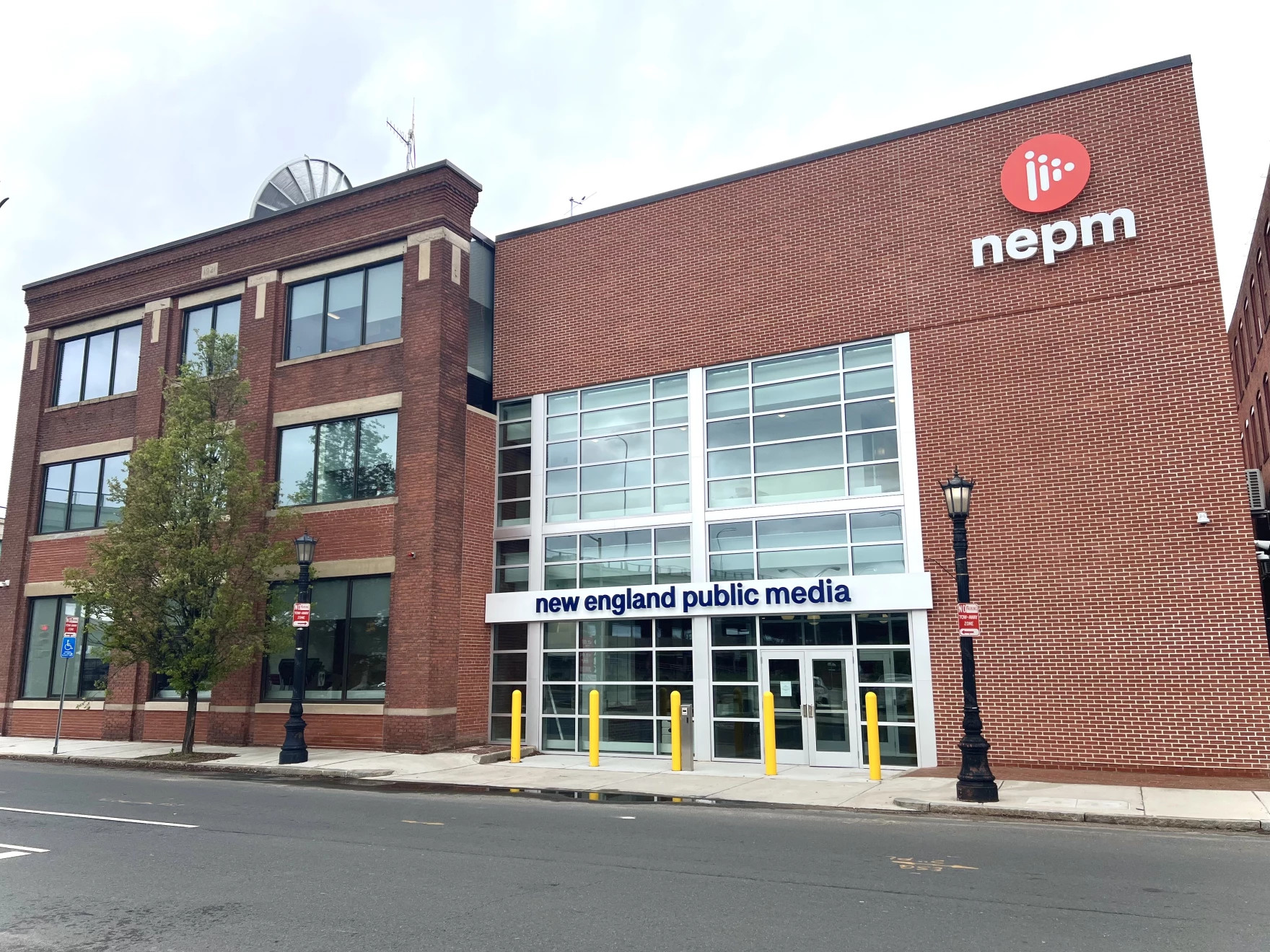
Teaming up. (via nepm.org)
Battered by the pandemic-era decline in public radio listening and the 413’s poor economy, NEPM had not faired well. It has seen layoffs and the end of television programming like Connecting Point. However, it has also expanded other local programming, even luring Monte Belmonte down I-91 to NEPM.
WMP&I Editor-in-chief Matt Szafranski has appeared on NEPM’s radio and television programming.
Public media in Boston has had its struggles as well. GBH has seen reductions in staff both in its news division and in its larger programming arm. GBH produces many flagship programs for PBS such as American Experience. It is not the only public media game in town, either. WBUR, nominally a property of Boston University, also produces national NPR content and has a sizable newsroom.
In a March interview with The Boston Globe, Goldberg floated the idea of a merger with WBUR. The latter’s leadership politely declined.
As Goldberg alluded to in her statement and interviews, scaling and efficiency is part of the plan. A spokesperson for GBH explained in an email there would be more collaboration on statewide news.
“We’ll be sharing resources and generating more operational efficiencies between GBH and NEPM so we can invest in our journalism and growing audience,” said Nicole Boudreau, GBH’s Director of Communications.
However, there are no layoffs planned. NEPM President Matt Abramovitz, who took over NEPM in 2022, will remain in that position. The release said he will also have the role of Vice-President of Audience Strategy and Operations at GBH.
The impact on staff is a concern. Even though layoffs are not in the immediate future, the labor situation is somewhat unique. Employees of WFCR were represented by the Professional Staff Union (PSU) at UMass-Amherst, not a private sector union subject to federal collective bargaining law. The employees who stayed with NEPM remained with the union and on UMass’s payroll.
The PSU confirmed that some of its members remain at NEPM. Vanessa Cerillo, a spokesperson for NEPM, confirmed that these employees would remain in the UMass union.
NEPM and GBH have been collaborating closely since 2019. The WGBH Foundation had been providing some financial support to NEPM according to Current, which covers public media. The tie-up will not only provide savings in administrative costs, but streamline underwriting and reduce membership fees.
The big question will be how coverage changes with the deeper-pocketed GBH hugging NEPM more closely. There were some hints at a statewide news network when the NEPR-WGBY merger happened. Now that is the explicit goal. GBH had already established a presence in Worcester and now it will effectively have a foothold in Springfield and the 413.
One immediate benefit will be more of each newsroom’s current content featuring more often on the other’s air. Longer term, the question will be whether more money comes into NEPM to provide more reporting in the increasingly journalism-starved four Western counties of Massachusetts.