Analysis: The Courthouse Battle in the Court of Public Opinion…
UPDATED 11/7/26 12:42: To include the date of the next hearing.
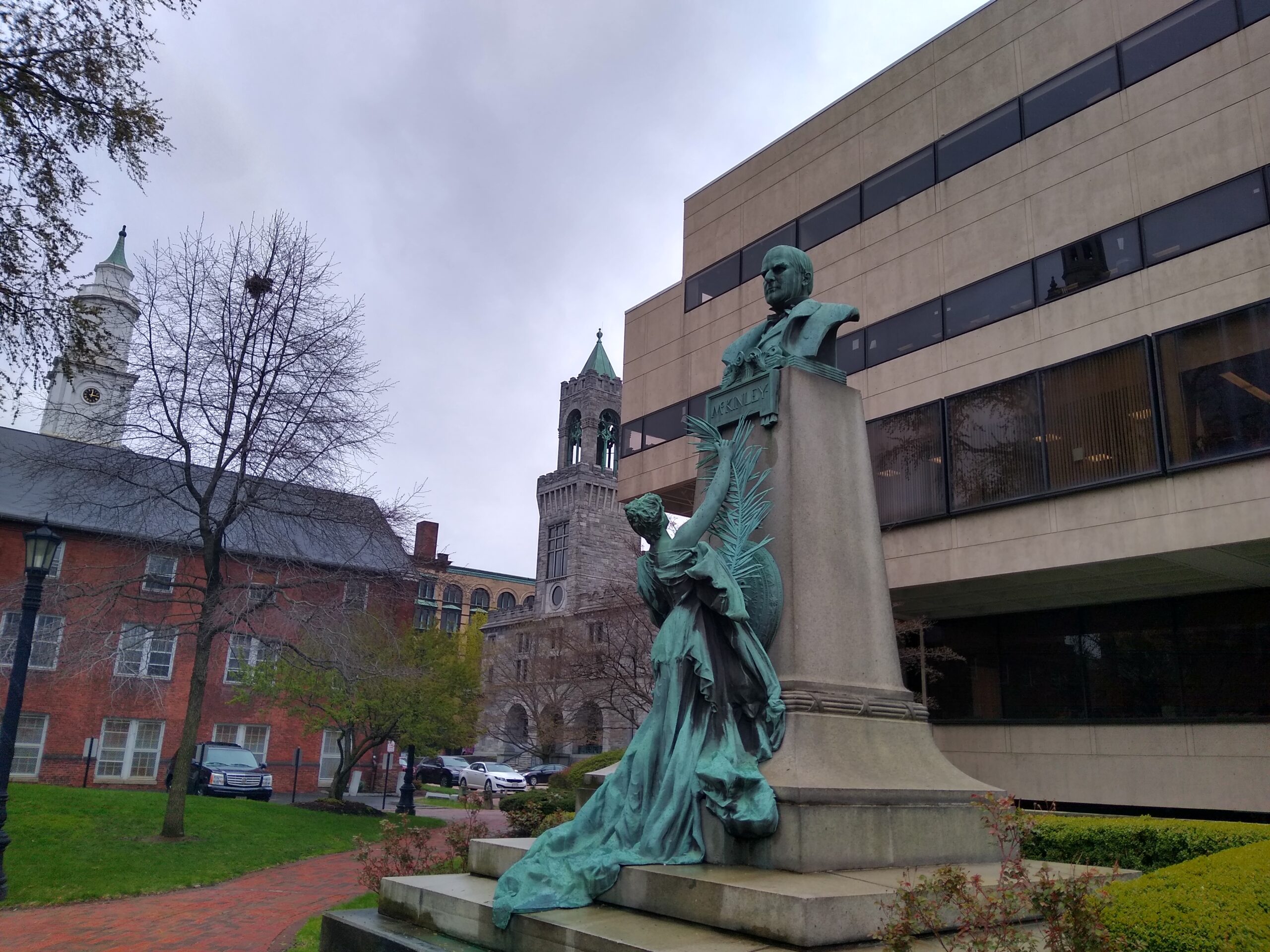
Reaching for the public’s verdict. (WMP&I)
For several weeks now, both sides of the battle over Springfield’s new courthouse have been taking their case to the people. Dinesh Patel and James Balise, the owners of companies formally suing over the selection of Liberty Junction, had been waging war in court and in public against the choice. A bit belatedly, Liberty Junction has mounted its own PR offensive, which has become more visible in recent weeks.
Judge David Hodge recently refused to stay discovery. However, the lawsuit may be better understood as a parallel track of opposition that slows down the developer and Commonwealth. In that space, Balise, Patel and other opponents can rally the public for—and against—reconsideration of a new courthouse at 125 Liberty Street in Springfield. Hence Liberty Junction’s move to step up its public showing.
The political and legal worlds of Greater Springfield, and to an extent of Massachusetts generally, have gone sideways since a state agency selected Liberty Junction to build the courthouse for Springfield-based courts. What began as an uproar over a conflict of interest has ballooned to broader critiques about the adequacy of the site and the impact on the city itself.
There is a sense that the public relations strategy Balise has financed—and Liberty Junction eventually countered—is surfing the gubernatorial election. There is some truth to that. Republican gubernatorial nominee Michael Minogue has tried to blast Governor Maura Healey over the situation. It was her administration that selected Liberty Junction. Despite paying for ads airing during major television events, including Healey and Minogue’s debates, Balise claims he supports the governor’s reelection.
Yet, it would be a mistake to think the public relations battle terminates once the votes are counted. Many people vehemently opposed to putting the new courthouse on Liberty Street would never vote for Minogue. Nor does it seem as though Healey is winning votes she would not otherwise get simply because she has acted to replace the decrepit 55 year-old existing courthouse.

The governor’s race is less relevant to the courthouse than Minogue may want it to be. (still via YouTube/CBS Boston)
Election Day shall not end the push to make the Division of Capital Asset Management & Maintenance (DCAMM) relent and rethink the Liberty Street site. To begin, the court fight is not going away. By not staying discovery, Judge Hodge is signaling he may not be dismissing the case right away.
The plaintiffs and defendants have filed their briefs on the latter’s motion to dismiss. A hearing and/or ruling has been scheduled for Decmeber 1. In an earlier ruling denying Balise and Patel’s preliminary injunction request, Hodge expressed deep skepticism of the case. Yet, the decision may not have thrilled DCAMM and Liberty Junction much either. The judge pointedly said the suit was unlikely to succeed—not that it was groundless. In allowing discovery to move forward, Hodge may be telegraphing some of the claims are legally sufficient to proceed. That does not bode well for the defendants’ motion.
Consequently, the depositions and trading of documents will go on for now. In that time, both sides will still compete in the public arena in the hopes of marshaling the political pressure necessary to either solidify the selection or reverse it. If Hodge does not dismiss the case, the timeline will stretch out further. It may have the effect of freezing or slowing lease negotiations. It may become harder to secure financing if it remains at least possible a judge could crush the selection.
In the early days of the case, the lawsuit was a major feature of the public relations campaign. Its focus had been on John Barros, the Massachusetts Convention Center Authority’s interim executive director. Barros is—or was—a partner in CoJo, which together with FD Stonewater constitutes Liberty Junction. Yet, even to the extent an ethical breach might have happened, that was a tenuous basis for a suit. Rather, the case has increasingly zoomed out to broader questions about how DCAMM’s fulfillment of commitments it made to various stakeholders.
The public relations push has become more prominent. Springfield Mayor Domenic Sarno, who favored Peter Picknelly’s absurd justice-on-the-Connecticut bid, expressed his objections immediately. More measured and more credible objections dripped out from Hampden county electeds over the summer. District Attorney Anthony Gulluni, Sheriff Nicholas Cocchi, Clerk of Court Laura Gentile, Register of Probate Rosemary Saccomani and Register of Deeds Cheryl Coakley-Rivera all registered opposition to the choice. The latter three face a particular impact because their offices are (or were) based on the courthouse.
Whether coordinated or not, this was a united front. It blunted DCAMM’s argument that what mattered was getting people out of the existing—and deteriorating—courthouse at 50 State Street. Until last month, there were few if any local officeholders backing the Liberty Street site. A Springfield City Council committee that rarely meets even held a hearing on problems with the choice.
Concurrent to this were a stream of claims and promises about cost and speed from Balise. Liberty Junction and DCAMM contested these assertions, but it was likely not winning them much.
The day Judge Hodge heard oral arguments on the preliminary injunction, a shift became evident. On the steps of the still-current courthouse in front of cameras, Liberty Junction execs began to more forcefully hit back at the plaintiffs. The scheduled meetings with unions to lock down project labor agreements. Liberty Junction has begun sending out toward using slick email newsletters with updates and events.
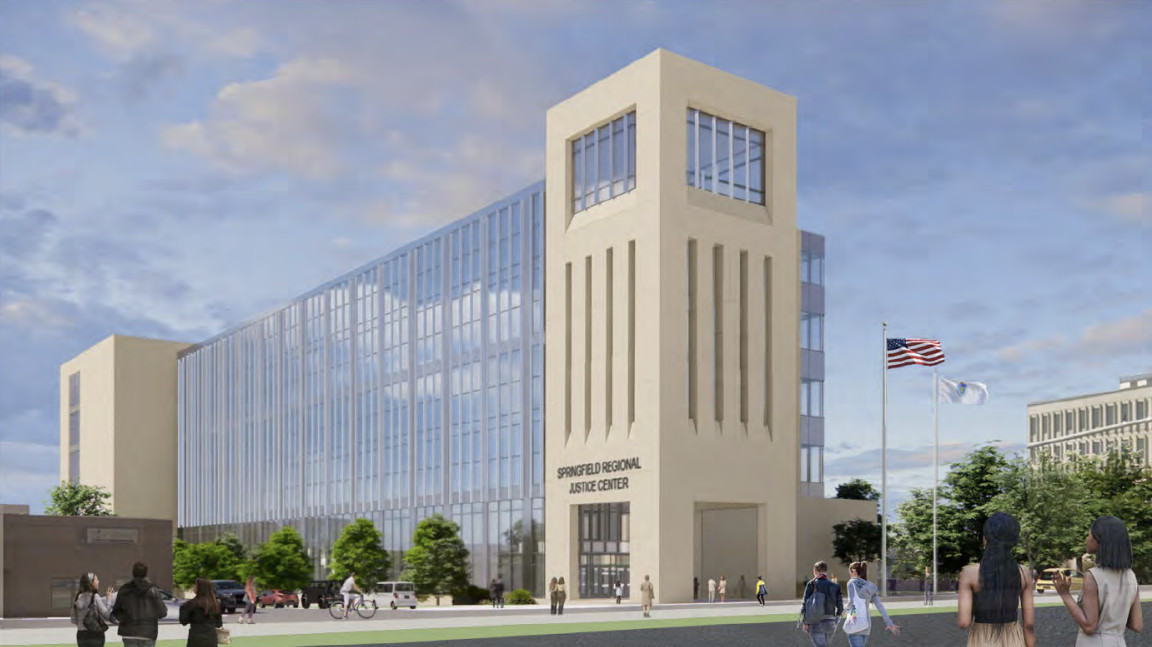
Liberty Junction: Don’t stop…believin’! (DCAMM)
Liberty Junction has also tried to chip away at the opposition within Springfield itself. Last week at Rebecca Johnson school, the developers held a public meeting and billed leaders in the Black community as hosts.
While carrying the air of an endorsement event, it was plainly an attempt to secure backing from a politically influential bloc within Springfield. No community speaks unanimously, but the African American community has become visibly fractious in recent years, politically speaking. Here, Liberty Junction seemingly spanned several divides to garner support from nearly all Springfield’s Black electeds, the local NAACP and other community leaders.
Whether this will hold back the political tide is uncertain. State Rep Bud Williams, who emerged from another bruising primary in September, is the first member of the city delegation to endorse Liberty Junction. While much the economic and structural impact of the courthosue will be in Springfield, it is not a city project. Its constituency is not confined to the city’s 33 square miles. Rather, it fans out from Tolland to Holland, the breadth of Hampden County.
DCAMM and Liberty Junction did score a minor legal victory in recent weeks though. Though he did not stay discovery, he agreed to a protective order. That means the parties and their counsel cannot share what DCAMM and Liberty Junction produce. The parties have not submitted a proposed order to Hodge yet although the filings suggest the defendants believe some of the plaintiffs’ request traipse into confidential commercial material. The order would likely only keep any covered materials from public view until they became part of later filings.
In other words, the odds of public disclosure of information that does not flatter the Commonwealth or Liberty Junction are unlikely before further filings in the case. From Balise and Patel’s point of view that may not help the PR offensive. On the other hand, it has not really been the plaintiffs’ practice to leak what discovery they obtained. They usually just attached it to briefs in court.
Even if the courthouse fight has probably not influenced the gubernatorial election much, the campaign provides context. If Balies and Patel were hoping to make Healey sweat, they only really succeeded in annoying Democrats. Most would rather be focusing on winning Congress. Minogue into making clownish appearances along Liberty Street in Springfield and vapid declarations during debates did not move the needle.
Likewise, DCAMM and Liberty Junction would be foolish to breathe a sigh of relief if Healey wins reelection. The campaign will continue as long as Balise is willing to finance it. Public disappointment will not evaporate overnight. The Commonwealth and Liberty Junction still need to win more people over. That assumes the courts ultimately rule in their favor.
Election Day might bring some data that nudges more Hampden County pols into one came or another. However, given the meteor seemingly heading toward Republicans nationally, it could be easy—and naïve—to overread a large Healey victory in and around Springfield as the electorate’s ratification of Liberty Junction.
Unlike the battle for Congress, the campaigns over where Springfield’s new courthouse are unlikely to end this week.