State Seeks Dismissal in Courthouse Case; Plaintiffs Revise & Extend Complaint…
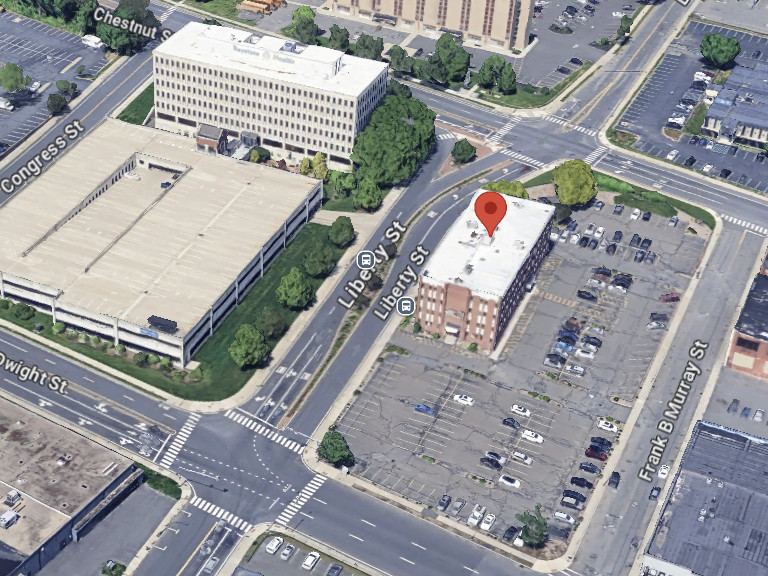
Give Springfield Liberty or Give it…what? (via Google Maps)
Just over two weeks ago, Superior Court Judge David Hodge refused to enjoin lease negotiations between the Division of Capital Asset Maintenance & Management (DCAMM) and Liberty Junction, the winning bidder for the new courthouse in Springfield. The unsuccessful bidders who brought the suit were clear that the case was not over.
Since then, DCAMM, through its lawyers with the Massachusetts Attorney General’s Office, have moved to dismiss the case entirely. However, the plaintiffs, USPB JV, LLC and Springfield Tower Square, LLC filed a notice of appeal. On Wednesday, they filed an amended complaint with new allegations. The tone indicates the plaintiff also think Hodge’s ruling had not fatally wounded their case.
“The information that has come to light goes well beyond any one issue with the winning proposal, and it only deepens our concerns about how this nearly $2 billion decision was made,” James “Jeb” Balise and Dinesh Patel, the owners of USPB JV and Springfield Tower Square respectively, said in statement.
“The people of Hampden County and the Trial Court employees who will depend on this courthouse for decades deserve a safe, modern facility, and confidence that the process was fair, complete, and lawful. We intend to keep fighting for both,” they continued.
The new complaint appears to take aim at DCAMM’s emphasis on cost after ostensibly disclaiming it as a determinative factor.
Liberty Junction was not impressed with the plaintiff’s new complaint. In a statement, the group slapped the plaintiffs for not seeking an emergency appellate hearing and then for refiling their complaint before an appeal played out. The developer ribbed the plaintiffs for touting how USPB JV’s proposal was more economical while decrying DCAMM for highlighting the price of Liberty’s Junction’s proposal.
“Liberty Junction once again calls on the losing bidders to stop these delaying tactics for the sake of all those who work in and use the Roderick L. Ireland Courthouse,” the group said in a statement. “Liberty Junction will continue to move forward with the Commonwealth on the DCAMM process. It is past time for them to put people above profit and stop standing in the way of a new, safe justice center.”
DCAMM announced Liberty Junction had won the bid to build the new Springfield Regional Justice Center on July 2. USPB JV and Springfield Tower Square sued on July 9. They alleged the involvement of John Barros, the interim head of the state convention center authority, tainted the entire process.

No more yielding than a dream? (DCAMM)
Judge Hodge telegraphed his skepticism of the case clearly in his August 24 ruling. Yet, it the decision may not have been slam dunk for DCAMM and Liberty Junction. His opinion certainly left space for DCAMM’s motion to dismiss. However, Hodge’s opinion went no further than saying the plaintiffs had not shown much likelihood of success.
Hodge had all but said the plaintiffs’ claims about violations of state ethics law were hopeless. However, he did not dismiss out of hand the notion that certiorari could apply to a selection process like DCAMM’s. To the contrary, Hodge indicated that certiorari, a means to review arbitrary and capricious government action, may apply here.
Not surprisingly, DCAMM’s motion to dismiss echoes its arguments against the injunction and Hodge’s ruling. It cites the opinion no fewer than six times, especially to attack the claim based on state ethics law.
“As this Court observed, ‘[t]here is no legal or logical support for the plaintiffs’ convoluted theory that DCAMM somehow violated G.L c. 268A, § 7, in the procurement process and that ‘Barros went above and beyond in ascertaining and then fulfilling his obligations under § 7,’” DCAMM’s motion argues.
DCAMM tries to slide past the gap Hodge left open on certiorari. The agency suggests, as it had before, that the claim had not been used against awarding authorities. Furthermore, DCAMM states that there are other means to challenge the award and that no lease has been signed.
The motion also argues that the declaratory judgment claim is also improper. The brief spends several pages describing it as unavailable in a suit against the Commonwealth. DCAMM also claims the plaintiffs have not articulated what law DCAMM violated.

Welcome aboard, Mr. Secretary. (via mass.gov)
For their part, the plaintiffs read Hodge’s ruling and revised their complaint accordingly. They also bring in new defendants. Plaintiffs added Asset Management Board (AMB), which approved the lease process for the courthouse, Secretary of Administration & Finance Matthew Gorzkowicz and DCAMM’s commissioner, Adam Baacke.
The revised complaint, filed Wednesday in Hampden Superior Court, does not abandon the allegation of ethics law violations. Instead, it implies any such breaches were part of a broader constellation of failures—or deliberate omissions—that unfairly led to the quiet selection of Liberty Junction before a holiday.
“After publicly touting the announcement that opened bidding on the project, the long-anticipated announcement of the SRJC award was tossed into a news dump on Thursday, July 2, 2026—just before Commissioner Baacke shut down the office for the three-day July 4 holiday weekend,” the amended complaint reads.
This new complaint makes clear the jurisdiction arises from the incorporation of ethics law into the bid. It alleges multiple failures on the part of DCAMM, Secretary Gorzkowicz and Baacke to properly handle the ethical obligations.
The plaintiffs claim DCAMM restyled its decision as cost-based after a “a high-level war-council-style meeting of state officials.”
Among the newer elements of the complaint is an allegation that the AMB did not make the necessary written findings when it authorized a lease for the courthouse and set aside certain procurement rules. The plaintiffs now also zero in on DCAMM’s promise to consider multiple factors when selecting a developer. Rather, they allege, DCAMM now claims the deciding factor was cost. They cite affidavits DCAMM and Liberty Junction submitted earlier in the case to emphasize an apparent shift toward cost as a primary metric used to choose a developer.
In terms of bulking up the ethical violations, the complaint relies on documents the plaintiffs have since obtained via public records requests. The plaintiffs stitch together a timeline of events and alleged omissions to raise questions about the propriety of the bid. These also serve to keep alleged ethical issues in the public conversation.
The plaintiffs also raised a claim in mandamus, a judicial tool used to order the executive to take mandatory actions. This count targets AMB’s alleged failure to issue written findings. The amended complaint also draws AMB into the certiorari claim alleging it also abused its discretion. The original complaint—and the amended one—had claimed DCAMM acted arbitrarily and capriciously.
The plaintiffs also hang on to the declaratory judgment claim. As in the original complaint, the plaintiffs seek injunction relief, too. However, there is no fresh motion for an injunction.
That may not be necessary, at least not yet. Despite the appeal, the plaintiffs were philosophical when Hodge refused their request for a preliminary injunction. They were already looking ahead to discovery. It is possible that as long as Balise and Patel are extracting information, depositions and documents from the defendants, Springfield’s new courthouse will remain on ice.
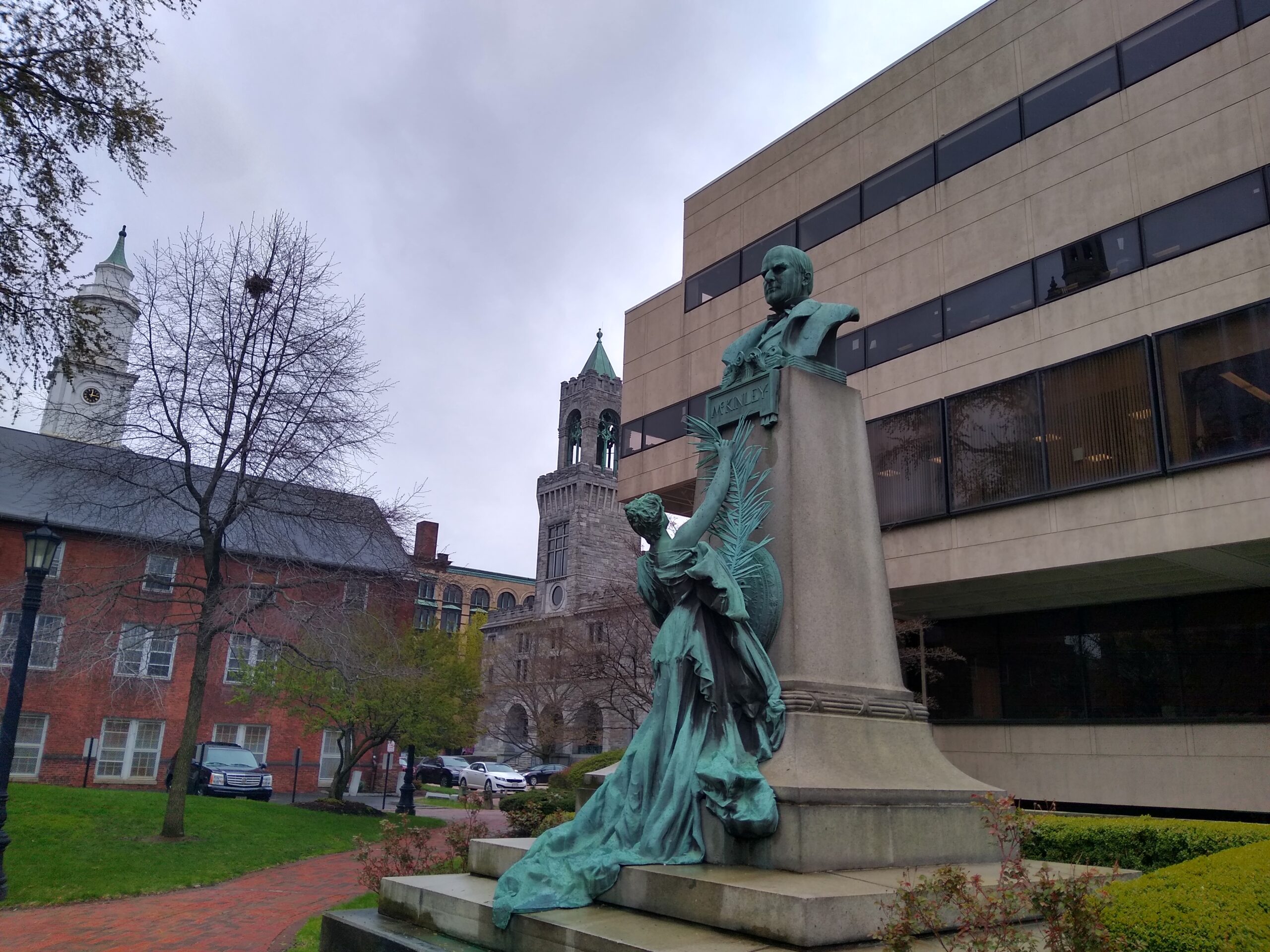
The next steps to move out of the old courthouse(s) may be out of reach. (WMP&I)