Disorder in the Courthouse Bid? Suit Challenges Process to Pick Springfield Justice Center…
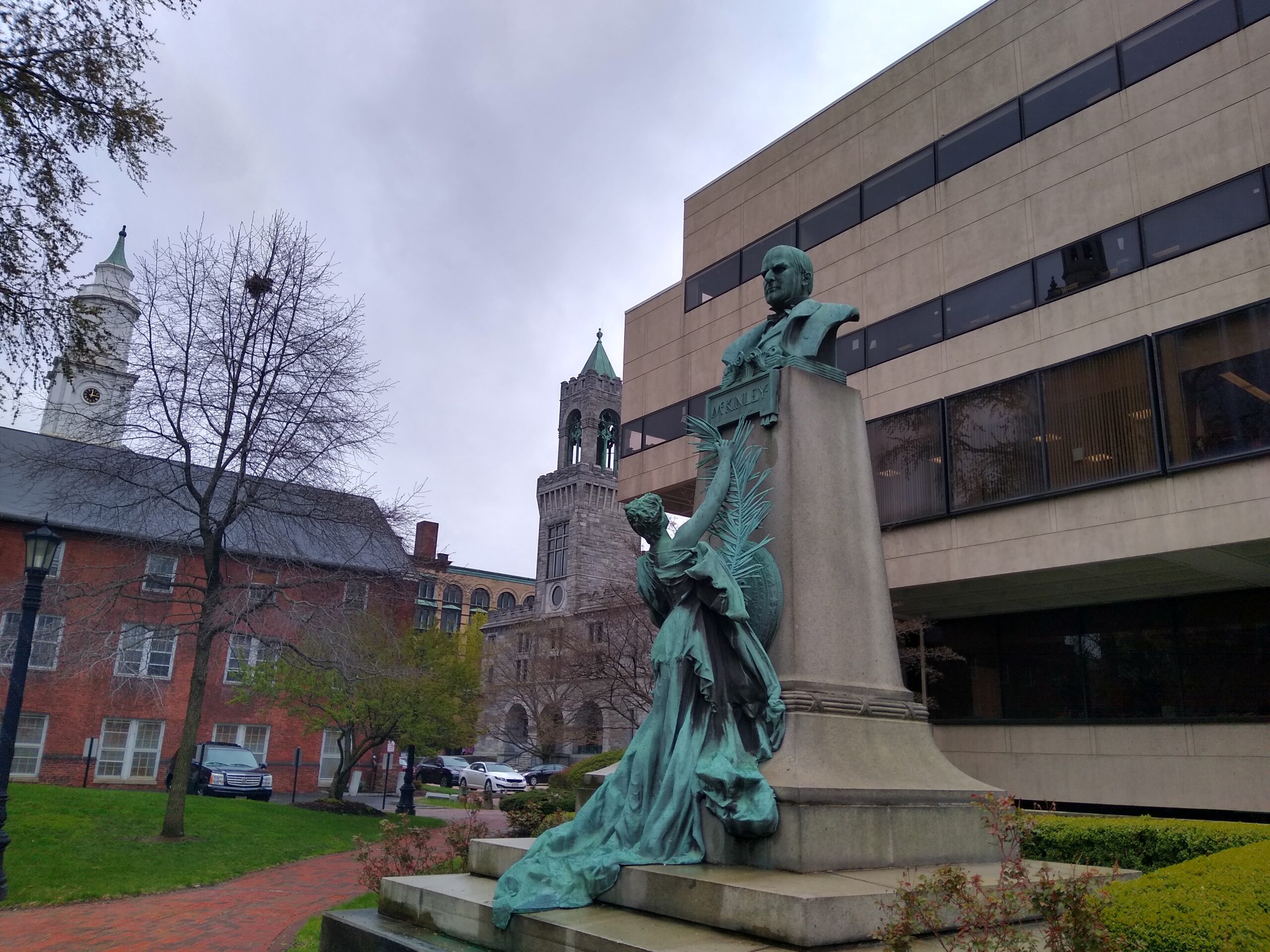
The Commonwealth and Liberty Junction may have to reach past a court case at the current courthouse before work can begin, if ever. (WMP&I)
When Liberty Junction was selected as the developer for the new Springfield Regional Justice Center, it seemed likely that the unsuccessful bidders would go quietly into the night. The invective and rending of garments was a job for the pols. The choice disappointed losing bidders, but it was not expected that they would take action against the choice.
Such was not the case.
A week after the Division of Capital Asset Management & Maintenance (DCAMM) chose Liberty Junction, two unsuccessful bidders retained a major law firm and filed suit. In a four-count complaint, Springfield Tower Square, LLC and USPB JV, LLC allege the state failed to follow its own rules and improperly selected a developer whose owners include a prominent state employee.
In a statement released on the day the suit was filed, Dinesh Patel, the owner and listed manager of Springfield Tower Square, and James E. “Jeb” Balise, owner of USPB JV, emphasized the project’s 40-year length and the need for fairness and transparency.
“Springfield has always been ready to compete on the merits, and today two of us who competed hard against each other are standing together, because this is bigger than any one bid,” Patel said. “We’re asking the court to press pause so Springfield gets the fair, honest process it deserves.”
Balise, whose family owns car dealerships of the same name, alluded to the Balises’ decades of investment in the region.
“I got into this for one reason: the good of Springfield.” Balise said, emphasizing the impact the downtown courthouse would have on the city. “This is not an effort to stop Springfield from getting a new courthouse. It is an effort to prevent the Commonwealth from locking taxpayers into a 40-year lease before serious questions about the award are reviewed.”
DCAMM declined to comment, citing the litigation.
The Plaintiffs hired WilmerHale, an international firm co-headquartered in Boston. They seek to enjoin DCAMM from negotiating a lease with Liberty Junction pending the outcome of the litigation. A hearing originally scheduled for July 16 is now set for August 11.
Liberty Junction’s proposal calls for building the new Hampden County courthouse. It will house all Springfield-based courts and county offices—at 125 Liberty Street. Just north of Union Station, renderings depict an L-shaped structure where the Liberty Medical Arts Building now stands. The project includes purchases of adjacent buildings for ancillary development and parking.

Executive malfunction for Barros and his CoJo’s role in the new courthouse? (via bc.edu)
Liberty Junction is a joint venture between Virginia-based FD Stonewater and CoJo Real Estate, LLC. The “Jo” is John Barros, the interim executive director of the Massachusetts Convention Center Authority (MCCA). His name and face were on the proposal’s documents. The Boston Business Journal reported his involvement on July 2, the day DCAMM announced its selection. The “Co” is Conan Harris, the husband of Boston Congresswoman Ayanna Pressley
Despite misgivings from some, DCAMM had shifted the Springfield project from a state-owned endeavor to a leasehold with a private developer building and owning the courthouse. An early concern was that the process might favor absurd ideas like motorcoach mogul Peter Picknelly’s Riverfront North proposal. Indeed, Picknelly’s loss was the focus of Springfield Mayor Domenic Sarno’s lamentations after Liberty Junction’s selection.
Others simply grumbled that a Boston developer, not a local one, got the bid. DCAMM said Liberty Junction was the least expensive option and promised the fastest delivery.
Patel and Balise argue something else was afoot. Their suit emphasizes the incorporation of ethics rules into the bid. That may become the plaintiffs’ best argument.
In choosing WilmerHale, they are arming themselves with considerable—and expensive—legal firepower to do battle with the state. The fruit of a 2004 merger between a Boston and a Washington firm, the Hale part employed Joseph Welch. He was the attorney whose “Have you no decency, sir?” riposte helped cut down Senator Joe McCarthy. WilmerHale is also one of four law firm Donald Trump’s executive orders target—along with half of the Bill of Rights.
The firm also has a substantial government contracts business. Its services range from protesting bids to procurement counseling and litigating contracts. Its clients include Apple and Harvard University. The firm represents AI firm Anthropic in a lawsuit with the Pentagon. The Wilmer half of the firm was heavily involved in contracting disputes arising from the Big Dig in Boston.
WilmerHale’s Boston office at 60 State Street. (via WilmerHale)
Nor has this case fallen to junior associates. The first attorney on the complaint, Felicia Ellsworth, a partner who heads the Boston office, is a vice-chair of the litigation department. She was part of the team that successfully defended the New York Times during former Alaska Governor Sarah Palin’s 2025 defamation trial, including the cross-examination of Palin. She has faced off with the Massachusetts Attorney General’s office, defending tech clients like Lyft and Meta.
As for the case itself, there may be real risks for DCAMM and Liberty Junction. The four counts against DCAMM and, nominally, Liberty Junction itself, are violations of state ethics law, certiorari, declaratory judgment and injunctive relief. Formally speaking, the latter two refer to types of relief. However, the first two are the substantive claims.
Over 14 pages, the plaintiffs lay out the procurement process, DCAMM’s promises and actions and Liberty Junction’s selection. The complaint remarkably details plaintiffs’ public records requests. That is, it essentially invites others (read: media) to request the same.
The complaint implies Barros’ MCCA position gave him an unfair advantage. A longtime community and real estate figure who ran Boston’s economic development office, Barros became the MCCA’s interim executive director in January. The MCCA runs the convention centers in the Commonwealth’s largest cities—including Springfield—and other assets like the Boston Common parking garage.
Liberty Junction submitted its bid a few months before Barros joined the MCCA. The complaint notes that Matthew Gorzkowicz, the Secretary of Administration & Finance (ANF), sits on the MCCA’s board. The ANF department is the parent agency of DCAMM.
One document the complaint alludes to is Barros’s 2025 statement of financial interest (SFI). He filed it as MCCA interim executive director. WMP&I obtained the SFI from the Ethics Commission. However, Barros did not list any offices or ownership for CoJo, his group that was part of the Liberty Junction joint venture. Incorporations documents on file with the Secretary of the Commonwealth’s office list him as a manager, yet the file also notes an involuntary dissolution for CoJo. A spokesperson for the Secretary’s office indicated that a failure to file two years of annual reports likely caused the dissolution. Either way, CoJo remains real enough to be part of a bid for the new courthouse in Springfield.
Barros did not respond to an email requesting comment. The Boston Globe obtained an ethics disclosure Barros filed with the Ethics Commission that states Liberty Junction won the contract, but describes himself as a passive investor.

Not off track yet. (DCAMM)
Despite the legal firepower and the complaint’s rhetoric, Springfield Tower Square and USPB JV’s case will not want for challenges. The plaintiffs may struggle to sustain the count premised directly on state ethics law. Indeed, Massachusetts courts have usually found only the Ethics Commission can enforce the law and by extension its provisions that can void tainted official action.
The certiorari claim may fare better. Certiorari is a judicial mechanism to challenge government actions absent specific means of appeal. While it is often used to challenge land use decisions in municipalities, it can apply to the state as well. Here, if the plaintiffs can establish DCAMM bound itself to broadly apply state ethics law but failed to do so, the selection may be void.
The complaint notes that on August 29, 2025, DCAMM added a provision that ostensibly incorporated state ethics law into the courthouse bid. It notes an independent obligation of the Asset Management Board (AMB)—the entity that approved the courthouse lease process—to prevent windfalls and conflicts of interests. Moreover, the language arguably broadens enforcement beyond the Ethics Commission.
“DCAMM has interpreted this requirement to mean that there might be certain cases where an individual or a firm may be precluded from joining a potential development team during the proposal submission phase on an AMB-approved project based on work performed for DCAMM – even if the ethics commission may not come to the same conclusion based on M.G.L.268A,” the addendum 5 reads.
Still, in full context, this appears to be about DCAMM employees and contractors it used for the bid. It may not extend to a quasi-independent body like the MCCA and its employees. Nonetheless, it could be the hook the plaintiffs need to sustain the suit and potentially win a temporary restraining order.
Even if that succeeds, it is a far cry from reversing the selection. There may be other mechanisms to halt progress as the negotiation process between DCAMM and Liberty Junction goes on, though.
However earnest Patel and Balise’s calls for fairness and transparency are, throwing sand in DCAMM’s gears has benefits. The Republican reported on an analysis that identified three finalists: Liberty Junction, USPB JV and—bizarrely—Picknelly’s plan. Riverfront North was already on the outer periphery of qualified, but the newspaper’s report also grades Liberty Junction poorly.
The highest-rated of those three? Balise’s USPB JV.