Take My Council, Please: Youth Commissioning in Revolt…
Déjà vu? (WMP&I and Google images)
SPRINGFIELD—The first City Council meeting of June featured an agenda of the usual fare. Grants and orders were plentiful but typical. There was an appointment to the Springfield Redevelopment Authority (SRA), one of the few positions where the Council has a gatekeeper role. However, there were two other items on June 1 that speak to the Council’s past and present.
The body considered an ordinance to revamp and therefore revive the Youth Commission, a body of young residents that addresses issues of importance to their generation. Councilors love the mission but were wary of losing influence over any appointments. Meanwhile, the Council sent a resolution on unrepaired sidewalks that evidenced some of the body’s internal politics.
At-large Councilor Jose Delgado was absent. Councilors Malo Brown and Brian Santaniello participated remotely.
The body began the meeting with acceptance of reports from the Environment & Sustainability, Finance and Health & Human Services committees. Of note, Community Preservation Act grant presentations will begin on June 22.
Asiala Rivera was before the Council for confirmation to the SRA. She received a wave of praise from councilors who would later approve her appointment unanimously. The SRA is among a handful of appointments not subject to the charter and thus requires Council confirmation.
Comptroller Pat Burns presented the April revenue and expenditures report. The city is on track to where it should be for that point of the year. Small grants for the Elder Affairs, Libraries and Parks & Recreation departments passed without dissent.
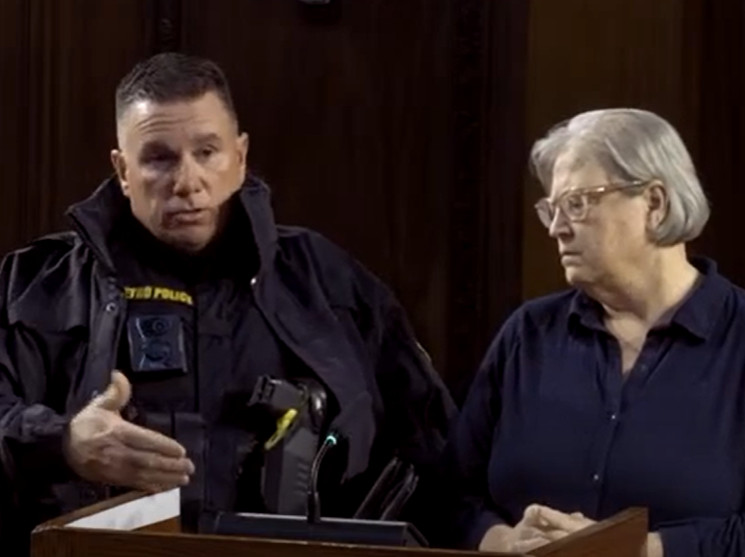
McCafferty seen here in 2024 with Lt. Brian Eliot. (still via YouTube/Focus Springfield)
The city is beginning to receive its annual US Department of Housing and Urban Development grants. Among those before the Council last Monday was $322,650 for the emergency solutions grant that addresses homelessness. Housing Director Gerry McCafferty said it would address seasonal needs and street outreach. The $1,461,823 HOME grant funds rental and homebuying programs. The Community Development Block Grant (CDBG) is $3,681,050 and covers a wide range of programs. All three were accepted without dissent.
The final large grant was the $10,358,841 Continuum of Care grant. This also focuses on homelessness with some rental assistance programming as well. McCafferty noted that the current regime in Washington had tried to reshape this grant into a competitive one but a court blocked that. Consequently, the previous year’s grantees were simply re-upped. The Council accepted it unanimously.
The Council approved the transfer of the $121,430 in franchise fees from Comcast to the city’s public access programmer, Focus Springfield. Another transfer was for $12,920 from free cash was to cover expenses the city hopes to recoup from the Environmental Protection Agency.
There were several more transfers from free cash. One was a $121,500 transfer to various departments to cover various rising costs. Another $625,000 transfer addressed rising workers compensation and health insurance costs for employees. A final $800,000 transfer funds a new contract for firefighters. All received councilors’ assent.
The Council approved a $5,865,610 reallocation of bond proceeds from 20 different projects for use on 15 other projects. The original projects, which mostly related to school reconstruction, ended up requiring less than the city borrowed. Among the larger ticket items on the list of projects receiving funds are 1,486,941 for the Franconia clubhouse, $623,459 for the Walker Grandstand in Forest Park and $520,000 for windows at Central High School.
Chief Administrative & Financial Officer Cathy Buono presented the acceptance of a grant of land near the end of Longhill Street. The property is not developable but has a sign welcoming people to Forest Park. Buono explained that the current owners, Concerned Citizens of Springfield (CCS), could no longer maintain it. The Parks Department said it would take on the property.
This led to an odd exchange with Councilor Brown who asked whether the public was given a chance to bid on it. Buono replied that the city had no control over what a private landowner wishes to do with property. Still, Brown insisted that there should be a process to allow an individual to buy it. For this to happen, the city would need to seemingly renege on any representations it made to CCS.
The transfer passed without dissent.

Buoniconti all but said it was up to the Council or accept the restructuring as offered. (via Springfield City Hall)
City Solicitor Stephen Buoniconti presented the proposed Youth Commission ordinance. He described the push to revive it as an initiative of Health & Human Services Commissioner Helen Caulton-Harris. The membership would increase from 11 to 17 with staggered terms. The youth members would rise to 11 from the current seven. The membership of officials—or their designee—would now include the vice-chair of the School Committee and the Commissioner of Health & Human Services. The mayor’s office would appoint a designee as well, replacing the Council President’s designee under current law.
The ordinance would shift the age range of youth members from those aged 18 to 21 to those enrolled in city schools. The bill also updates the Commission’s scope to cover modern concerns of young people like mental health, food insecurity, social media, relationships.
The Council generally agreed with bringing the Youth Commission back to full force. However, there was reluctance to see the role of the Council President—and by extension the Council—diminish. There was also concern about the mayor’s role in choosing the student members.
It quickly became clear the item would go to committee. That was not before an extraordinary moment—well, it shouldn’t be extraordinary—where Buoniconti essentially told Ward 1 Councilor Maria Perez the Council can construct the Commission how it deems fit.
“The City Council has full authority as a legislative body of the city makes any changes to the ordinance of the city which is the city’s local laws,” he said. “So as a result, even if you don’t have a role in a commission, it’s your authority to either amend or change the ordinances themselves.”
Brown seemed to inquire again about the Council’s authority before urging that the bill be amended to re-include the Council. When Council President Tracye Whitfield suggested Brown review the bill and propose language while others debated, he demurred.
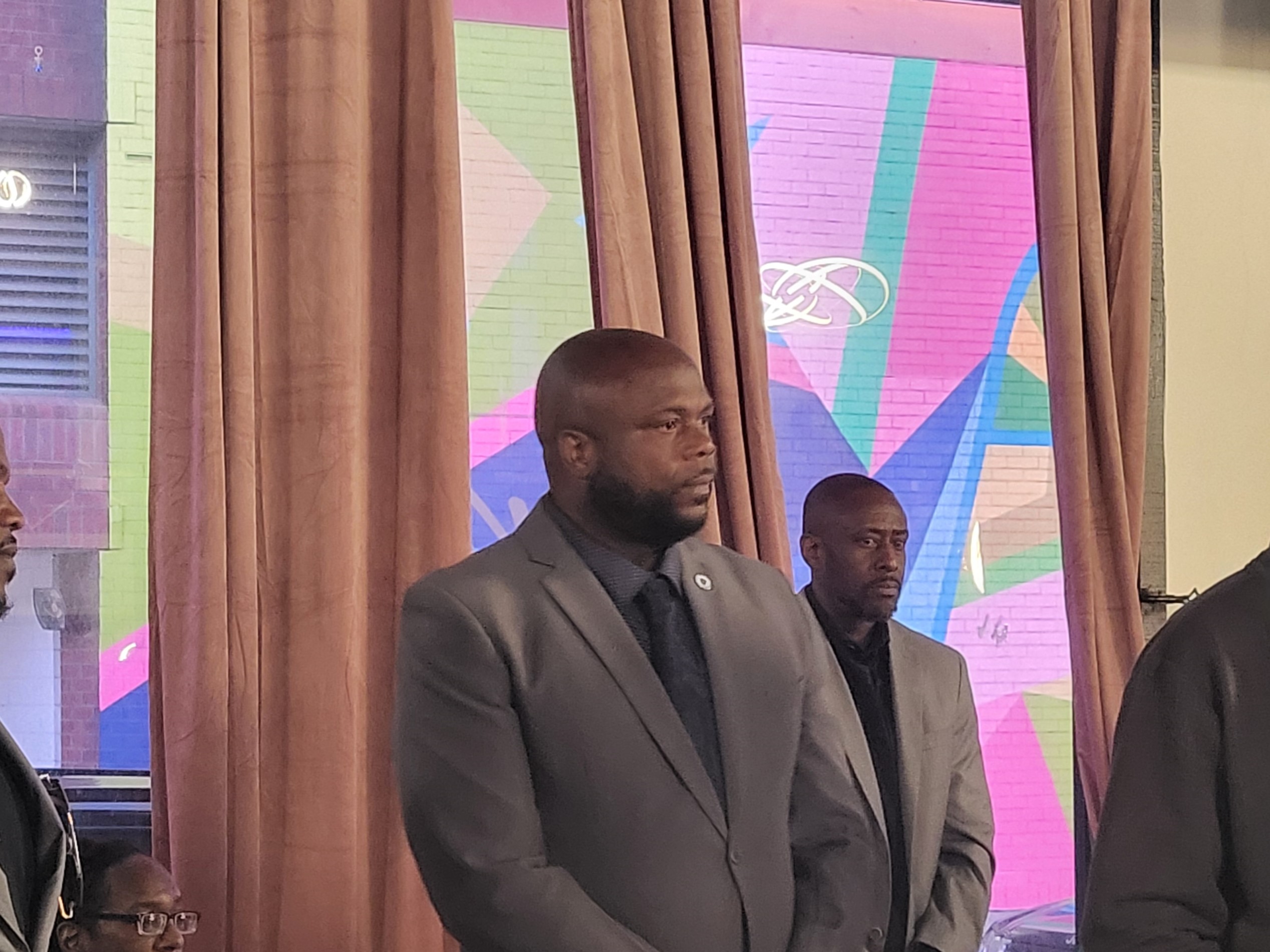
Brown is known to say he writes legislation as part of his day job. (WMP&I)
“I would defer probably to one of my colleagues to do it because I’m sure a lot of them are interested in” moving an amendment, said Brown, who is formally the chief of staff to a state representative.
Ultimately, the item moved to Committee without dissent.
The final item was a resolution put forward by Ward 7 Councilor Gerry Martin. It call for sidewalk reconstruction in East Forest Park. Martin claimed that several sidewalks remained unrepaired from the 2011 tornado, which had touched down exactly 15 years before that very meeting last Monday. Much of the damage was from overturned trees or from large repair and recovery vehicles. The resolution specifically mentions Wayside and Kipling streets, Surry Road and Roosevelt Avenue.
The city has a long sidewalk repair backlog and councilors noted that other areas of the city need attention, too. There was no outright opposition to the resolution, but rather some discomfort in focusing on one neighborhood. Some councilors lightly chided Martin for only addressing Ward 7’s sidewalks, yet his resolution focused on specific streets.
Martin’s resolution went to committee unanimously.
What haunted this debate was the fraught politics of sidewalk repair in Springfield. Because of the city’s limited resources, there are essentially two tracks of sidewalk repair. One is through bonding, which the city takes on itself. The other is using funds like the CDBG allocation.
The problem with using CDBG is the city can only direct them to less wealthy areas. The result is that usually when big sidewalk repair blitzes happen, the side left out complains. Councilors representing poorer neighborhoods raise objections that the city doesn’t borrow to fix their sidewalks. Councilors from better-off areas grouse that the intricacies of grant rules do not impress their constituencies.
(WMP&I)
That this familiar dispute surfaced again is not really a bad sign. It could be read as a reminder of the pettifoggery that has immobilized the Council in recent years. It may also be normal political churn. Either way, residents should eye it carefully.
At the same time, the invitation to take more control as with the Youth Commission ordinance is a callback to the Council’s brief period of interventionism. That period ended more than six years ago. One could suspect the substitution of the mayor’s office in the bill is a classic Domenic Sarno power move. However, the Law Department does not seem eager to relitigate the Council’s authority. Will the Council relearn its history and reassert itself once more?