Plaintiffs Aim to Breathe New Life into Noho Divestment Suit with New Complaint…

Class not yet dismissed at Hampshire Superior Court? (WMP&I)
Over a month after a Hampshire Superior Court judge dismissed the case, plaintiffs seeking to void a Northampton City Council action that urged municipal divestment from Israel-connected assets are going back to court. Opponents of the Council’s September 2025 resolution hope a recent Supreme Judicial Court ruling and a new complaint will be enough to revive the suit. However, obstacles remain. Moreover, the city argues the SJC’s ruling changes little.
When Judge Charles Groce, III dismissed the case, he found that the 10 Northampton citizen plaintiffs lacked standing. The statute they used applies to government action involving expenditure of funds. Groce indicated the indirect or hypothetical expenditures of complying with the resolution were not enough. The plaintiffs now counte the SJC has found otherwise.
“The judge had dismissed the case only based on standing, and our amended complaint includes newly alleged facts that directly respond to the judge’s comments regarding sufficiently demonstrating misuse of municipal funds,” said Rachel Sebbag, one of the plaintiffs’ attorneys and litigation counsel with the National Jewish Advocacy Center.
Those changes are aimed at hooking onto Fitzmaurice v. City of Quincy, a case the SJC decided in August. While it concerned Quincy’s plans to purchase icons of patron saints of police and firefighters, it touched on the same 10-citizen statute that the Northampton plaintiffs have attempted to use. (The SJC ruled against the city and upheld an injunction against the statues’ installation.)
The case in Paradise City arose from a nonbinding resolution the Council passed last year. Citing the devastation in Gaza arising from Israel’s prosecution of its war against Hamas—who had in turn murdered over a thousand Israelis on October 7, 2023—councilors called for divesting municipal funds from various assets with ties to Israel. Specifically, it calls for withdrawal from companies with “complicity” in various human rights abuses against the Palestinians.
In their 10-citizen suit, a group of Northampton residents claimed the resolution violated state law and traipsed into the feds’ foreign policy prerogatives. Groce’s ruling only touched on whether expenditure of funds was too vague to sustain the suit.
The amended lawsuit is part of a motion to alter judgment or otherwise grant leave to file a new pleading. The proposed complaint tightly hews to the 10-citizen statute and frequently cites to the SJC’s August decision.
“Fitzmaurice is binding precedent that was overlooked in this case, and supports our clients’ position that the of the City of Northampton and its officials, before, during, and after the passage of the Resolution demonstrates an ongoing unlawful expenditure of municipal funds and incurring of obligations” that trigger the residents’ right to sue, Sebbag continued.
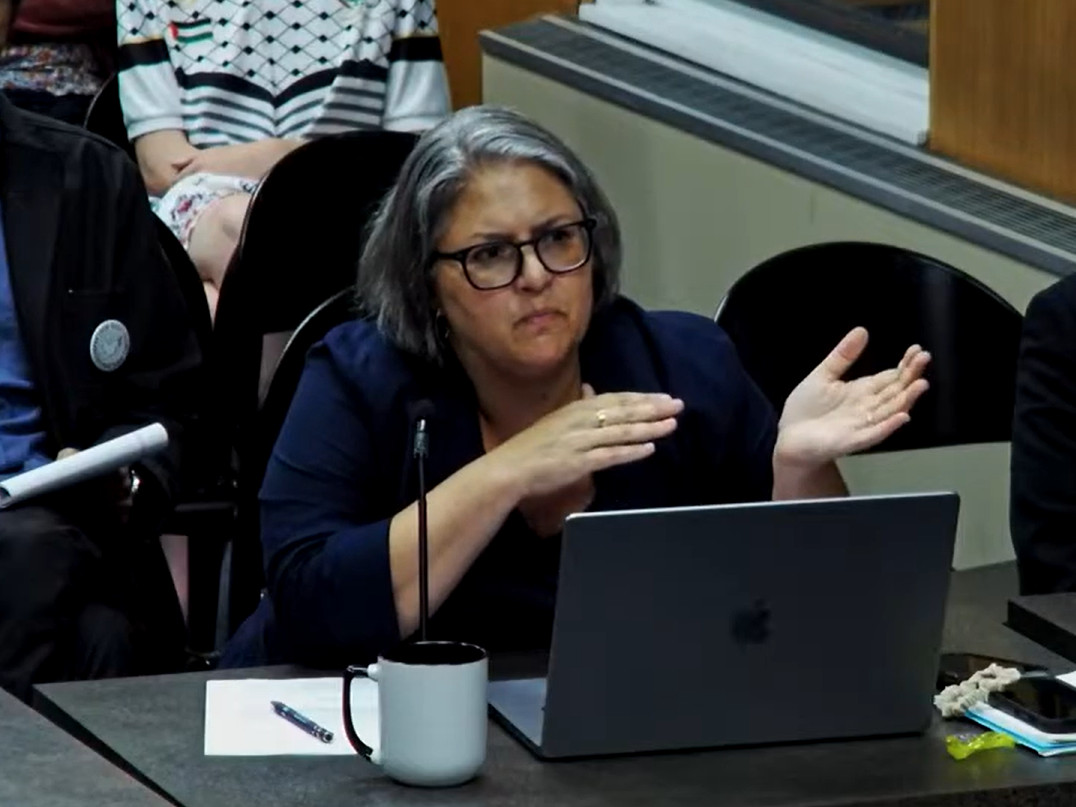
The plaintiffs’ smoking gun? Or just vibes? Sciarra at the Council on September 18, 2025. (still via YouTube/Northampton Govt Video Archive)
For the first time, plaintiffs clearly address actions that the city had taken or will take to implement the resolution. Specifically, it cites Mayor Gina-Louise Sciarra’s statements last year before the resolution passed. At the time, she indicated to the Council that the city’s investment manager was sensitive to concerns like those in the resolution. She added that the city no longer invested in some assets on a list the American Friends Service Committee compiled. These actions, plaintiffs argue, used city funds, thus permitting a 10-citizen suit.
For the most part, the specific legal claims are similar. The plaintiffs plead the 10-citizen suit more clearly. They still maintain that federal law still preempts the resolution and divestment. Still, the focus has shifted to allegations that compliance with the resolution conflicts with officials’ fiduciary duties as managers of city funds. The filing now argues that subordinating financial interests to political ones is not permissible under Massachusetts law.
The city’s legal team does not appear impressed.
“[O]ur pleadings state our position that the amended complaint, like the original complaint is lacking in merit,” said Jay Talerman a lawyer with the municipal law firm the city hired for its defense. “We are prepared to continue to defend the City accordingly.”
Alan Seewald, the Northampton City Solicitor, declined to comment.
In its opposition to the plaintiffs’ request to file the amended complaint, the city downplays Fitzmaurice’s impact. Acknowledging that the SJC’s ruling interpreted the 10-citizen law broadly, the city asserts there still must be some discrete action.
“There, the City of Quincy had already spent at least $761,378.75 to commission the challenged statues and anticipated additional expenditures to transport and install them, bringing the anticipated total to approximately $850,000,” the city argues. “Those expenditures were concrete, monetary, and directly attributable to the challenged municipal action.”
Northampton, by contrast, merely involved employees acting while paid their normal salaries and conducting routine administrative functions. That includes speaking with financial advisors. The city also cites cases that say hypothetical consequences do meet the threshold of the 10-citizen statute.
The proposed changes may be enough to get over the standing issue Judge Groce ruled on. However, it may not solve the lawsuit’s other problems.

Even if the Quincy case gives the plaintiffs a boost, Northampton’s defense may still have a lot to stand on. (WMP&I)
The resolution itself was nonbinding and did not require the mayor’s signature. The Council merely “urges” action. The resolution lacked any force of law. It may not have any nexus to the actions Sciarra said the city undertook. Sciarra had claimed last year the city pension fund was not invested in any of companies the resolution implicated. However, at least a fraction of the Northampton Retirement Board’s funds lie in the state’s asset pool. That may or may not include companies the resolution pertains to. The Retirement Board, which is legally distinct from the city, has taken no action since the resolution’s passage.
There is also still little evidence that the city took any steps to divest since September 2025. In response to a public records request, the city asserted this past August it had no records of the finance department’s adherence or non-adherence to the resolution. The city further claimed it had taken no action to follow (or not follow) the resolution.
The city highlights many such issues in the rest of its opposition. Although amended complaints are usually allowed, they can be blocked if futile, the city claims.
Northampton contends that there is no “sharp” conflict between Massachusetts laws and the resolution. That is necessary to trigger a state law preemption. It claims the plaintiffs vastly overread the state law establishing municipal money managers’ fiduciary responsibilities.
“The fact that the policies suggested in the Resolution may, if adhered to, narrow the universe of permissible investments or affect potential returns does not establish an irreconcilable conflict with statutory requirements concerning prudent investment, safety, liquidity, or yield,” the city states.
The city still takes on the federal preemption claim a bit more robustly. It emphasizes that the plaintiffs identify no federal law that preempts the resolution. It claims a 2000 US Supreme Court case that struck down a Massachusetts law aimed at Burma, now Myanmar, addressed states trying to impose competing sanctions. That, the city claims, is far afield from a municipality investing as it wishes.
The defendants’ opposition does not seriously contest plaintiffs’ claims about Mayor Sciarra and her administration’s action, though. That may explain why the city’s brief characterizes such actions as ho-hum check-ins with advisors rather than claim nothing has happened.
Déjà vu for Judge Groce? Or is plaintiffs’ complaint just a gross rehash? (via mass.gov)
It is a point the plaintiffs pounce on in their reply.
“Indeed, Defendants’ primary answer to Plaintiffs’ claims is a blanket denial that the challenged conduct occurred because of the Resolution; they do not dispute that the acts occurred,” the plaintiffs state.
They add that whether the resolution is truly nonbinding is a question for discovery. That may not be correct. However, discovery could uncover whether the city is actually acting on a divestment policy, whether due to the resolution or not.
The plaintiffs’ reply briefly defends the other claims, but the primary focus will likely be whether Fitzmaurice changed anything. If it did, the court will have to move on to the other arguments the city offered before and now, including the nonbinding nature of the resolution and City Hall’s speech rights.
The plaintiffs have requested an oral argument, although Judge Groce could decide to rule on the papers. No hearing has been scheduled as of posting time.