Take My Council, Please: Quite an Oversight and Foresight to See…
(WMP&I and Google images)
On April 13, the Springfield City Council took a few forward actions that could have significant implications for two neighborhoods. It granted a zone change to Temple Beth El’s property on Dickinson Street, which could yield significant housing development. Meanwhile, the body authorized funding for a new branch library for East Springfield.
The Council also greenlighted a five-year term for a School Department food service contract. The move came amid an audit that questioned the incumbent contractor’s performance. Councilors did not act on a resolution that encourages the city and state to work together on the impacts of the new courthouse. Instead, it went to Committee, despite the efforts of some advocates.
Councilors Malo Brown, Lavar Click-Bruce, Maria Perez, Brian Santaniello and Kateri Walsh participated in the meeting remotely.
After brief updates from the Audit and Environment and Sustainability committees, the Council moved to couple zoning items. One was a Planning Board referral. These are common during regular meetings and require no vote.
Less common is an actual zone change during regular meetings. However, Council President Tracye Whitfield explained that Beth El’s proposed zone change faced several postponements due to weather. Rather than make them wait, the Council heard the change at its regular meeting on April 13.
Ward 2 Councilor Michael Fenton recused himself as his firm represents Beth El. Indeed, a partner at Fenton’s firm, Ellen Freyman, outlined the temple’s plans. Like many congregations, Beth El has seen a decline in its membership. However, the temple, which has been on Dickinson since the 1950s, is not closing. Rather, it intends to develop the sprawling piece of land on which the sanctuary sits.
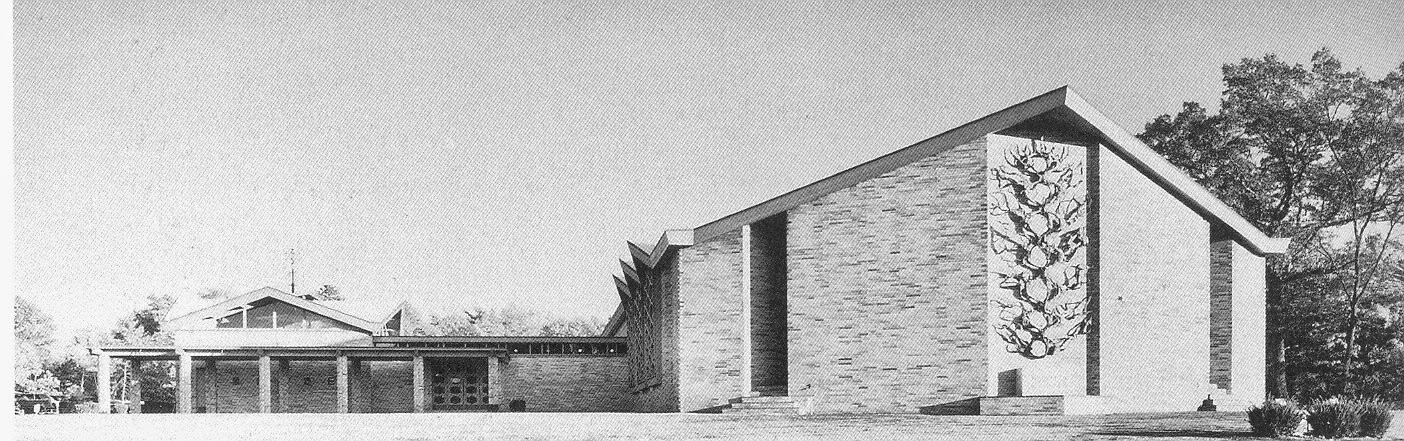
The first Temple Beth El building on Dickinson Street circa 1953. (tbespringfield.org)
Freyman explained that the congregation decided to put out a request for proposals for developing the land rather than selling it off. Reading from the RFP, she laid out Beth El’s goals.
“We’re looking for a developer who presents a design that envisions residential development that enables Temple Beth El to maintain its sanctuary and remains mindful and respectful of environmental impacts, create a vibrant residential community that coexists harmoniously with Temple Beth El and the neighborhood characteristics, creates amenity spaces and fosters community interactions,” Freyman read.
The temple had met with the Forest Park Civic Association and agreed to a concession. Originally, Beth El sought to rezone all of its land to allow denser housing. Instead, the temple agreed to maintain single-family zoning for part of the land to act as a “buffer.”
There was no public opposition and the Council granted the request without dissent.
Councilors unanimously authorized street work for Eversource to upgrade gas lines on Forest Glen Road. Technically, that road is in Longmeadow, but some Springfield right-of-way is affected.
The body also authorized $1 million in bonding for schematic design work to repair the roofs on Brunton, Boland and Van Sickle schools. It also approved payment of a $748.93 bill from a prior fiscal year. Chief Administrative & Financial Officer Cathy Buono said it was for software the city uses to track municipal operations.
The Council approved two items pertaining to the construction of a new East Springfield branch library on Osbourne Terrace. The entire project will cost over $12 million, however, nearly $7 million will come as part of the a capital grant from the Massachusetts Board of Library Commissioners (MBLC) .
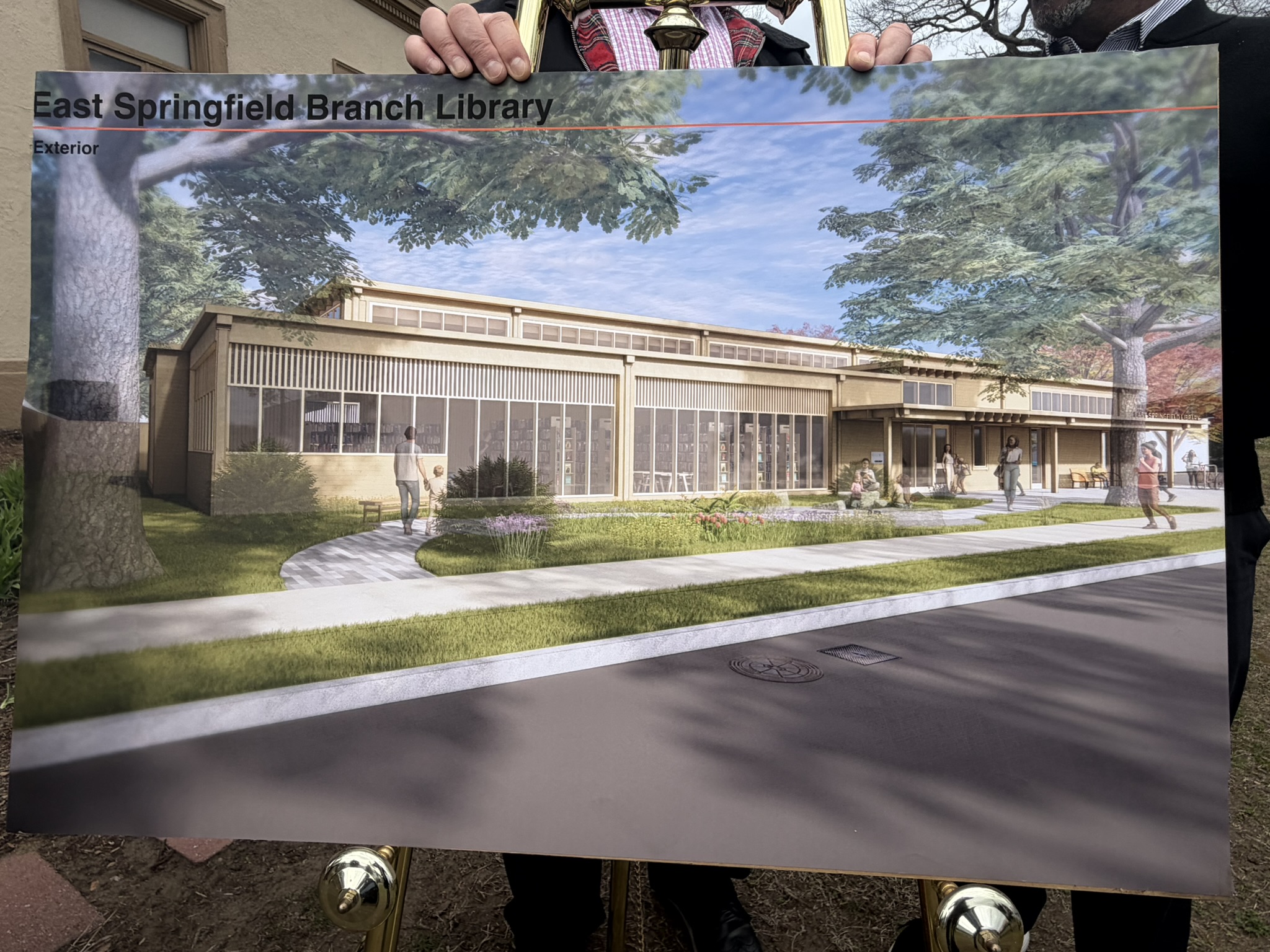
A rendering of the proposed library displayed at an announcement earlier on April 13. (via Springfield City Hall)
Springfield Library Director Molly Fogarty explained that the last time the city applied for this MBLC grant, it funded the new East Forest Park Library. The city also received a $500,000 federal grant to defray costs. Shortly before the meeting, Congressman Richard Neal announced the release of the grant that he had secured in the budget for the US Department of Housing & Urban Development.
Fogarty said the existing structure has about 3,000 square feet. The new one will be nearly three times as large.
Councilor Fenton, whose ward includes part of East Springfield, praised the project. He observed that other libraries in or near his ward have closed or downsized, namely the Liberty Heights and Pine Point branches.
“At that time, myself and others in the library administration identified definitely a need to focus on and invest specifically in this branch,” he said. “It’s one of the last neighborhood, true neighborhood branches that we have that’s on a residential street.”
The project is not without controversy. While not one of the city’s Carnegie libraries, the structure dates to the beginning of the 20th Century and has a distinctive style. Some preservationists have lamented its impending demise.
The city will bond for the full amount of the project and use the state and federal grants to defray the costs. The city will bear about $4.5 million of the project’s overall cost. Both the bond and acceptance of the state grant passed without dissent.
The city’s Health & Human Services Commissioner, Helen Caulton-Harris, presented a $250,000 grant from the Massachusetts Office of Disability. She told councilors it will pay for a self-assessment on the city’s compliance with the Americans with Disabilities Act. The city can apply for grants to make upgrades once the assessment is complete.
The Council spent little time on the courthouse resolution. The Commonwealth is selecting a site for a new courthouse in Springfield. The chosen developer will build it and the court system will lease it. This has raised questions about the relationship between the owner and the city. The resolution calls for the city to explore approaches to answer some of these questions.
Councilors raised questions about what the resolution was actually seeking. Despite pleas from Ward 6 Councilor Victor Davila, the resolution went to Committee on a 9-4 vote. He and Councilors Whitfield, Melvin Edwards and Zaida Govan dissented.

Schools CFO Roach said the longer term might induce more bidders on the food service contract. (via Springfield Public Schools)
The final item of the meeting last week was on the contract authorization the School Department was seeking. State law permits city departments to enter into contracts of up to three years. Longer terms require the body’s sign-off. While the School Department largely operates independently, the schools are subject to this law.
Patrick Roach, the School Department’s chief financial officer, described the request as a one-year food service contract with four one-year options. As that could total five years, Council authorization is necessary.
The request came amid a damning auditor’s report on the current food service contract with Sodexho. Last year, Director of Internal Audit Yong No found noncompliance with contractual commitments, “mathematical inaccuracies,” and a lack of transparency among other issues.
Superintendent of Schools Sonia Dinnall told councilors her department has put protocols in place to provide more oversight moving forward.
Roach explained a longer-term contract could make the contract attractive to other bidders. The city owns meal preparation facility and recipes, but a contractor hires, trains and oversees employees and operations. That up front cost may prompt other bidders to balk. The option would let the schools change course if the department is unsatisfied. Despite an apparent desire to boot Sodexo, it will likely bid on the contract again.
At-large councilor Justin Hurst, who chairs the Audit Committee, said he would back the longer term because of No’s work.
“Auditor No has committed to continuing to have oversight over whatever contract comes down the pike in the future,” Hurst said. “And so, because I trust Auditor No, and know that he’s going to do a good job and be a watchdog on behalf of the city of Springfield, I’ll be voting in favor of this tonight.”
Some councilors were reluctant to grant the longer-term authorization without a contract in hand. As he had in the past, Fenton voiced opposition to greenlighting a longer term before contractor selection.
“I don’t oppose the length of the RFP going out for five years,” Fenton clarified. Yet, he believed the statute envisioned more Council review. “I do think that the Council should have the final say in whether or not that contract, if over three years, is going to be entered into by the city. There’s a lot of money at stake.”
Ward 7 Councilor Gerry Martin concurred, saying the Council should not “walk away” from authority it has. Still, the authorization prevailed 10-3 with Councilor Brown joining Fenton and Martin in dissent.
Before the Council voted, Fenton suggested Roach allow President Whitfield to appoint a councilor to the oversight panel for the contract. Roach demurred, suggesting the timelines were already tight. However, he committed to doing what he could.

(WMP&I)
It might be glib to say that this meeting could be quite consequential for Springfield’s future. Neither East Springfield nor Forest Park may be radically remade by a library or a housing development. Yet, the fate of these could shape future of both places in the city.
Yet, the relationship the city has with contractors and the state—and/or its courthouse landlord—also speak to the city’s overall fate. How well City Hall manages complex liaisons speak to its ability to navigate a whole host of challenges.