How Western Mass Can (and Will) Get More Rail Service Comes into Focus…
Do not adjust your screen, but Compass Rail is coming into focus, starting with East-West rail. (via MassDOT)
Hourly service to New York was the headline out of the March 19 Massachusetts Department of Transportation board of directors meeting. Rail & Transit Administrator Meredith Slesinger turned heads when she announced that as a goal last Thursday. Yet the clarity she offered on the future of passenger rail in Western Mass more generally may have been more significant.
Slesinger said a lot more would need to happen before that hourly service can go forward. However, implementation of Compass Rail, which includes East-West rail, is advancing. While few of the projects the state’s top transit and rail bureaucrat mentioned are new, her presentation showed them coming together, however fitful the pace.
“Compass Rail is both a vision and a brand. I always like to say it’s a program of projects, not just one project,” Slesinger said. “The Inland Route is the most notable project advancing the expansion of Compass Rail,” she continued, referring to the route to New Haven from Boston through Springfield.
Perhaps what should stand out from that meeting was how state officials laid out the path forward for Compass Rail. However maddeningly slow process for East-West rail has been, things are moving.
Slesinger indicated—and MassDOT and its partners confirmed—how the pieces are lined up for initial service. East-West rail will lead the way, using the Inland Route. It will complement the Lake Shore Limited, a Boston to Chicago service that stops in Albany, Pittsfield, Springfield and Worcester. Yet, she also looked beyond those first trains and what needs to happen to add even more service.
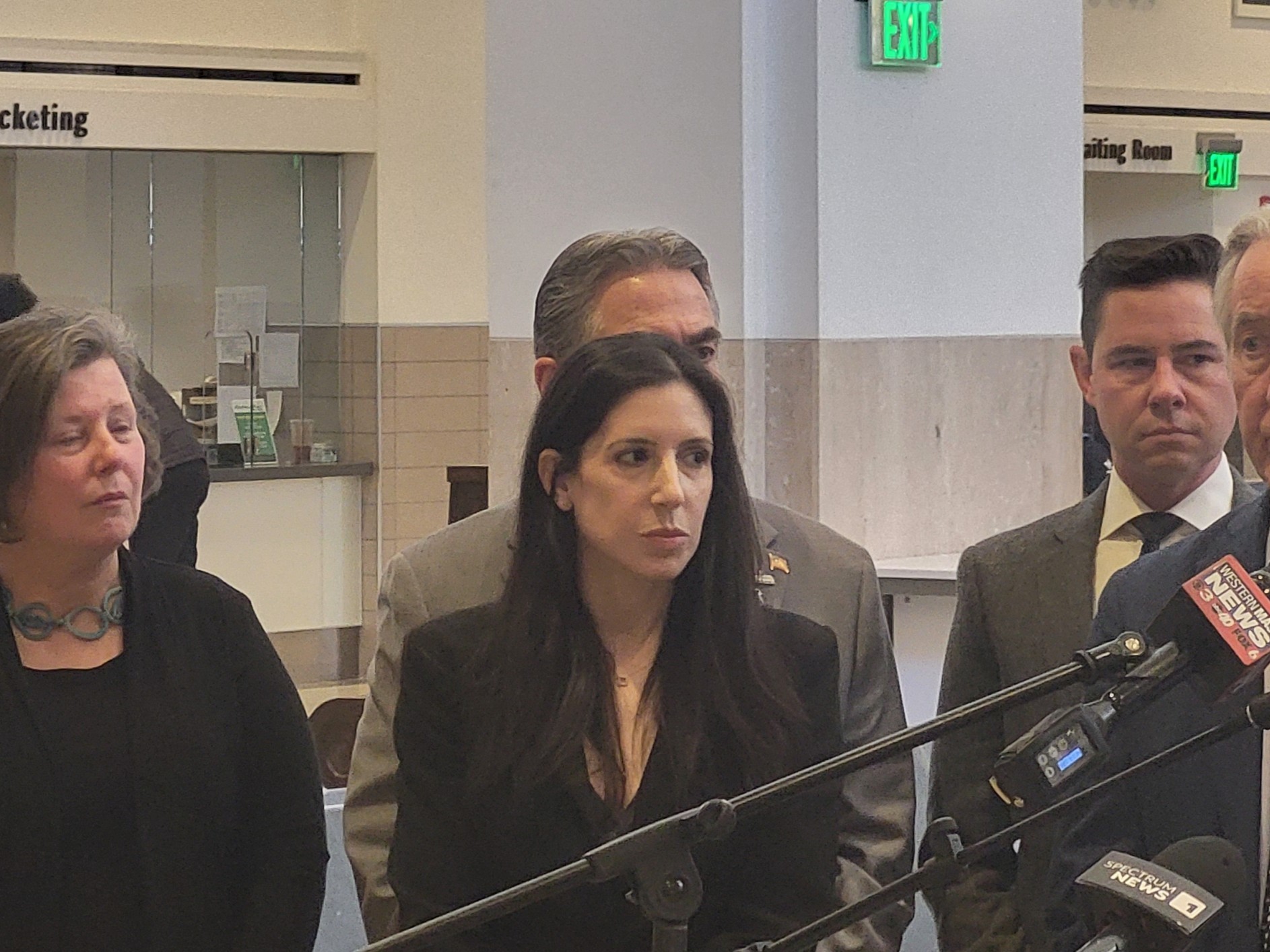
Slesinger laid out the Compass Rail game plan. (WMP&I)
By contrast, the hourly service to New York is somewhat theoretical. Slesinger said the idea arose because most Massachusetts intercity rail (vs commuter rail) trips are to or from the Empire State. However, details were spare and infrastructure work and potential turf wars loom. A spokesperson for MassDOT suggested that, at a minimum, there would be more direct trips to New York from Springfield.
“One seat rides are envisioned,” the spokesperson said.
The Connecticut Department of Transportation referred questions about such hourly service to Amtrak, which owns the New Haven-Springfield line. For its part, Amtrak was eager but not specific.
“Amtrak is looking forward to continuing our discussions for potential expanded service in New England and working with our state partners to study the benefits and costs of adding new service frequencies,” Jason Abrams, a spokesperson for the railroad, said in a statement.
Whatever MassDOT’s long-term goals, service to Springfield’s south is key to the Compass Rail program and the introductory East-West rail service.
The track geometry of Springfield is such that trains from Boston can proceed north to Upper Valley cities and Vermont, west to Albany or south to Connecticut and New York City. Compass Rail, fully realized, could restore Springfield as the crossroad of New England for passenger rail.
MassDOT received $108 million from the feds in 2023. This funds work on CSX’s track between Springfield and Worcester. Once done, Amtrak will run two roundtrips between Boston and Springfield and on to New Haven. In addition to linking the Commonwealth’s first and third cities, it will facilitate connection between city pairs like New Haven and Worcester and Hartford and Boston.
The grant funds upgrades, new railroad sidings and repairs necessary for the new service to start. Slesinger said that looking ahead, Amtrak will need more equipment to expand service. The railroad is accepting delivery of new Airo trainsets that will replace much of the Amfleet coaches Amtrak bought 40-plus years ago.
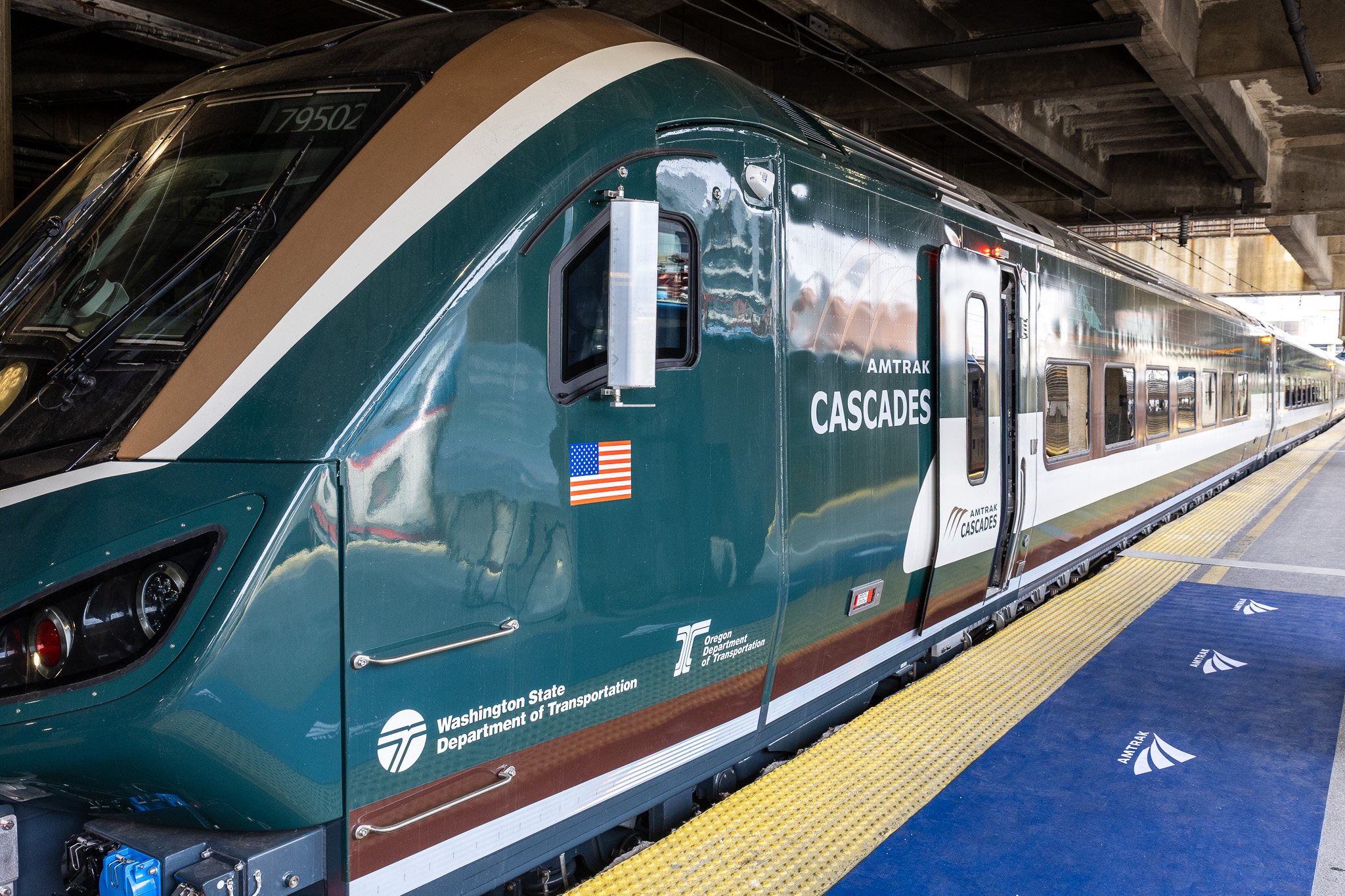
Coming soon…well, without the Washington State livery. (courtesy Amtrak)
“Last month, in partnership with multiple states, we supported Amtrak’s $2.7 billion application to FRA’s National Railroad Partnership Program to exercise its option orders with Siemans to order additional new Airo trainsets,” Slesinger said referring to the Federal Railroad Administration.
But will there be enough for the startup service connecting Boston and Springfield? Although MassDOT said Amtrak’s current Airo order only covers current services to Springfield, MassDOT said it was coordinating with Amtrak and noted that the introduction of Airos would free up other equipment.
For its part, Amtrak expects to have the coaches and locomotives to begin Inland Service when the infrastructure work is complete.
The $108 million federal grant focuses on the stretch of track between Springfield and Worcester. However, there could be capacity constraints east of Woo-town. Among the projects that will open capacity on the line to Boston are installing a third track in parts and adding second platforms to Newton’s three stations. MassDOT told WMP&I that the line to Boston could handle the initial service to Springfield as is, though.
Slesinger identified other steps that will be necessary for more service expansion. Other than Amtrak’s option to buy more Airos, she said that the state would eventually need to expand South Station.
The longstanding and somewhat controversial project would restore tracks and platforms to the downtown Boston terminal that were pulled up when rail hits its nadir. Opponents question the need, suggesting the North-South rail link—which would connect North Station and South Station—would provide capacity. The expansion would be expensive—if not as pricey as a new tunnel under Boston. It also hinges on the Post Office vacating land along the Fort Point Channel.

Will South Station be a growing pain for Western Mass? (via Wikipedia)
“If we want to be more ambitious ad do more service, which what everyone is looking for, South Station need to start moving,” Slesinger said.
It is not clear expansion would need to happen. Some transit advocates have suggested Amtrak and the Massachusetts Bay Transportation Authority’s commuter rail could utilize existing South Station capacity better. Phil Eng, the General Manager for the MBTA and the interim Secretary of Transportation, said during the March 19 MassDOT meeting the Commonwealth was looking at exactly that.
Not all post-2030 work is out east, however. At the meeting, Slesinger highlighted planned work in Pittsfield, Springfield and West Springfield. The Commonwealth will be eliminating a major grade crossing in Westside and is eyeing new infrastructure in the Berkshires.
The Pittsfield work includes layover track that would most immediately benefit the Berkshire Flyer. The summertime train runs between New York’s Penn Station and Pittsfield via Albany. Slesinger said the service lost its season last year due to a sinkhole, but expects it to resume this year. Massachusetts is also eyeing a new layover track and a second platform in Pittsfield to reduce conflicts with freight trains. Inevitably, this would benefit service connecting Albany and Springfield.
The most significant long-term work in the 413 may take place in Springfield itself. MassDOT had announced the Springfield Area Track Reconfiguration Project (SATRP) some time ago, which would eliminate backup moves for service to points north of Springfield, namely the Vermonter and Valley Flyer. Yet, only in the last few months had the agency released rough schematics of the new track geometry.
The early SATRP schematics suggests Springfield Union Station could see all four of its original platforms reopened. Seven tracks could be in service. The Commonwealth would also build a new yard to the east of Union Station. It would likely not be far from where the Boston & Albany Railroad once had such a facility.
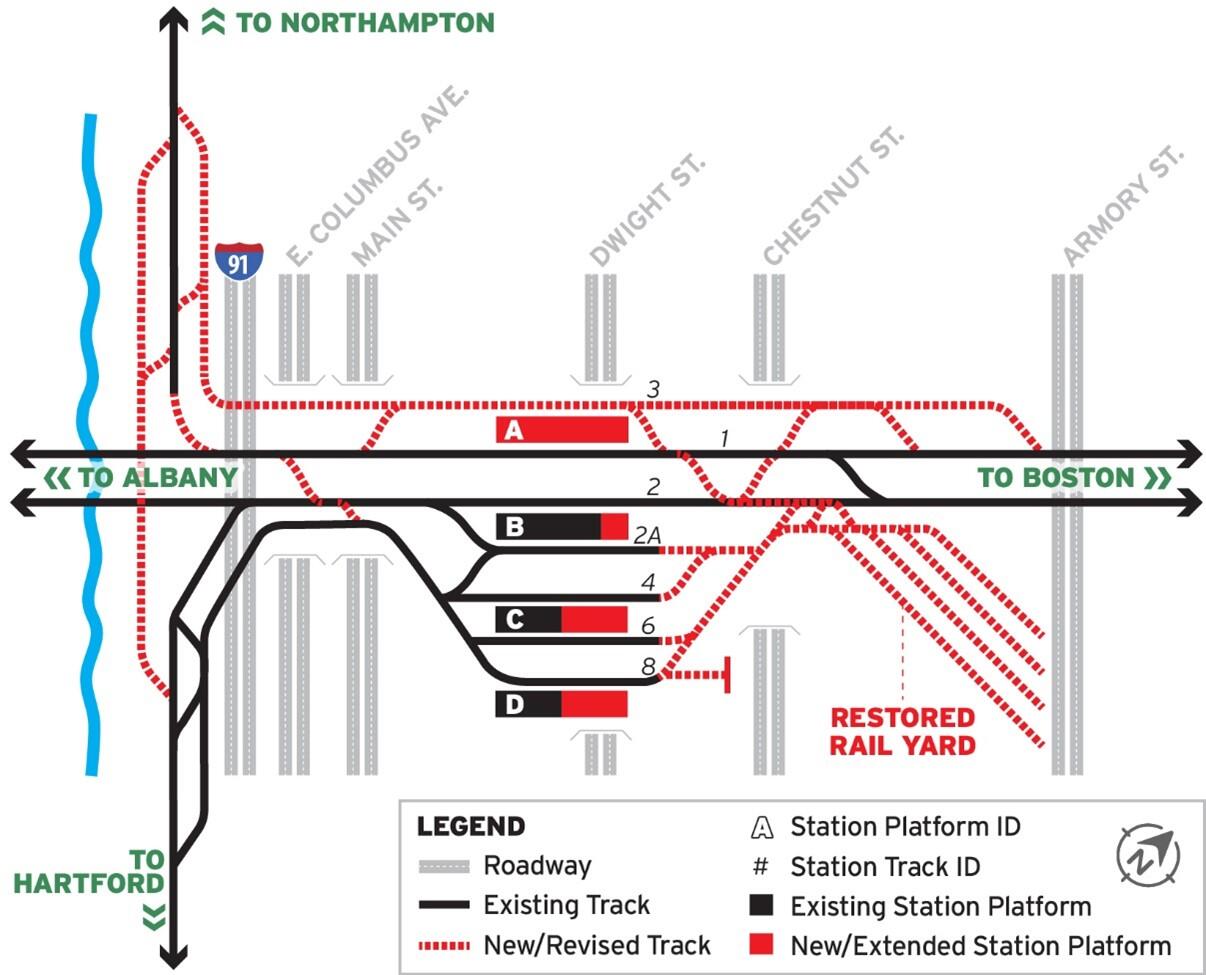
The image is not to scale, but the ambitions could scale up quite a bit. (via MassDOT).
A MassDOT spokesperson said the cost for SATRP should be available by summer. Although not technically part of SATRP, Amtrak will be updating an interlocking just south of Union Station this summer.
Then there is the development of the broader service plan for the Boston & Albany corridor. Slesinger noted that the state had received the initial money for the Inland Corridor/East-West rail just before beginning a study of what broader Boston to Albany service would look like. Once design is complete, the state can apply for additional infrastructure funding.
Still, the hourly service to New York grabbed attention. While that plan remains murky, there is no denying how crucial the New Haven-Springfield line is for Western Mass’s rail future.
Demand for service linking Hartford, New Haven and Springfield has consistently exceeded expectations. The weekend commuter service along the route began, ConnDOT and Amtrak struggled with a crush of passengers. The route recovered passenger numbers more quickly than any other rail service in Connecticut. By 2024, patronage had already exceeded that of the last year before pandemic.
There is a lot of work still to do on the New Haven-Springfield line Presently, service south of Springfield consists of Amtrak and ConnDOT commuter trains to New Haven. Three of Amtrak’s trains are one-seat rides to New York.
ConnDOT’s commuter service, the Hartford Line, links Hartford, Springfield and other communities to New Haven. From there, travelers can make connections to New York via Amtrak or Metro-North. Amtrak’s own Hartford Line trains (formerly Shuttles) along the route accept ConnDOT’s tickets (and vice versa).
The commuter service began in 2018 after nearly a decade of work on the New Haven-Springfield line. It isn’t even really finished.
Another 12 miles are still single-tracked. Fully restoring double-tracking will not happen soon. Amtrak has funds to study how best to address the now single-tracked Connecticut River bridge between Enfield and Suffield. However, replacement with a double-tracked bridge is on the table. The other question is whether Connecticut moves I-84, which could relocated Hartford’s train station, too.
In the meantime, ConnDOT announced in September it would be installing double-tracking for the rest of the route among other upgrades. The agency claims the work would enable another 18 trips a day. A smattering of other projects, including new or relocated stations also lie ahead.
The pace notwithstanding, there it is beyond apparent that service is expanding in Western Mass and in all of Compass Rail’s directions. It could transform the 413—if local players set the table to reap the rewards.