Take My Counsel, Please: Confidence in Supply…
(WMP&I and Google images)
SPRINGFIELD—City councilors hurled disapproval and invective, at times in an apparent violation of the body’s rules during Monday’s tempestuous meeting. In the end, however, it signified nothing—at least for now. The Council voted down a resolution of no confidence in Council President Tracye Whitfield but not before trading fire amongst themselves for some time.
Supporters of Whitfield filled the chamber, but there had been signs before Monday the no-confidence push might peter out. Councilors’ enthusiasm was tepid when Councilor Victor Davila announced it on the day the Council reversed the vote that had prompted the ethics probe into Whitfield. Area social media hinted at the motion’s limited support.
It failed 4-7. Whitfield herself abstained from the entire debate.
“I’m glad it’s over,“ she said after the meeting. “I’m ready to get to work.”
Councilors Malo Brown, Maria Perez and Brian Santaniello participated in Monday’s meeting remotely. Ward 7 Councilor Gerry Martin was absent. Whitfield dedicated the moment of silence to his father, who had passed away the week before.

Whitfield at the meeting with the discontinuance that started everything. (still via YouTube/Focus Springfield)
Ever since its February 2 meeting, the Council has been in flux. That day, Whitfield lingered at the dais during debate on a street discontinuance that would have expanded a parcel that belongs to a company she co-owns. She ultimately departed and did not vote on the item.
She acknowledged the error and sought advice from City Solicitor Stephen Buoniconti. He found her brief presence during the debate and a failure to disclose her ties to the business and its presenter on February 2—her son—violated state ethics law. Buoniconti also recommended the Council purge its vote to discontinue the street.
However, there had been a request for a deeper dive. That probe yielded more alleged failures to disclose and attendance at auctions of city property. It also claimed that a couple months ago she threatened a neighborhood association with an audit if it did not pay what it owed a constituent.
That report, which Buoniconti released hours before the February 13 meeting, led Davila to call for Whitfield to resign or face a no-confidence vote. The impact of the latter would largely be symbolic. The City Charter has no mechanism to remove the president.
The resolution itself does not dig into Whitfield’s alleged transgressions. However, it expresses a lack of confidence and calls for her resignation as “presiding officer,” which may or may not mean a permanent exit.
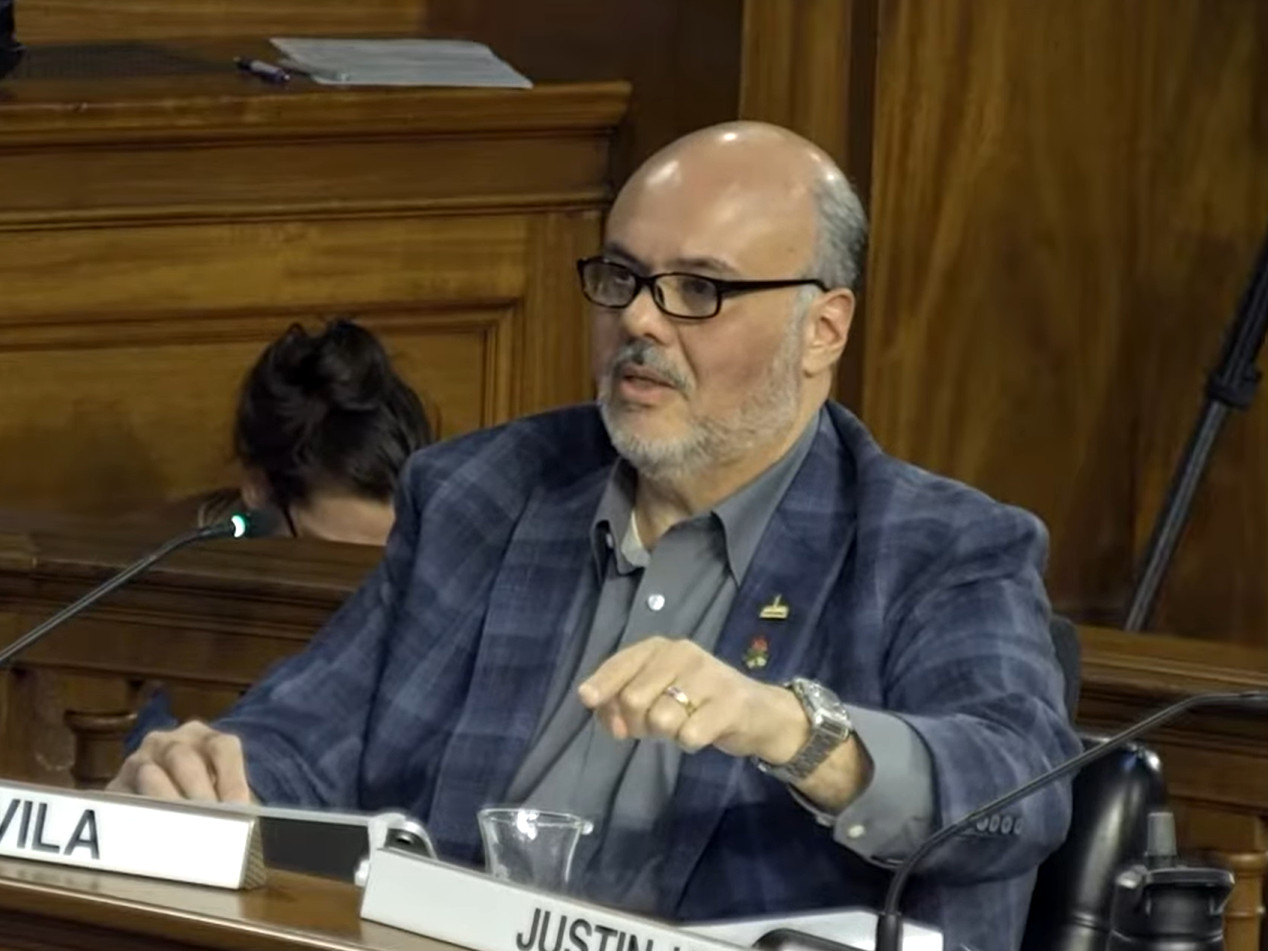
Not the victor of the no confidence resolution. (still via YouTube/Focus Springfield)
“First, let me say this whole incident has been difficult and upsetting to me,” Davila said Monday. The Ward 6 councilor had voted but the discontinuance, but now he felt the Council was “deceived.” “People have asked me straight out, is it possible that none of you knew about this.”
At-large Councilor Justin Hurst spoke next. A Whitfield ally, it was no surprise he would speak against the motion. Indeed, he came out swinging.
Hurst said he could credit Buoniconti’s predecessors or others in the Law Department. Pointing to an disciplinary note the Board of Bar Overseers issued in 2016, Hurst said Buoniconti should not be practicing law let alone passing judgment on Whitfield.
“His political appointment by Mayor Sarno made our city and our law department the laughingstock to all who practice law in Western Mass and beyond,” Hurst continued.
(The matter pertains to Buoniconti “placing or causing…to be placed” the signature of his then-wife on closing documents. No substantive discipline issued because the BBO found no harm. Buoniconti did not respond to an offer to comment.) The online publication the Metro Record originally flagged the 2016 disciplinary note, if with some gilding, on February 15.
Hurst condemned his colleagues for relying on Buoniconti’s advice, but he was not done. Turning to Ward 2 City Councilor, Hurst flagged a 2021 discontinuance for a stretch of Armory Street between Atwater and Weaver roads. If that terminal stretch of Armory Street had been discontinued—which is laid out, but not paved—the land would revert to the four abutting properties. One was Fenton’s home at the time. One of the petitioners for the discontinuance was Fenton’s husband.
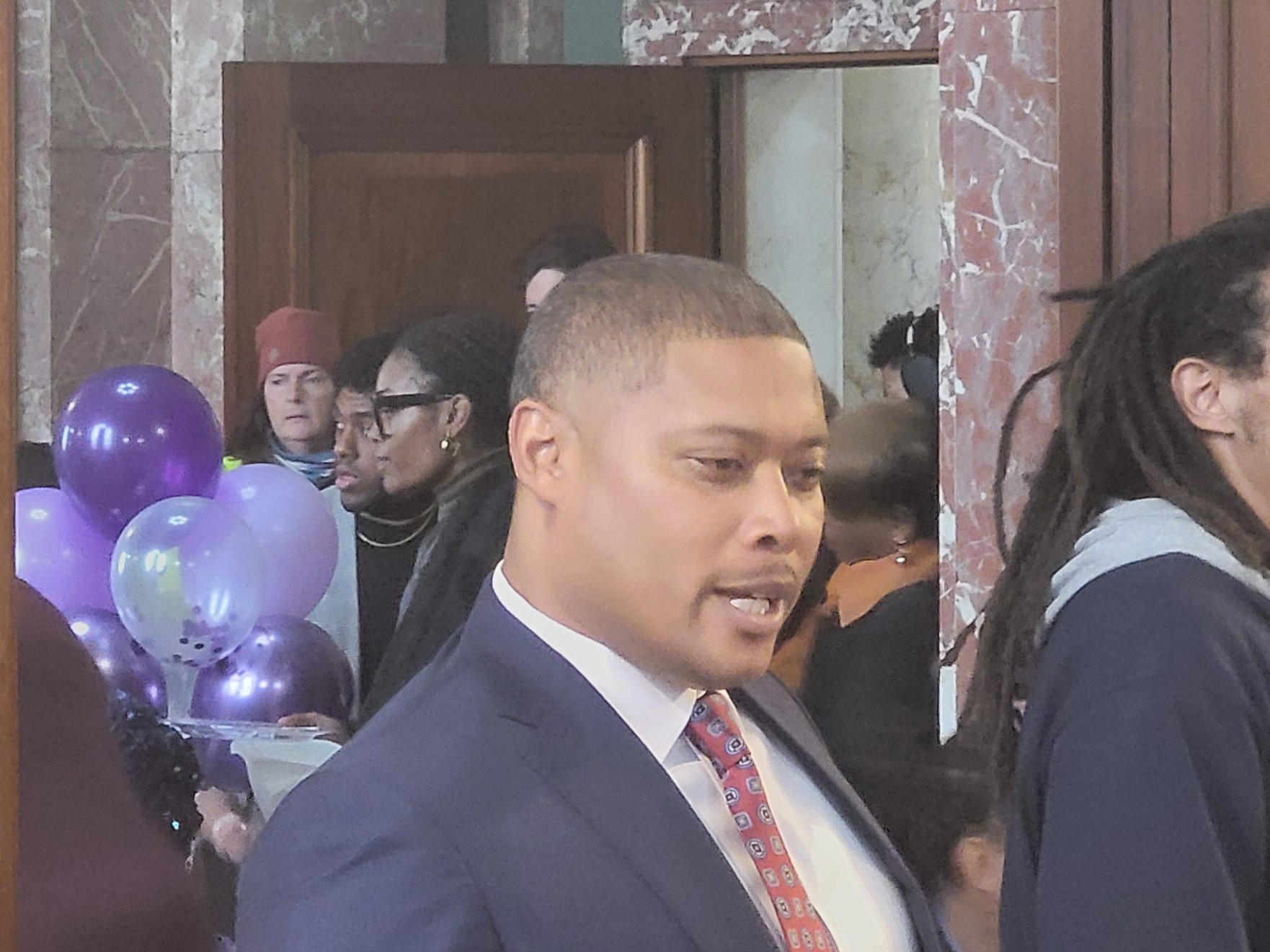
Hurst unloaded on the solicitor and a colleague as part of his opposition to the motion. (WMP&I)
“He never disclosed he had a financial interest in the discontinuance,” Hurst said. Citing to the exact timestamp in the February 8, 2021 meeting, Hurst describes Fenton as recusing but not announcing a financial interest in the item. Hurst implied there were correspondence with department heads, but offered no details.
“Yet, when it came to Councilor Fenton, the end result was drastically different, Mr. President,” Hurst continued. “See, the department heads never reached out to the law department to say he was placing an undue influence on the department to advance the armory street discontinuance.”
Hurst continued until Vice President Jose Delgado, who was presiding in Whitfield’s absence, attempted to enforce the Council’s procedural rules against attacking colleagues.
Before Fenton replied, Councilor Brown spoke and disclaimed the finger pointing. He also noted that the resolution had no power to remove Whitfield and questioned the point at this juncture. Brown would later speak again and disclaimed any suggestion that racism played a role in the motion.
When Fenton spoke, he briefly set aside prepared remarks and pushed back on Hurst’s allegation. He called it changing the narrative and compared it to the current regime in Washington.
“You sounded like Trump and the attacks on our solicitor are unjust and unwarranted,” he said. “And the attacks on me are lies.”
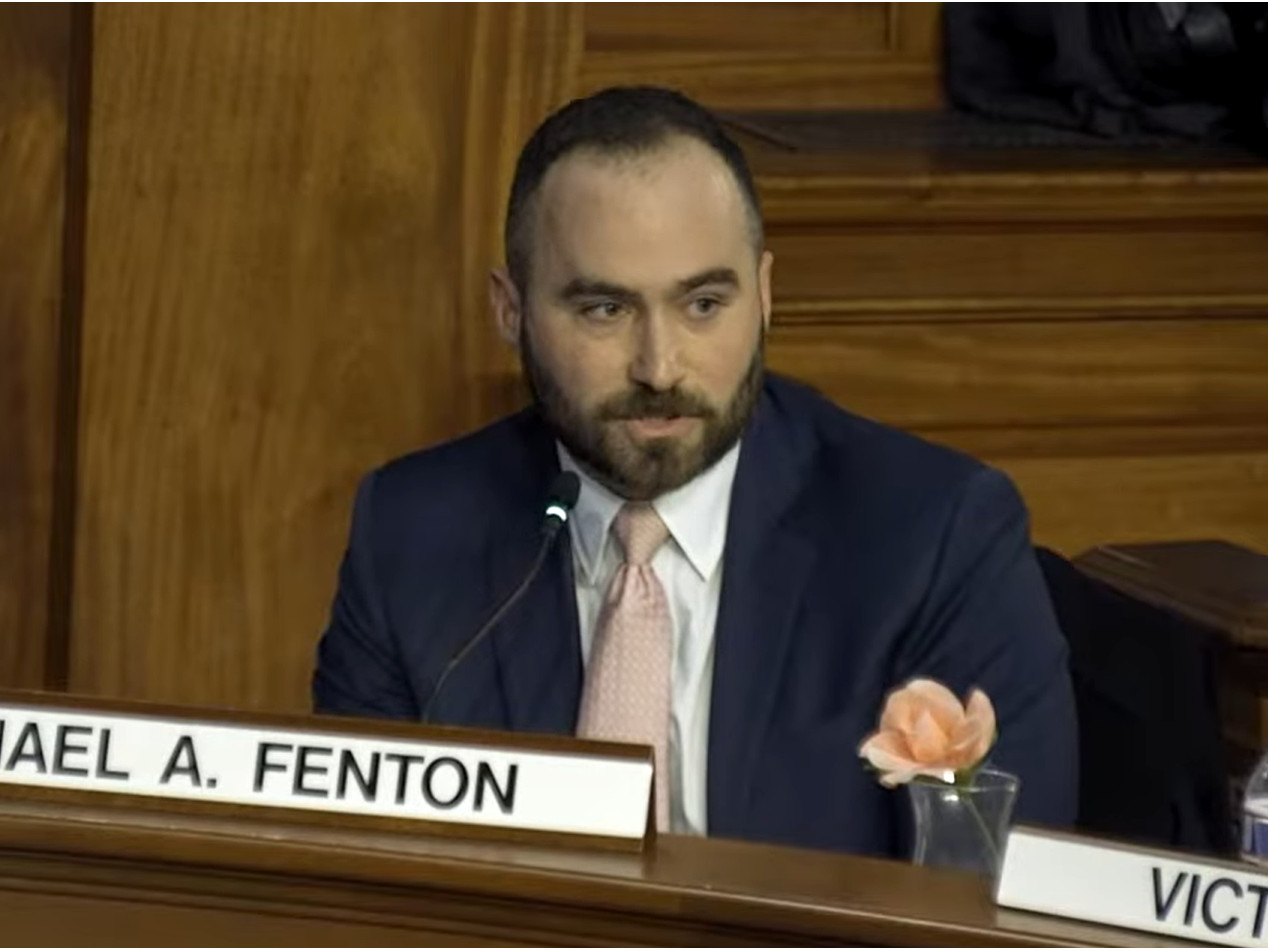
Fenton all but accused Hurst of whataboutism. (still via YouTube/Focus Springfield)
Fenton said that he did disclose his relationship to the item and noted that it never passed. City Clerk Gladys Oyola-Lopez confirmed in an email the Council tabled the 2021 Armory Street discontinuance and never revived it. On February 8, 2021, at Public Works Director Chris Cignoli’s suggestion, the Council paused action on the discontinuance. Fenton was recorded as recused. (He sold the relevant property in 2022.)
In reviewing the tape from that meeting—which occurred when the City Council was still fully remote during the COVID-19 pandemic—Fenton does say he is an abutter before announcing his recusal. The question is whether that is sufficient. The Massachusetts Ethics Commission advises government employees that simply not participating on a potentially conflicting matter may avoid a violation entirely.
Of the allegations leveled at Whitfield, her presiding, however briefly, over the discontinuance item would be the closest analog. Presiding itself would be violative participation under state law.
On Monday, when Fenton returned to the no confidence motion, he indicated that the haste in passing the discontinuance compounded issues. Yet, what spurred him to join the resolution was Whitfield’s presence at an auction the next day and the allegations she threatened the Old Hill neighborhood council with an audit to cajole it to pay a debt it owed (to an unrelated third party).
“If [the auction attendance] was a mistake, it’s not one I’m prepared to look past. At best it was very poor judgment to participate in that auction,” he said. “As for the threats to Old Hill, I think those speak for themselves.”
A few more councilors spoke afterward. Ward 8 Councilor Zaida Govan. She announced she would vote down the motion, but did not exactly defend Whitfield, a longtime ally, either.
“I’m urging us to have grace and to allow the process to play out,” she said.
Ward 3 Councilor Melvin Edwards, who is Black, condemned any suggestion that racial undertones to the motion.
“It’s disrespectful to assume everyone who believes that there have been violations of ethics or that there may have been possible criminal conduct are only interested in sabotaging the political career of our colleague,” he said.
The motion failed 4-7. Only Councilors Davila, Edwards, Fenton and Perez voted for it.
Whitfield returned to preside and on the rest of the agenda, things moved quickly.

Just a bill, not a feud this time. (via Wikipedia)
The Council confirmed John McCloskey, a parks department employee who lives in Forest Park, the Mobile Home Rent Control Board. Councilors accepted an unremarkable revenue and expenditure report for January and greenlit payment of 2024 bill to Amtrak. Chief Administrative & Financial Officer Cathy Buono said it was to pay for Amtrak Police during the 9/11 ceremony at Riverfront Park.
The Council approved the quarterly $116,675 payment to Focus Springfield, which Comcast funds. The body also allowed a $500,000 transfer to the facilities division account for snow removal.
Councilors authorized $1.25 million in bonding for energy efficiency design work for Zanetti, Talmadge, Liberty and South End Middle schools. At one point, Councilor Brown began discussing athletic facilities, earning an admonition from President Whitfield. She said she had been advised the Council had to stick to the topics on the agenda. The implication was to do otherwise might violate open meeting law.
The Council kept a food service contract over three years in committee, but approved a four-year term for a school printing contract. The authorization was in the bid. It was not to authorize a specific contract. Only Fenton dissented. Historically, he has opposed up front authorization for longer terms instead of bidding for longer terms and allowing the Council to review the purported savings.
Ostensibly, that was not the case for an information technology lease for five years. Chief Information Officer Andrew Doty said the city sought a five-year lease. The authorization passed unanimously.
The body approved various small grants to the Elder Affairs, Library and Police departments. It accepted the biennial Continuum of Care grant for oral health and casework for homeless individuals. Health & Human Services Commissioner Helen Caulton-Harris said the grant effectively serves the whole region.
The Council sent permits for curbside electric chargers to committee. It approved utility work for Ashmun, Blanche, Central, Crestwood, Edgemont and Oklahoma streets and St. James Circle.
The final item was a resolution Councilor Hurst introduced—which virtually all councilors cosponsored—that called for the Hoophall Classic to remain in Springfield. It further called for the administration and the Hall of Fame to work together to avoid a situation where it could ever be played somewhere else.

In-fame-ous? (via Wikipedia)
The issue arose after the Boston Contrarian, a newsletter on Substack, reported that the former Massachusetts Convention Center Authority CEO Marcel Vernon opened talks with Hall of Fame head John Doleva to move the game to Boston. The negotiations ultimately went nowhere and Vernon left office last year.
Insufficient facilities in Springfield is purportedly a reason this was happening. The Hall of Fame has since agreed to use Springfield College for the immediate future. Still, the talks enraged Greater Springfield. The Boston Contrarian, noting the economic disparities between east and west, went as far as to call it “Robin Hood in reverse.”
Hurst only read the resolution on Monday, but the night before he published a video condemning Sarno’s complicity. Sarno has also taken umbrage at the actions of Doleva and the MCCA then-CEO. Yet, Hurst intimated that something else was going on.
In an interview Monday, he said the mayor must have known about it given officers of the Hall were close enough to regularly donate. (In his video, he referred to Doleva and Hall Treasurer Frank Colaccino.
“I believe he is aware of it,” he said of the game’s discussed move, and called the plot a “money grab.” “It didn’t come to fruition, but I just can’t believe the mayor didn’t know about it. If it is true that he didn’t know about it, he’s lost touch.”
The mayor’s office did not respond to a request for comment. WMP&I reached a Hall spokesperson, but Doleva did not comment.
The resolution passed unanimously.
The outcome of the no confidence vote was not much of a surprise. Without passing judgment on the appropriateness or credibility of each charge laid on Whitfield, a sudden rush of bad press does not crush the way it used to.

(WMP&I)
Last year, Joesiah Gonzalez’s campaign for city council not only revived but regained competitiveness despite a blooming scandal. He still lost to incumbent Ward 1 Councilor Perez, but the wall of opprobrium in the public and the press did not crush him. It would have 20 years before. Whitfield’s situation has significant differences, however.
One thing remains certain. While Whitfield may be back to work as president, there are further acts to play out before the final curtain.